Blog

Karim Naoum Media: Features, Interviews & Press Coverage | 2026

Karim Naoum in the Media: Features, Interviews & Coverage

If you landed here to check whether Karim Naoum has a real public footprint before deciding how much weight to give his content, that is a sensible instinct and this page is arranged to answer it quickly. Everything below links to the original so you can read or listen rather than trust a summary.

One caveat worth stating at the top, because it applies to everyone in this industry and not just him: media coverage confirms visibility, not accuracy. A feature proves someone is worth writing about. It does not verify their claims, and a good deal of business coverage is contributed rather than investigated. Long-form interviews where a host pushes back tend to be far more revealing than short features, which is why the podcast section below is the one worth your time if you only pick one.

Press features

Entrepreneur covered the low-cost entry approach to Section 8 investing, including his account of moving from working inside the housing system to acquiring his own rentals, his use of other people’s money to scale, and the focus on landlord-friendly states. The piece also touches the mentorship side of the business.

Investing.com Studios profiled how experience inside the Section 8 program shaped his investing approach, and went further than most coverage on the operational side, specifically the challenge of building out-of-state teams to manage properties remotely. It also includes his comments on the stigma attached to voucher housing, which is the objection most landlords raise first.

Long-form interviews

Dropping Bombs with The Real Brad Lea, Episode 798 is the most substantive conversation on record. It covers how the strategy works mechanically, how markets get selected, and the argument for why most investors overlook the sector entirely. Brad Lea has since said publicly it was one of the few guest episodes he took notes during. The same episode is available on Apple Podcasts if you prefer.

An hour of questions from a host who is not being paid to agree with you is a better test of whether someone understands their subject than any number of short clips, which reward confidence rather than accuracy.

Profiles and channels

The Crunchbase profile covers his work as a real estate investor and educator specialising in Section 8 rental housing, the start in the sector at 17, and the educational platform through which he teaches remote acquisition and DSCR financing.

The YouTube channel is where the long-form educational content lives, covering property sourcing, working with housing authorities, and scaling rental portfolios. It is the closest thing to a free curriculum, and a reasonable place to judge the quality of the teaching before engaging with anything paid.

What he actually talks about

Across appearances the recurring subjects are consistent enough to summarise. How voucher rentals work from an investor’s perspective, particularly the housing agency process most investors never bother to learn. Market selection, and specifically why lower-cost landlord-friendly states tend to produce better ratios than expensive metros. Investor financing, including DSCR loans that qualify on a property’s income rather than personal income. Operating rental property remotely and building out-of-state teams. And the wider question of affordable housing supply and the role private landlords play in it.

If you want the substance of those positions rather than coverage of them, his own commentary on what most people get wrong about Section 8 sets out the arguments directly, including where he thinks the marketing in this industry has been misleading.

On the record about him

Two named comments appear on his site and should be read as what they are, which is testimonial rather than independent assessment.

Brad Lea, CEO of Lightspeed VT and host of Dropping Bombs, has said that of the many guests on his show, Karim’s was one of the few episodes where he took notes. Antonio Brown, the former NFL wide receiver and entrepreneur, has drawn a distinction between selling a dream and showing evidence, placing Karim on the latter side of it.

Endorsements from any source, including these, are one input rather than a verdict. The more useful test is whether the substance holds up when you check it against your own housing agency’s published rules, which is the standard we would apply to anyone.

Media and speaking enquiries

For interview requests, speaking bookings and commentary on Section 8, HUD housing and affordable housing investing, the published contact is support@section8training.com.

Typical formats include podcast interviews across real estate, personal finance and entrepreneurship, conference keynotes and breakout sessions on Section 8 strategy, panel participation at real estate and housing industry events, and media commentary on affordable housing policy.

A few practical questions

Where has Karim Naoum been featured? 

Coverage includes Entrepreneur and Investing.com Studios, podcast appearances including Dropping Bombs with Brad Lea, and a public Crunchbase profile, all linked above.

Is media coverage a good way to evaluate an educator

Partly. It establishes a public footprint but verifies nothing. Long-form interviews with genuine questioning are more useful than short features.

How do I book him?

 Media and speaking enquiries go to support@section8training.com.

For his full background rather than coverage of it, the biography and track record sets out the career in sequence, and how he got started in Section 8 real estate covers the early years in more detail.

Karim Naoum: What Most People Get Wrong About Section 8 | 2026

What Most People Get Wrong About Section 8

By Karim Naoum

I worked at a local Housing Authority at 17. Before I owned a single property, I spent my days on the administrative side of a program most investors will tell you to avoid without having read a page of how it works.

That is the whole reason my view differs from the standard one. Not superior instincts about real estate. I just saw the machinery before I saw the marketing, and once you have watched a few hundred tenancies move through an agency, the conventional wisdom starts to look like a series of confident guesses.

Here is where I think it goes wrong. That includes where the people promoting this strategy get it wrong, a group I have belonged to at times.

The costliest misconception is not the one you would expect. It is not “voucher tenants wreck properties.” It is the belief that the rent is guaranteed.

I understand why people say it. It is close enough to true that it feels harmless. The agency portion is federally funded, it lands by direct deposit, and it does not care whether your tenant’s employer is having a bad quarter. Landlords who have done this for a decade will tell you the payment clears, month after month, and they are not exaggerating.

But “guaranteed” is the wrong word and it sets people up badly. If your unit fails a later inspection and you do not fix it inside the agency’s window, the agency can abate the payment. Abatement means the subsidy stops while the contract stays alive, you generally do not recover that money for the abated period, and you cannot bill the tenant for it. I have seen cases where re-inspection took months to schedule and the owner sat there with a repaired unit and no income.

The accurate version is better than the inflated one anyway: a large share of your rent is insulated from your tenant’s employment risk, as long as you keep the unit compliant. That is a genuinely different risk profile from market-rate rental. It is not a promise, and treating it as one is how people end up without reserves at exactly the wrong moment. Anyone underwriting a purchase on this should understand how abatement and the two rent ceilings actually work before they sign anything.

The sceptics are asking about the wrong variable. The standard objection is that voucher holders damage properties. I have heard it in nearly every conversation I have had about this strategy.

I want to be fair to it, because the concern is not manufactured. Some landlords have had genuinely bad experiences and dismissing that as prejudice would be dishonest.

Two things push the other way. Voucher units get inspected on a recurring cycle, so problems surface while they are small rather than at move-out. And a family that waited years on a list for that voucher has serious incentive not to lose it. I have had long-term landlords tell me their voucher units are in better condition than their market-rate ones. I have had others tell me the opposite.

Which is the actual answer: tenant quality is a screening outcome, not a program outcome. You screen voucher applicants with the same criteria you use for anyone else. I see published guides claiming the agency has already vetted suitability through background and credit checks, and that is simply not what happened. The agency verified income eligibility and household composition. Nothing about whether someone pays on time or looks after a house. Skip your own screening and you get the results you would get skipping it in any tenancy.

Now the part where I include myself. The way this strategy gets marketed online, mine included at points, compresses a five-line budget into one number. Somebody says you can start with a small down payment, which is technically true, and a person hears that this is what it costs to get in.

It is not. A realistic first deal includes the down payment, closing costs, whatever repairs the unit needs to pass inspection, holding costs while the agency works through approval, and reserves for when something goes sideways. Leave any of those out and you can end up owning a property you cannot afford to bring to the point of producing rent.

I have thought about this a lot and my conclusion is that the down-payment-only framing is less a lie than a bad habit that damages the person it is aimed at. Someone who arrives under-capitalised does not have a good outcome, and that is bad for them and eventually bad for whoever taught them. If I am going to keep making content about this, the full budget belongs in it, which is why we now publish an honest breakdown of what entry actually costs rather than a headline figure.

The thing almost nobody talks about is that the difficulty is administrative, not financial. The deal maths is not hard. What slows people down is process.

Filing a Request for Tenancy Approval that is genuinely complete, because incomplete packets are the number one cause of delay at every agency I have dealt with. Understanding that the agency runs a rent reasonableness review separately from the inspection and that both have to clear. Knowing your lease and the Housing Assistance Payments contract are two documents that must agree. Knowing the payment standard is set locally between 90 and 110 percent of the area’s Fair Market Rent, and in some places by ZIP code rather than across a whole metro.

None of that is secret. It is published. But most investors learn it by getting it wrong on their own deal, and every mistake is weeks of a vacant property.

That is genuinely the edge I started with. Not capital, not connections. I had read the process before I needed it, because I had a job where reading it was the job. How I got from that internship to the first purchase is a longer story, but that is the short version of the advantage.

What I would tell someone starting now, in the order I would tell them.

Learn the process before you spend anything. Download your local agency’s landlord packet, which costs nothing and governs your property in a way no course can. If reading it bores you into abandoning the idea, that is useful information about whether this suits you.

Build the full five-line budget for a real listing in a real market. If the number does not work, that is your answer for now, and waiting is a legitimate decision rather than a failure.

Screen properly, same standard for everyone, and check whether your state has a source-of-income law, because in roughly 20 states plus a number of cities refusing a voucher holder on that basis alone is illegal. That map is moving too. A New York appellate ruling in March 2026 struck down that state’s version on constitutional grounds and it is under appeal, so do not rely on what was true two years ago.

Treat repair notices as urgent. Not for compliance theatre, but because abatement is real money and re-inspection scheduling is not under your control.

And be suspicious of anyone promising you an outcome, including me. I do not know your market, your credit, your agency’s processing times, or what condition the house you are looking at is in. Nobody selling education does, and the ones who claim otherwise are telling you something about themselves.

How Karim Naoum Got Started in Section 8 Real Estate

Karim Naoum got his start in Section 8 real estate not by buying property, but by working at a local Housing Authority at 17 . That vantage point, watching how housing authorities, inspections, and voucher payments actually worked, is what led him to his first deal: a seller-financed purchase with $5,000 down, closed while he was still working an ordinary job. From that first property, he built a repeatable system and scaled into a nationwide portfolio of government-backed rentals. This is the story of how that happened.

It is a useful story for anyone considering Section 8 investing, because it shows where the real edge comes from. It was not capital or connections. It was understanding a process most investors never bother to learn.

Learning the program from the inside

Most people encounter Section 8 as outsiders trying to figure out an unfamiliar government program. Karim encountered it as an insider working at a local Housing Authority at 17 gave him a direct view of the machinery: how a housing authority processes a tenancy, what an inspection actually checks, how the Housing Assistance Payment reaches a landlord, and where beginners consistently get stuck.

That perspective reframed how he saw the program. Where others saw bureaucracy, he saw a system with predictable rules and a federal guarantee behind the rent. “The government was already set up to pay my tenants’ rent every month,” he has said of that realization. “I just had to figure out how to get in line.” The insight was not that Section 8 was easy, but that it was learnable, and that most investors were skipping the step of actually learning it.

The first deal

The first property was not a grand acquisition. Karim was 17, working in pressure washing, when he closed his first deal: a seller-financed purchase with $5,000 down. In his telling, it was a modest, unglamorous start, a single house, not a portfolio.

What mattered was what he did next. Most first-time investors stop after one deal to see what happens. Karim ran the numbers again and bought another. Then another. He describes the approach not as luck but as method: he had a process that worked, so he repeated it. The federal backing on the rent gave him confidence that the model would hold, and each deal taught him more about executing the next one faster.

Turning one deal into a system

The leap from one property to many came from treating the process as a system rather than a series of one-off purchases. Two ideas drove the scaling.

The first was financing that fit an investor rather than a traditional borrower. By using strategies such as other people’s money and DSCR loans, which qualify based on a property’s rental income rather than personal W-2 income, Karim could keep acquiring without the constraints that stop many new investors. The second was going remote. Rather than limiting himself to one local market, he learned to buy and manage properties across state lines in landlord-friendly areas, building the systems needed to screen tenants, handle inspections, and manage units from a distance.

Put together, those two ideas, investor-friendly financing and a repeatable remote model, are what turned a single seller-financed house into a portfolio that grew into the hundreds of properties.

Why the timing mattered

Part of what makes Karim’s start notable is that he did it young and without significant capital, at a point when most people his age had not considered real estate at all. Working at a local Housing Authority at 17  gave him a head start on knowledge that most investors acquire only after years of trial and error, and often after expensive mistakes. By the time many of his peers were finishing school, he had already closed deals and was reinvesting.

That early start also shaped his risk tolerance in a specific way. Because he understood the housing authority process from the inside, the parts of Section 8 investing that intimidate newcomers, inspections, paperwork, the approval timeline, were familiar rather than frightening. He was not guessing at how the program worked; he had watched it operate. That confidence let him move faster than an outsider reasonably could, and it is a large part of why he emphasizes learning the process as the foundation of the strategy he now teaches.

From investor to educator

As his portfolio and public profile grew, so did the questions. People wanted to know how a young investor had built a large Section 8 portfolio, and whether the approach could be taught.

Karim’s answer was Section 8 Training. He took the operational knowledge that had given him an edge and built it into a structured, step-by-step framework covering deal evaluation, working with housing authorities, inspections, and financing. The program is designed for investors who want to understand the model before acting, and it is organized into tiers that match support to an investor’s stage. The goal was to compress for others the learning curve he had climbed the hard way, from the inside of a housing authority office.

What his start teaches other investors

A few lessons stand out from how Karim began, and they apply whether or not you ever work with his program:

  • The edge is in the process, not the capital. Karim started with $5,000 and a job, not a fortune. What set him apart was understanding how the program worked before he invested.
  • The first deal is a start, not a finish. The habit of running the numbers and buying again, rather than stopping to admire the first win, is what created the portfolio.
  • Systems beat hustle. Remote acquisition and investor-focused financing turned a single property into a repeatable model.
  • Section 8 rewards learning the rules. Much of the friction in this strategy is procedural, and learning the housing authority process is most of the battle.

Frequently asked questions

How old was Karim Naoum when he started?

 He began working at a local Housing Authority at 17  and closed his first seller-financed property around the same age.

How much did he start with?

 His first deal was seller-financed with $5,000 down, closed while he was working in pressure washing.

How did he scale so quickly? 

By treating the process as a repeatable system, using investor-focused financing such as DSCR loans, and buying and managing properties remotely across state lines in landlord-friendly markets.

Where to read more

For his full background and career, read Karim Naoum’s biography and track record. To understand the strategy itself, our education site explains how to become a Section 8 landlord from first contact with a housing agency through the first payment.

Karim Naoum: Background, Career, and Track Record

Karim Naoum is a real estate investor and educator known online as Section 8 Karim, specializing in rental properties leased through the federal Housing Choice Voucher program. He began working inside the Section 8 system as a teenager, moved from the administrative side to investing, and built a nationwide portfolio of government-backed rentals before founding the education program Section 8 Training, operated by Section 8 Consulting LLC“ . This is his official biography page.

His work sits at an unusual intersection: someone who learned how the voucher program operates from the inside, then applied that knowledge as an investor, and now teaches it. That path is the through-line of everything below.

Early start in the Section 8 system

Karim’s entry into real estate did not begin with buying property. It began with understanding the program. He began working at a local Housing Authority at 17, gaining a firsthand view of how housing authorities operate, how inspections work, and where the process trips people up.

By his own account, that inside knowledge is what set his approach apart from investors who came to Section 8 from the outside. “I realized the knowledge was valuable. Instead of just working a job, I used what I’d learned to start acquiring my own Section 8 rental properties at a young age” Most investors learn the housing authority process by making mistakes on their own deals. Karim learned it before he owned anything.

From first deal to a portfolio

Karim’s first purchase, as he tells it, was a seller-financed deal closed with a small amount down while he was still a teenager working an ordinary job. Rather than stop at one, he ran the numbers again and bought another, then another, using financing strategies such as other people’s money and DSCR loans, and focusing on lower-cost properties in landlord-friendly states.

That approach, buying government-backed rentals remotely across state lines and building repeatable systems to manage them, is what allowed him to scale from a single rental into a large portfolio at a young age. Public profiles and his own materials describe a portfolio that grew into the hundreds of properties across the United States as the business matured.

The strategy behind that growth is consistent: target markets where the numbers work, use financing that qualifies on property income rather than personal income, and lean on the reliability of the subsidy portion of Section 8 rent to support the model.

The investing approach he became known for

The strategy Karim built his portfolio on has a clear shape, and it is worth understanding because it explains both his results and what he teaches. Rather than chasing appreciation in expensive markets, he focused on cash flow from lower-cost properties in landlord-friendly states, where the numbers on a Section 8 rental tend to work in the investor’s favor. The reliability of the subsidy portion of the rent, paid directly by the local housing agency, is central to why the model appealed to him.

Two decisions made scaling possible. The first was financing built for investors rather than traditional borrowers. By leaning on approaches such as other people’s money and DSCR loans, which qualify based on a property’s rental income instead of personal income, he could keep acquiring without the limits that stop many new investors. The second was operating remotely, buying and managing properties across state lines and building the systems needed to handle screening, inspections, and management from a distance. Together, those choices turned a single early purchase into a portfolio spanning multiple markets.

None of this removes the ordinary risks of real estate. Units still have to pass inspection, tenants still have to be managed, and markets still vary. What the approach offered was a repeatable model built on a rent stream with federal backing, which is the foundation of both his own investing and the framework he later taught.

Building Section 8 Training

As Karim’s investing became more visible, people began asking how he did it. That demand became Section 8 Training, the education program he founded to teach the process in a structured way.

The program grew out of a simple observation: the operational knowledge that gave him an edge, how housing authorities work, how to evaluate deals, how to prepare for inspections, how to finance acquisitions, was learnable, but scattered and hard to piece together from public sources. He built a step-by-step framework around it, aimed at investors who want to understand the model before acting. Today the program serves students at a range of experience levels, from first-time buyers to operators scaling existing portfolios, through its Launchpad, Inner Circle, and Legacy tiers.

Alongside the program, Karim built a large following under the Section 8 Karim brand, publishing educational content across social platforms and reaching a wide audience of investors interested in government-backed rental housing.

What Karim is known for

A few things define his public profile:

  • An insider’s understanding of the voucher program. His starting point was the administrative side, not the investing side, which shaped how he approaches deals.
  • A remote, systems-driven model. He built his portfolio by acquiring and managing properties across state lines rather than concentrating in one local market.
  • A focus on financing that fits investors. His approach leans on tools like DSCR loans that qualify on property income, making the strategy accessible to investors who do not fit conventional lending boxes.
  • Education at scale. Through Section 8 Training and the Section 8 Karim brand, he has turned his own process into a structured curriculum for other investors.

A note on figures

Public figures for any active investor’s portfolio and student count change over time and appear at different levels across different profiles and dates. Where specific numbers matter to you, the most current source is Karim’s own official material rather than third-party summaries, which often lag or vary. What is consistent across sources is the shape of the story: an early start inside the Section 8 system, a portfolio built remotely using investor-focused financing, and an education business built on top of that experience.

Frequently asked questions

How did Karim Naoum get started in real estate? He began working in the Section 8 housing system at 17, then used that knowledge to start acquiring his own voucher rentals, closing his first deal with seller financing and a small amount down. Read the full account in how Karim Naoum got started.

What is Karim Naoum known for? Specializing in Section 8 rental investing, building a nationwide portfolio remotely, and teaching the strategy through Section 8 Training and the Section 8 Karim brand.

What does he teach? A structured framework for Section 8 investing covering deal evaluation, working with housing authorities, inspections, and financing. See the Section 8 Training program.

Where to read more

For the fuller narrative of how he began, read how Karim Naoum got started in Section 8 real estate. To understand the brand and method rather than the person, see who is Section 8 Karim

Is Section 8 Housing a Good Investment​?

Yes, Section 8 housing is a solid investment due to guaranteed rental income, lower vacancy rates, and long-term tenant stability. The Housing Choice Voucher (HCV) Program provides government-backed payments from the Department of Housing and Urban Development (HUD), ensuring Section 8 landlords receive consistent rent payments, around 70% of the rent from the government. This makes Section 8 properties particularly attractive for investors seeking low-risk investments with steady cash flow, especially in D-class neighborhoods where affordable housing is in high demand.

The Section 8 housing program also leads to long-term tenants, reducing turnover cost and hassle of tenant turnover, enhancing return on investment (ROI). Investors also benefit from property appreciation, especially in high-demand, affordable housing markets. Section 8 properties must meet Housing Quality Standards (HQS) and undergo regular property inspections, which help maintain the property’s condition and its long-term value.

However, investors must be prepared to navigate the bureaucracy and red tape involved in the program. Additionally, compliance with Fair Market Rent (MFR) guidelines and understanding the Request for Tenancy Approval (RFTA) process are essential to maximize the investment’s profitability.

Why Should You Invest in Section 8 Properties?

You should invest in Section 8 housing for guaranteed rental income, lower vacancy rates, long-term tenant stability, reduced financial risk, and government-backed payments. With the government covering around 70% of the rent, investors enjoy reliable cash flow, especially in D-class neighborhoods where affordable housing demand is high. Additionally, Section 8 properties offer recession-resistant income and potential tax benefits, making them a smart, low-risk investment option.

10 reasons for investing in Section 8 housing are as follows:

1. Government-Guaranteed Rental Income

One of the biggest reasons for investing in Section 8 housing is the government-guaranteed rental income through the Housing Assistance Payments (HAP) contract. With the Public Housing Authority (PHA) overseeing the program, around 70% of the tenants’ rent is covered by the government, ensuring consistent, reliable payments even if tenants face financial hardships. This makes Section 8 properties a low-risk investment, particularly in D-class neighborhoods where there is a high demand for affordable housing. Additionally, the government-backed payments provide recession-resistant income, offering Section 8 landlords a steady cash flow. The program’s long-term tenants further reduce turnover costs, while the HAP contract helps maintain a reliable return on investment (ROI) over time.

2. Lower Vacancy Rates & High Demand

Investing in Section 8 housing leads to lower vacancy rates and ensures consistent tenant demand. Due to the affordability of subsidized rent, Section 8 properties are highly sought after, especially in D-class neighborhoods where affordable housing options are limited. With around 70% of the rent covered by the government, tenants are more likely to stay long-term, reducing the frequency of vacancies and turnover. This high demand, combined with the stability of the Housing Choice Voucher (HCV) Program, ensures that Section 8 housing remains occupied. Such a consistent occupancy rate helps Section 8 landlords ensure a steady stream of income, minimizing the risks associated with empty rental units.

3. Long-Term Tenants

If you invest in Section 8 housing, you will benefit from long-term tenants, reduced turnover costs, more stable cash flow, and a reliable, government-backed rental income stream. The Housing Choice Voucher Program provides subsidized rent, encouraging tenants to stay in the property for many years, particularly in D-class neighborhoods where affordable housing is scarce. This stability reduces the need for frequent property management interventions and minimizes expenses related to tenant screening, advertising, and maintaining the property between leases. With long-term tenants in a federally subsidized housing program, Section 8 landlords can enjoy steady income flow and fewer vacancies, making Section 8 housing a more predictable investment for enhanced ROI.

4. Stable, Recession-Resistant Income

Section 8 investment provides stable, recession-resistant income, with guaranteed rental payments funded by the Department of Housing and Urban Development (HUD). With subsidized rent covering 70% of the tenant’s payments, Section 8 landlords are assured of consistent income, even during economic downturns or market instability. This makes Section 8 properties particularly attractive during recessions, as they are less affected by the volatility of private rental markets. Additionally, government-backed payments ensure that public housing authorities (PHA) continue to cover tenants’ rent, reducing financial risks for investors. This makes Section 8 investment a low-risk, consistent source of income, with reliable long-term cash flow.

5. Flexible Rent Pricing

Since Section 8 housing is regulated by Fair Market Rent (MFR) standards, investing in these properties allows Section 8 landlords to adjust rents based on local market conditions while staying compliant with government regulations. The Housing Assistance Payments (HAP) program ensures that a portion of the rent is subsidized by the government, providing a reliable income stream for investors. This helps Section 8 landlords to set competitive rents, particularly in high-demand neighborhoods where affordable housing options are limited. By aligning rent with payment standards and local demand, investors can maximize their return on investment (ROI), all while benefiting from the security of government-backed rental payments that reduce the risk of vacancy and missed payments.

6. Low Initial Investment

Investing in Section 8 housing requires a low initial investment compared to other real estate opportunities, particularly in D-class neighborhoods or areas with a high demand for affordable housing. Because the Housing Assistance Payments (HAP) cover a portion of the rent, landlords face lower upfront costs related to rent collection and financial risk. Additionally, investors can acquire below-market properties or capitalize on value-add opportunities, allowing them to enter the market with a smaller financial commitment. With the government subsidizing part of the tenant’s rent, Section 8 properties offer a more accessible entry point, making it a great option for both new and experienced investors looking for stable returns.

7. No Additional Cost for Screening, Renovation, or Eviction

Putting your money into Section 8 housing removes costs associated with tenant screening, renovations, and evictions. The PHA conducts comprehensive tenant screening to ensure applicants meet eligibility requirements, reducing the need for landlords to invest in background checks, credit reports, or income verification. Housing Quality Standards (HQS) inspections ensure that the property is maintained to a high standard, often reducing the need for expensive repairs or renovations. In case of eviction, the federally subsidized housing program provides clear guidelines and legal support, making the process smoother and cost-effective than traditional private landlord evictions. This streamlined system helps investors save on operational expenses and enhances overall profitability, making Section 8 properties a more efficient and profitable investment.

8. Cheap or Free Advertising

Financing your capital in Section 8 housing offers significant savings on advertising costs, as PHAs provide free or low-cost listing services for available properties. Many PHAs maintain online portals where Section 8 landlords can post property listings at no charge, giving them direct access to a pool of qualified tenants. Since Section 8 tenants are actively looking for government-approved housing, landlords do not have to rely on expensive marketing campaigns or third-party platforms. This access to subsidized housing networks makes advertising for Section 8 properties a cost-effective option, helping investors maximize their returns by reducing operational expenses.

9. Potential Tax Advantages

Section 8 investment allows landlords to reduce their taxable income through various deductions related to property management, maintenance costs, and capital improvements. Expenses such as repairs, insurance, utilities, and mortgage interest on Section 8 properties are typically tax-deductible, providing immediate financial relief. Additionally, investors may qualify for Low-Income Housing Tax Credits (LIHTC) if they develop or rehabilitate affordable housing, offering further tax incentives. These benefits, combined with the government-backed rental payments and reduced vacancy risks, make Section 8 housing a highly tax-efficient investment, maximizing return on investment (ROI) for property owners.

10. Property Appreciation Benefits

Section 8 investment offers the potential for property appreciation, as the stability of government-backed rental payments and increasing demand for affordable housing can lead to long-term value growth. Although Fair Market Rent (MFR) guidelines set rent caps, the underlying property values can still rise due to improvements in the neighborhood or increased demand for affordable housing. Additionally, participation in government programs like Low-Income Housing Tax Credits (LIHTC) and Rental Assistance Demonstration (RAD) can enhance the property’s value through grants, renovation incentives, and redevelopment efforts, resulting in both consistent cash flow and appreciation over time. This combination of reliable income and potential property growth makes Section 8 properties a solid investment.

What Investors Should Know Before Entering the Section 8 Program?

Before entering the Section 8 housing program, investors should be aware that properties must meet Housing Quality Standards (HQS) and comply with Fair Market Rent (MFR) guidelines set by the Public Housing Authority (PHA). These requirements ensure the property meets the housing standard and that rent aligns with local market expectations. Section 8 landlords also need to manage tenant eligibility and adhere to government regulations, which can involve more paperwork compared to traditional rentals.

To effectively navigate these complexities and ensure a smooth experience, investors must also invest in Section 8 training. This training will provide a clear understanding of the program’s specific requirements, helping investors manage tenant eligibility, HAP payments, and PHA processes with confidence. Being well-prepared through the Section 8  training course can help investors avoid common pitfalls, optimize their investment, and ensure long-term success in managing Section 8 properties.

What are the Best Cities for Section 8 Investing?

Investing in Section 8 properties offers real estate investors a reliable stream of government-backed rental income and long-term stability. Unlike traditional rentals, Section 8 housing provides guaranteed rent payments from qualified tenants. However, the success of these investments can vary significantly depending on the city, with factors like rental demand, property values, and local government programs playing a critical role.

The investment potential of Section 8 properties differs widely across cities due to variations in local market conditions. While some cities offer affordable property prices and high tenant demand, others present opportunities in growing markets with rising rents and stable economic conditions. The Price-to-Rent Ratio (PTR) is a key metric that helps Section 8 investors evaluate the balance between property costs and rental income potential.

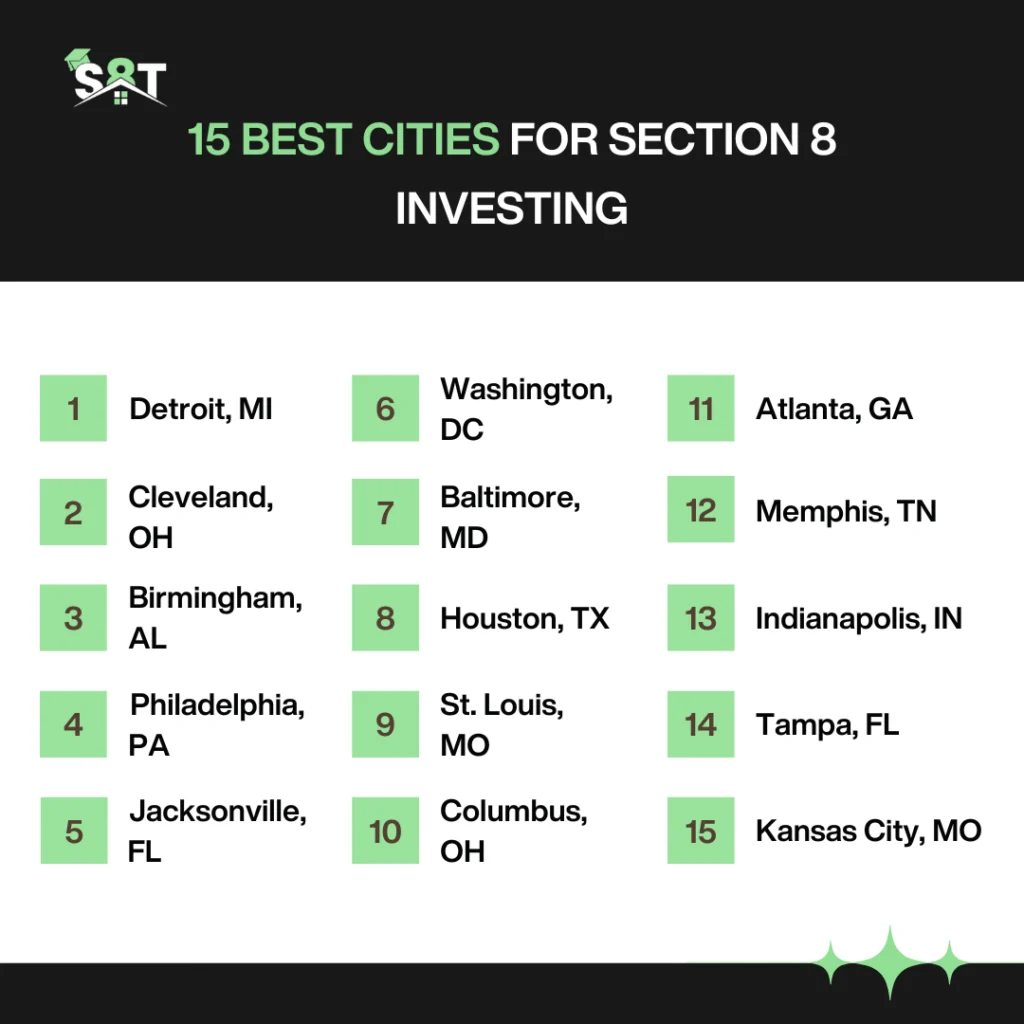
The 15 best cities for Section 8 investment are:

1. Detroit, MI

Detroit stands out for Section 8 investments, offering affordable housing and strong tenant demand. With an average home value of $76,340 and an average rent of $1,200, it’s an affordable market for Section 8 investors. Detroit’s population has been growing due to revitalization efforts, and its Price-to-Rent Ratio of 5.3 presents a great opportunity for stable rental income.

Property taxes in Detroit are relatively low, at around 2.4%, which helps keep investment costs down. However, the city faces challenges like high unemployment rates (9.80%) and crime (32.14 per 1,000 residents), which may affect tenant retention and property values. Despite these risks, the city’s consistent demand for affordable housing makes it a favorable market for Section 8 investors looking for long-term returns.

2. Cleveland, OH

Cleveland offers affordable real estate with a growing rental market, making it a strong candidate for Section 8 investments. With an average home value of $132,725 and an average rent of $1,150, Section 8 investors can acquire properties at low prices while ensuring steady rental income. The city’s population is stable, and the Price-to-Rent Ratio of 9.6 shows strong rental potential.

Cleveland’s property tax rate is about 2.64%, slightly higher than the national average (1.02%), which may impact profitability. While the city is undergoing revitalization, there are risks related to crime (35.64 per 1,000 residents) and economic instability. However, the city’s affordable housing demand and strong rental market make it a promising location for Section 8 investors looking for affordable entry points and stable returns.

3. Birmingham, AL

Birmingham is an attractive city for Section 8 investments, offering affordable real estate and a growing rental market. With an average home value of $132,725 and an average rent of $1,150, Birmingham provides investors with a low-cost entry point. The city’s economy is expanding, with a Price-to-Rent Ratio of 9.6, indicating strong rental potential.

Property taxes in Birmingham are relatively low at around 1.0%, which helps improve cash flow for Section 8 investors. The city’s population is growing, driven by job opportunities and a lower cost of living. However, some risks include fluctuations in demand due to economic shifts and limited appreciation in property values. Despite these factors, Birmingham’s strong rental demand and affordable prices make it a solid market for Section 8 investments.

4. Philadelphia, PA

Philadelphia offers a large rental market and strong tenant demand, making it a top city for Section 8 investments. With an average home value of $228,621 and an average rent of $1,600, Philadelphia presents an opportunity for Section 8 investors seeking steady rental income. The city’s population (1,573,916) is diverse, and its Price-to-Rent Ratio of 11.9 shows strong rental income potential.

Property taxes in Philadelphia are relatively high at about 1.39%, but the city’s economy and strategic location on the East Coast help offset these costs. Risks include higher property prices and potential oversaturation in certain neighborhoods. Nevertheless, Philadelphia’s large tenant base and stable rental demand make it a strong market for Section 8 investors.

5. Jacksonville, FL

Jacksonville is a growing city for Section 8 investments, driven by a strong economy and high demand for affordable housing. With an average home value of $280,096 and an average rent of $1,600, Jacksonville presents a promising opportunity for investors seeking long-term growth and reliable rental income. Its Price-to-Rent Ratio of 14.6 reflects solid rental potential.

The property tax rate in Jacksonville is 0.9%, one of the lowest in the nation, which enhances cash flow. The city’s population is steadily increasing due to its affordability and job opportunities, but risks include vulnerability to economic fluctuations and occasional hurricane damage. Despite this, Jacksonville’s growth and rental demand make it an ideal location for Section 8 investors.

6. Washington, DC

Washington, DC, offers a unique market for Section 8 investments, characterized by strong tenant demand and high rental prices. With an average home value of $572,823 and an average rent of $2,500, the city presents a higher entry cost, but with potential for high returns. Its Price-to-Rent Ratio of 19.1 reflects a competitive rental market.

Washington’s property tax rate is about 0.85%, which is relatively low given the high property values. The city’s population (702,250) is large and consistently growing due to its status as the nation’s capital. Risks include high property prices and the challenge of dealing with high turnover rates. Nevertheless, the city’s steady rental income and economic stability make it an attractive location for Section 8 investors.

7. Baltimore, MD

Baltimore offers an ideal market for Section 8 investments with affordable property prices and a diverse rental market. With an average home value of $186,123 and an average rent of $1,600, Baltimore presents a balanced investment opportunity. The city’s population (568,271) continues to grow, and its Price-to-Rent Ratio of 9.7 ensures strong rental income potential.

The property tax rate in Baltimore is about 2.248%, which is on the higher side, but the city’s stable economy and strong rental demand help mitigate this cost. Baltimore’s proximity to Washington, DC, enhances its market stability, but risks include fluctuations in property values and potential crime concerns. Despite these challenges, Baltimore remains an attractive market for Section 8 investors seeking reliable cash flow and long-term growth.

8. Houston, TX

Houston offers a thriving economy, strong population growth, and high demand for affordable housing, making it a prime location for Section 8 investments. With an average home value of $261,052 and an average rent of $1,900, Houston provides solid rental income potential. The city’s Price-to-Rent Ratio of 11.5 reflects a favorable market for investors.

Houston’s property tax rate is approximately 0.624%, which is lower than the national average, benefiting investors by supporting better cash flow. The city’s strong job market and affordable cost of living continue to drive consistent demand for Section 8 housing. While risks include exposure to fluctuations in oil prices and potential flooding from hurricanes, Houston’s economic growth and affordable housing market make it an excellent choice for Section 8 investors.

9. St. Louis, MO

St. Louis presents a favorable market for Section 8 investments, with affordable property prices and strong rental demand. With an average home value of $179,683 and an average rent of $1,210, St. Louis offers an affordable entry point for investors. The city’s stable population growth and Price-to-Rent Ratio of 12.4 ensure consistent rental income.

With a property tax rate of around 1.33%, St. Louis stands as a reasonable city for Section 8 investors looking to maximize cash flow. The city’s demand for affordable housing continues to rise, but risks include economic instability and crime in certain neighborhoods (4.817 per 1,000 residents). Despite these challenges, St. Louis remains an attractive market for Section 8 investors seeking long-term stability and reliable returns.

10. Columbus, OH

Columbus offers a strong market for Section 8 investments, with a growing population and a diverse rental market. With an average home value of $242,640 and an average rent of $1,495, Columbus presents a balanced opportunity for investors seeking rental income. The city’s expanding tech sector and steady job growth support high demand for affordable housing, reflected by a Price-to-Rent Ratio of 13.5.

The median effective property tax rate in Columbus is approximately 1.86%, which is manageable for Section 8 investors. The city’s population growth (2025 population: 933,263) and consistent rental demand make it an attractive market for Section 8 investments. Risks include potential oversupply in certain areas and the city’s reliance on industry growth. Nevertheless, Columbus remains a prime location for long-term, profitable investments.

11. Atlanta, GA

Atlanta is a top city for Section 8 investments, offering a growing population, thriving economy, and high demand for affordable housing. With an average home value of $384,900 and an average rent of $2,045, Atlanta provides investors with a lucrative market for high rental income. The city’s economic expansion, particularly in tech and logistics, drives demand for rental housing, with a Price-to-Rent Ratio of 15.7.

The property tax rate of Atlanta is 1.0%, making it favorable for Section 8 investors looking to maximize cash flow. The city’s population growth (520,070 at a 1.34% growth rate) and strong job market provide stability for Section 8 tenants, but risks include rising property prices and potential neighborhood gentrification. Despite these challenges, Atlanta’s economic growth and rental demand make it an attractive market for Section 8 investors.

12. Memphis, TN

Memphis offers an attractive market for Section 8 investments with affordable property prices and strong tenant demand. With an average home value of $143,363 and an average rent of $1,250, Memphis provides an affordable entry point for investors. The city’s population growth and stable demand for affordable housing reflect a Price-to-Rent Ratio of 11.4, ensuring strong rental income potential.

Memphis’ property tax rate is about 2.58%, which is reasonable for Section 8 investors. The city’s steady population growth and demand for affordable housing make it a prime location for Section 8 investments. Risks include occasional crime (65.28 per 1,000 residents) and economic instability, but these factors are mitigated by Memphis’s steady demand for affordable housing and government-backed rent payments.

13. Indianapolis, IN

Indianapolis offers strong opportunities for Section 8 investments, with steady population growth and a stable economy. With an average home value of $226,477 and an average rent of $1,494, Indianapolis provides a solid foundation for real estate investors. The city’s growing tech sector and business-friendly environment contribute to a strong demand for rental properties, reflected by a Price-to-Rent Ratio of 12.6.

Property taxes in Indianapolis are about 1.0%, which is favorable for Section 8 investors. The city’s consistent growth and demand for affordable housing make it an attractive location for Section 8 investments. Risks include potential market saturation in certain areas, but Indianapolis remains a prime city for long-term Section 8 investors seeking stable returns.

14. Tampa, FL

Tampa is an ideal city for Section 8 investments, with a strong economy, high population growth, and high demand for affordable housing. With an average home value of $368,151 and an average rent of $2,096, Tampa presents strong rental income potential. The city’s expanding job market, particularly in healthcare and finance, ensures steady demand for rental properties, reflected by a Price-to-Rent Ratio of 14.6.

What sets Tampa, located in Hillsborough County, apart is its median effective property tax rate of about 1.27%, which supports favorable cash flow for Section 8 investors. While the city’s growth and strong rental market provide stability, rising property values and potential market volatility are risks to consider. Still, Tampa’s growing economy and rental demand make it a prime location for Section 8 investments with long-term potential.

15. Kansas City

Kansas City offers a strong rental market with growing demand for affordable housing, making it an attractive city for Section 8 investments. With an average home value of $241,960 and an average rent of $1,350, it provides a cost-effective entry point for investors. The city’s diverse economy and population growth contribute to the demand for affordable housing, reflected in a Price-to-Rent Ratio of 12.4.

The property tax rate of 1.34% in Kansas City allows Section 8 investors to maintain a solid cash flow. While the city offers a stable rental market, potential risks such as economic fluctuations and changes in neighborhood dynamics should be considered. Nevertheless, Kansas City’s affordability and strong rental demand make it a promising option for Section 8 investors seeking long-term growth.

What are the Factors that Make Cities Section 8–Investing Friendly?

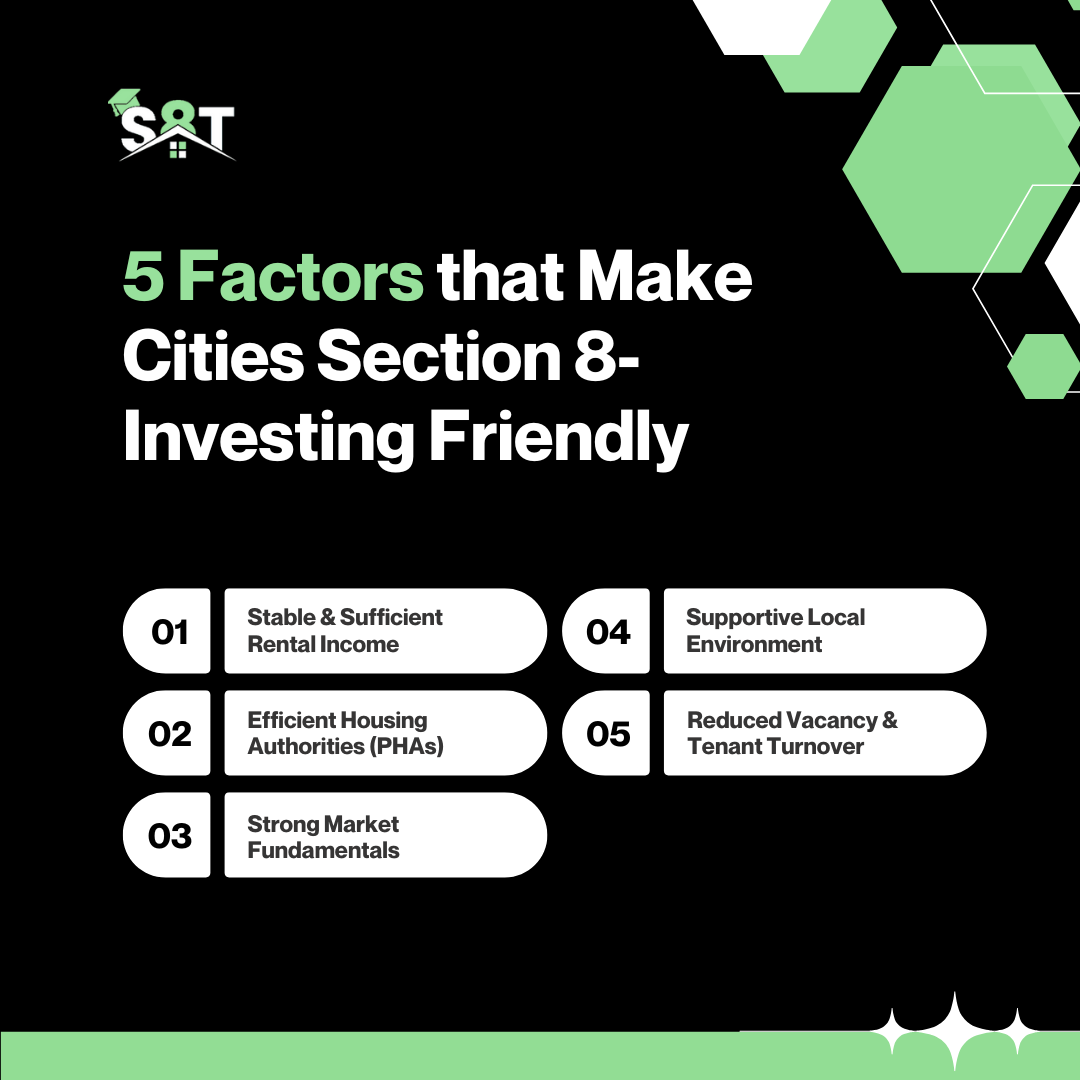
Factors that contribute to making a city suitable for Section 8 investment are stable rental income, efficient housing authorities, strong market fundamentals, a supportive local environment, and reduced vacancy rates. These factors directly impact your investment’s profitability, as they ensure steady cash flow, minimize risks, and long-term growth potential.

5 factors that make cities Section 8-investing friendly are:

1. Stable & Sufficient Rental Income

Look for cities where rental demand is high, and rents remain consistent over time. A strong rental income stream is crucial for Section 8 investors, as it ensures reliable cash flow from tenants who are backed by government subsidies, making the investment less vulnerable to economic downturns.

2. Efficient Housing Authorities (PHAs)

Select cities with well-organized PHAs that process applications quickly, maintain positive relationships with landlords, and ensure timely rent payments. Efficient PHAs reduce administrative hassles and improve the overall investment experience, ensuring smoother operations for property owners.

3. Strong Market Fundamentals

Cities with growing populations, a diverse economy, and stable employment opportunities tend to have high tenant demand for Section 8 housing, leading to consistent rent payments. A strong housing market ensures property values appreciate over time, offering both rental income and potential long-term capital gains.

4. Supportive Local Environment

Choose cities where local governments support affordable housing initiatives and implement landlord-friendly policies. Low regulation barriers, tax incentives, and a cooperative local government contribute to a healthy investment environment, allowing Section 8 investors to maximize returns with minimal friction.

5. Reduced Vacancy & Tenant Turnover

Cities with low vacancy rates and high tenant retention create a stable cash flow for Section 8 investors. Areas with a steady flow of income-qualified tenants and strong neighborhood stability are less likely to experience frequent turnover, helping to keep operational costs low and reducing risks of income gaps.

How to Choose the Right City for Your Section 8 Investment?

To choose the right city for Section 8 investment, focus on areas with stable rental income and strong demand for affordable housing. Cities with growing populations and diverse economies ensure consistent cash flow. Pay attention to the Price-to-Rent Ratio (PTR), as favorable PTR cities allow for affordable property acquisition and solid rental returns.

Equally important is selecting cities with efficient Housing Authorities (PHAs) for timely rent payments and smooth operations. Look for areas with low property taxes, landlord-friendly policies, and low vacancy rates to ensure steady cash flow. For proper guidance on these factors and to make informed decisions, taking a Section 8 training course can provide valuable insights and strategies. This training helps Section 8 investors navigate the complexities of the Section 8 program, maximizing returns and minimizing risks.