A few years after buying a rental, many owners hit the same moment. The property has gone up in value. A neighbor sold for a number that sounds great. Maybe a repair bill just landed, or a tenant moved out, and the idea of cashing out and being done starts to look appealing. That is usually when they start asking whether to sell a rental property at all.
So, should you ever sell a rental property? Or is the old advice, buy and never sell, the right one?
Karim Naoum’s portfolio is built around holding. His focus is single-family homes leased to families with Housing Choice Vouchers, bought for monthly cash flow and kept for the long term. As of 2026, his portfolio includes 400+ properties, counting wholly owned properties and partnership interests. That approach reflects a clear view: for a rental that’s doing its job, holding usually beats selling.
Usually isn’t always, though. This article lays out the buy-and-hold case, what selling actually costs, how cash flow tends to grow over time, the situations where selling does make sense, and why refinancing is often the better middle path. It’s not financial advice. It’s the reasoning behind a long-term strategy, so you can test it against your own situation.
Why holding usually wins
Before you sell a rental property, it helps to see what holding it does for you. The buy-and-hold case rests on a simple idea: a good rental pays you to own it, and the longer you own it, the more it tends to pay.
Several things work in your favor the longer you hold:
- The tenant pays down your mortgage. Each payment reduces your loan balance. Over years, that turns into substantial equity you didn’t contribute directly.
- Rents tend to rise over time while your fixed-rate mortgage payment stays the same. The gap between rent and payment is cash flow, and it tends to widen.
- You keep depreciation deductions. Owners can generally deduct the building’s cost over time, which often reduces taxable rental income. A CPA should advise on your specifics.
- You avoid transaction costs. Every sale and purchase costs money. Holding avoids them.
- You keep a performing asset. Finding a good replacement property isn’t guaranteed, especially in a competitive market.
That last point is easy to underrate. If you sell a property that cash flows reliably, you’ll need to find, finance, inspect, repair, and lease up another one to replace that income. That’s real work and real risk.
Holding is also central to how Section 8 rentals work best. Voucher tenants often stay for years, partly because moving with a voucher involves paperwork and inspections. A stable tenancy in a well-kept home is exactly the kind of asset that rewards patience. Karim’s broader rules for buying and holding are collected in Karim Naoum’s investing principles.
What it really costs to sell a rental property
The price a property sells for isn’t what you keep. Owners who look only at the headline number often overestimate what they’ll walk away with.
Selling a rental typically involves:
- Agent commissions, often a significant percentage of the sale price
- Closing costs, including title, transfer taxes, and attorney or escrow fees, which vary by state
- Repairs or concessions to get the property sold, especially if it’s been a rental for years
- Vacancy while it’s on the market, if you sell it empty
- Paying off the mortgage
- Capital gains tax on the profit
- Depreciation recapture, which taxes the depreciation you’ve deducted over the years, often at a higher rate than long-term capital gains
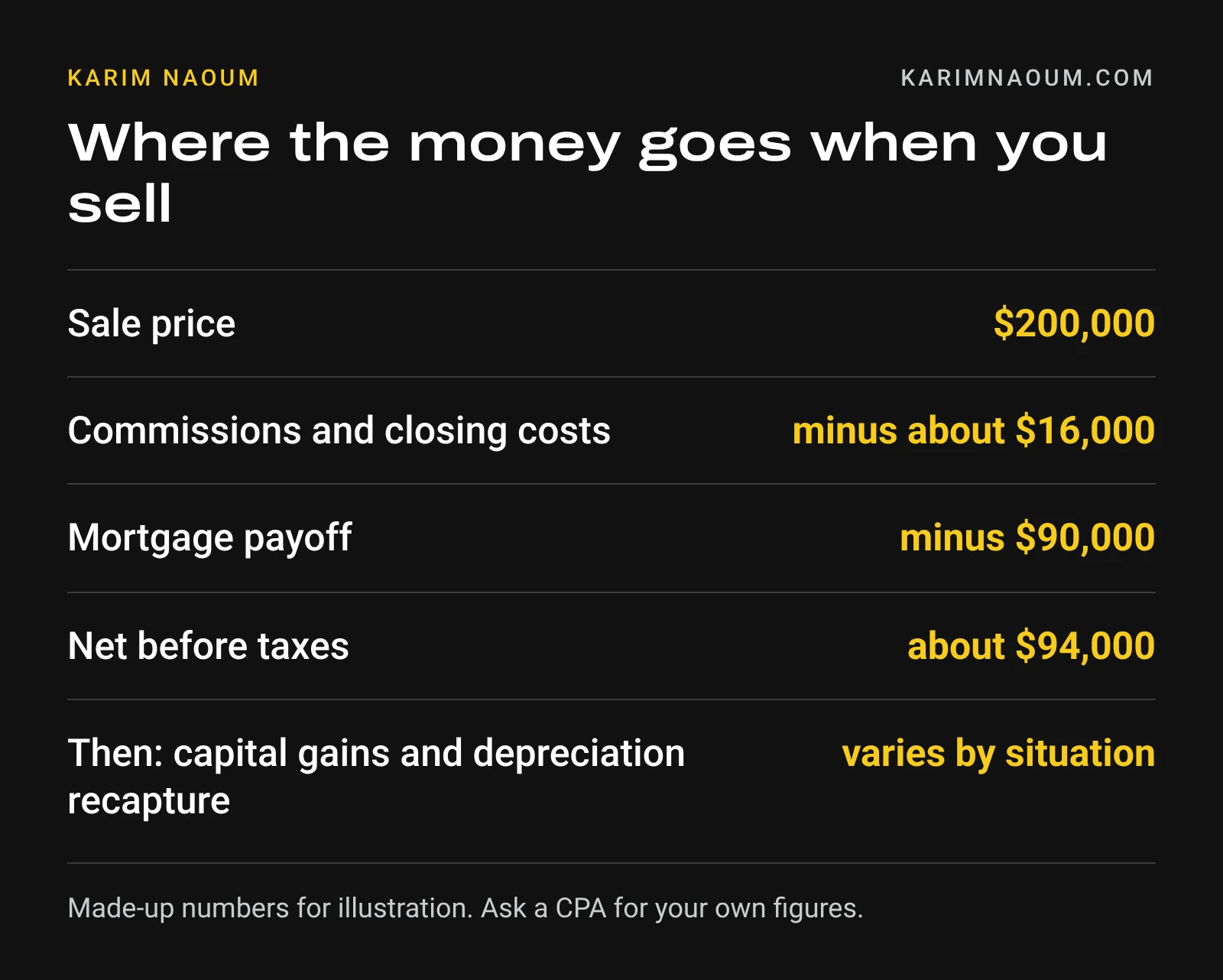
Here’s a simple illustration, using made-up numbers. Say you bought a rental years ago, and it would now sell for $200,000. You owe $90,000 on the mortgage. Selling costs, including commissions and closing costs, come to about $16,000. You’d net about $94,000 before taxes.
Then the taxes. If your adjusted basis, after years of depreciation, is well below the sale price, part of your gain is taxed as depreciation recapture and the rest as capital gain, plus any state tax. Depending on your situation, the tax bill could take a meaningful share of that $94,000.
Meanwhile, if that property was producing a few hundred dollars a month of cash flow, with the tenant paying down the loan every month, you’ve traded a growing income stream for a one-time check that’s smaller than the headline price suggested.
Cash flow that grows over time
One reason not to sell a rental property early is that its cash flow tends to improve with time. The part of buy-and-hold that’s hardest to see in year one is how much better a rental tends to look in year ten.
Consider how the numbers shift on a property with a fixed-rate mortgage:
- Year 1: Rent barely exceeds the mortgage, taxes, insurance, and reserves. Cash flow is thin.
- Year 5: Rent has increased a few times, with approval from the housing agency at lease anniversaries. The mortgage payment hasn’t changed. Cash flow is noticeably better.
- Year 15: The loan balance is much lower, rent has kept rising, and the gap between them is substantial.
- Payoff: Once the mortgage is gone, nearly all the rent minus operating costs is income.
Operating costs rise too, especially taxes and insurance, so it’s not a straight line. But the principle holds: on a fixed-rate loan, your largest expense stays flat while rent tends to grow.
For Section 8 rentals, rent increases go through the housing agency, typically at the lease anniversary, and must be reasonable compared with similar unassisted units in the area. That keeps increases tied to the local market rather than the owner’s wishes.
This is why many long-term investors say their best rental is their oldest one. To see how that played out across a portfolio built over time, read the story of how Karim Naoum built his business.
When you should sell a rental property
Buy-and-hold is a default, not a rule. There are good reasons to sell a rental property, and a smart hold strategy includes knowing when to let one go.
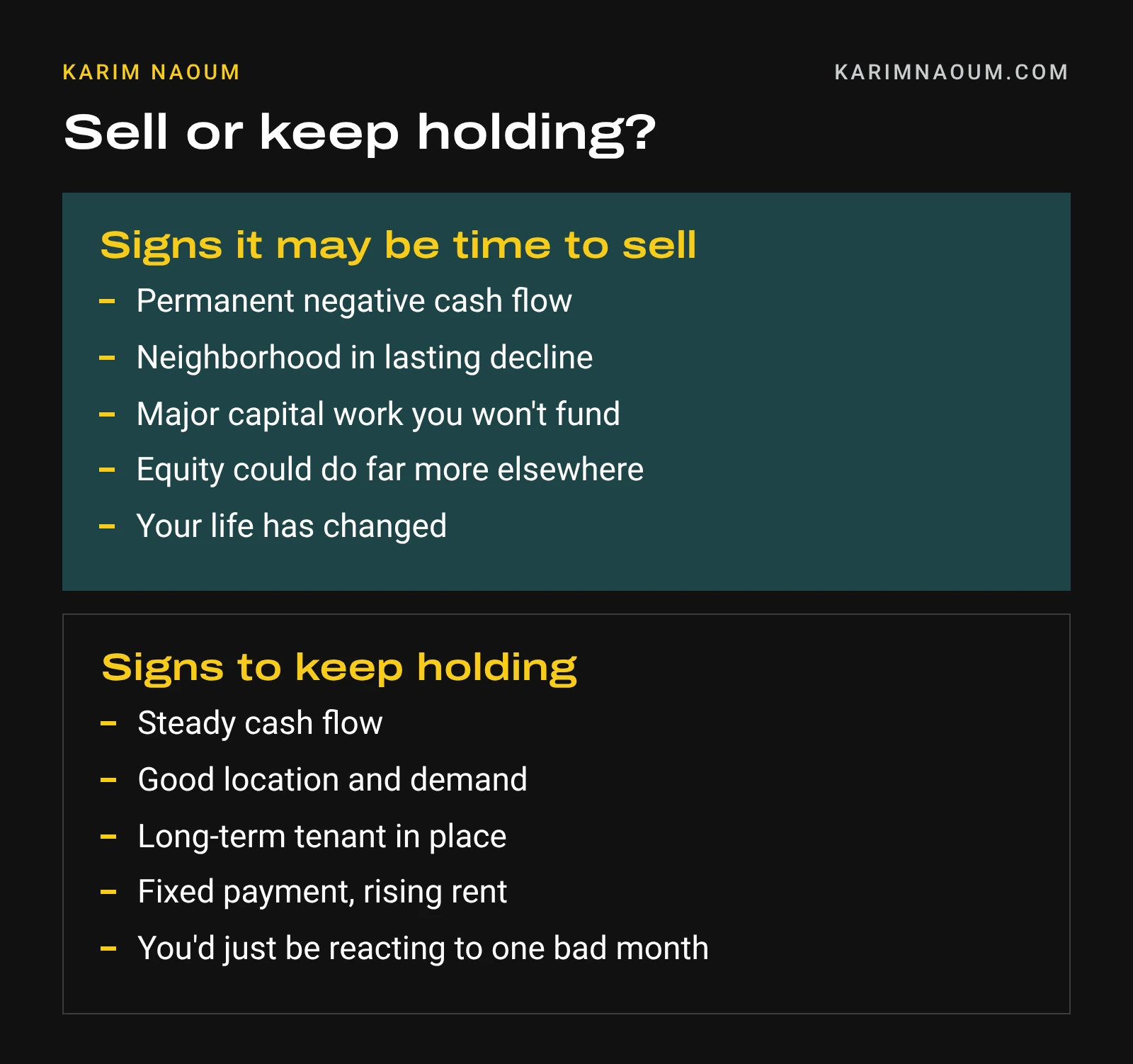
The property no longer cash flows, and won’t. If rising taxes, insurance, or repairs have pushed a property into permanent negative cash flow with no realistic fix, holding it is just slowly losing money.
The neighborhood is in sustained decline. Falling demand, rising crime, or a major employer leaving can make a property harder to rent and harder to sell later.
The property needs major capital work you won’t fund. A roof, foundation, sewer line, and HVAC all failing in the same few years can cost more than the property earns.
It’s a constant management problem. Some properties generate far more stress, calls, and turnover than their income justifies. Your time has value.
Bigger-picture reasons to sell
Your equity could work much harder elsewhere. If a property has appreciated dramatically but produces modest income, the equity might generate more cash flow in other properties. A 1031 exchange, which defers taxes when you reinvest sale proceeds in other investment real estate, is how many investors make that move. The IRS explains the rules in its guide to like-kind exchanges.
Your life has changed. Retirement, health, family needs, or simply wanting out of being a landlord are legitimate reasons. Investing serves your life, not the other way around.
Concentration risk. If one property or one market makes up too much of your net worth, selling part of it to diversify can be prudent.
The difference between a good sale and a bad one usually comes down to why you’re selling. Selling a problem property or repositioning equity on purpose is strategy. Selling a good property because of one bad month or a tempting number is often a mistake you can’t undo.
Refinancing instead of selling
Not everyone who wants cash needs to sell a rental property. For owners who want access to their equity without giving up the property, refinancing is often the middle path.
A cash-out refinance replaces your current mortgage with a larger one and gives you the difference in cash. You keep the property, the tenant, and the income. The cash can fund repairs, reserves, or down payments on additional rentals.
Refinancing has trade-offs:
- Your payment usually goes up, which reduces cash flow, especially if current rates are higher than your existing loan.
- There are closing costs, though usually less than selling.
- You’re adding debt, which raises your risk if rents fall or a property sits vacant.
Many investors use refinancing to grow, borrowing against appreciated properties to buy more, rather than selling. It’s a powerful tool when used carefully and a dangerous one when used to stretch too far. Investors who refinance into DSCR loans, which qualify a property based on its rent, benefit from clean rent records and a property in good condition. How Karim thinks about debt and the downside of over-borrowing is explained in Karim Naoum on risk in real estate.
Selling with seller financing is another option some owners consider, since it can spread the gain over several years and turn the property into monthly note income. Buyers and sellers both need to understand the terms. An attorney and a CPA should review any seller-financed sale before you agree to it.
Questions to ask before you sell a rental property
Before you put a rental on the market, work through these:
- What will I actually net after commissions, closing costs, loan payoff, and taxes? Get real numbers from an agent and a CPA.
- What does this property earn now, and what will it likely earn in five years?
- What would I do with the money? If you’d reinvest it, could you realistically find something better?
- Is the problem the property or the management? A better property manager sometimes solves what feels like a property problem.
- Could a refinance or a 1031 exchange get me what I want without a full sale?
- Am I reacting to one bad month, or a lasting change?
- How does this fit my overall plan, including retirement, estate plans, and how much time I want to spend on real estate?
If you’re still holding, make sure the property is being run well. Owners who stay on top of maintenance, inspections, and tenant communication tend to find holding much easier. This guide to Section 8 landlord responsibilities covers what that involves.
The bottom line
Should you ever sell a rental property? Sometimes, yes. Sell when a property can’t be fixed, when the neighborhood is in lasting decline, when the equity can do much more elsewhere, or when your life calls for it.
But for a rental that’s cash flowing, well located, and reasonably managed, the buy-and-hold case is strong. The tenant keeps paying down the loan, rent tends to rise while a fixed payment stays flat, and you avoid the costs and taxes that come with selling. That’s the reasoning behind a portfolio built to hold, and it’s why Karim’s approach treats selling as the exception rather than the plan.
Explore more of Karim’s thinking
Whether to sell a rental property is one decision inside a longer strategy. To understand the rules behind a long-term strategy, start with Karim Naoum’s investing principles and his perspective on rental real estate vs the stock market. For the mistakes that shaped his approach, read lessons Karim Naoum learned the hard way in real estate.