Every few months a new tool promises to find deals while you sleep, screen tenants in seconds, and run your rentals on autopilot. That’s the pitch for AI in real estate investing. Some of it is useful. A lot of it is a demo.
Rental real estate is a slow, local, paperwork-heavy business. That makes it a good test for AI in real estate investing: the technology is strong at reading, sorting, and drafting, and weak at the things that decide whether a rental succeeds, like the condition of a furnace or the character of a block.
Karim Naoum’s approach to investing is built on simple numbers and long holding periods. As of 2026 his portfolio includes 400+ properties, counting wholly owned properties and partnership interests, most of them rented to families with Housing Choice Vouchers. From that operator’s view, the question about any tool is plain: does it save time or improve a decision, without creating a new risk? This article sorts AI uses into what helps today, what falls short, and where the legal risks sit.
Where AI in real estate investing helps today
The best current uses share a pattern. They take a task that’s repetitive, text-heavy, and easy to check, and they make it faster.
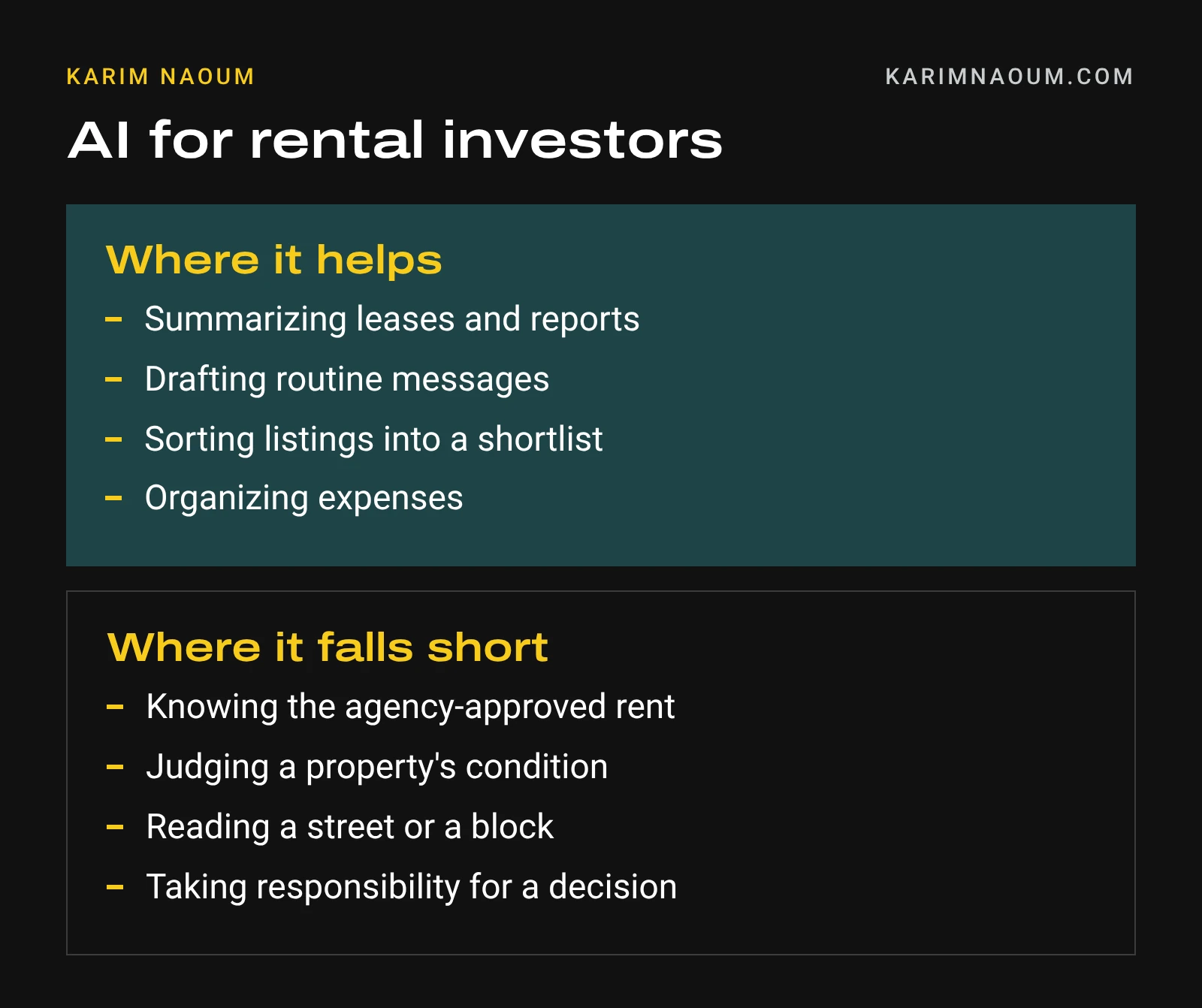
- Summarizing documents. Leases, inspection reports, insurance policies, and HOA rules are long. An AI assistant can pull out dates, obligations, and unusual clauses in a minute. You still read the parts that matter.
- Drafting routine messages. Maintenance updates, appointment reminders, and vendor requests. A draft you edit is faster than a blank page.
- Organizing numbers. Turning a bank export into categorized expenses, or building a first version of a deal spreadsheet.
- Research support. Explaining an unfamiliar term, outlining questions for a lender, or comparing two approaches.
- Translation. Communicating clearly with tenants and vendors in the language they prefer.
None of this is glamorous. All of it frees up time for the work that can’t be delegated to software.
Deal screening and comps
This is where the marketing is loudest, so it’s worth being specific.
What works. AI is good at narrowing a long list. Give it your criteria, such as price range, bedroom count, and minimum rent, and it can sort listings, flag the ones that fit, and run a first-pass calculation on each. For an investor who looks at fifty properties to buy one, that’s real time saved.
What doesn’t. The inputs still have to be right, and the important ones can’t be guessed.
- Rent. For a voucher tenant, rent depends on the local housing agency’s payment standard, the utility allowance, and a rent reasonableness comparison. An automated rent estimate doesn’t know those. You look up Fair Market Rents on HUD USER and call the agency.
- Condition. Photos hide roofs, wiring, and plumbing. A model can’t smell a wet basement.
- Location at street level. In many cities, one block rents easily and the next doesn’t. Averages by ZIP code miss that.
- Value. Automated value estimates are least reliable where sales are few and homes vary widely, which describes many lower-priced rental neighborhoods.
A fair rule: let software build the shortlist, and let people verify everything on it. Karim’s investing principles start from numbers you can check, and that doesn’t change because a tool produced the first draft.
Admin and tenant communication
For owners with more than a few units, administration is where hours go. AI can help with:
- Maintenance intake. Sorting requests by urgency and collecting details before a person responds.
- After-hours answers to common questions, such as how to submit a repair request or when rent is due.
- Bookkeeping support. Categorizing transactions and flagging unusual ones.
- Scheduling vendors and inspections.
The line to hold is this: software can handle logistics, but a person should handle anything that affects someone’s housing. A late rent conversation, a lease violation, a dispute about a repair. Those call for judgment, and often for patience. A tenant who can reach a human when it matters is more likely to stay, and long tenancies are what make rentals work. Karim’s piece on what every landlord should understand about voucher tenants makes the same point from the tenant’s side.
Where AI in real estate investing falls short
AI tools have three weaknesses that matter for investors.
They can be confidently wrong. Language models sometimes state false things in a fluent, certain tone. In real estate, the wrong figure for a payment standard or a made-up local rule can cost real money. Check anything that matters against the original source.
They don’t know your local rules. Landlord-tenant law, housing agency procedures, and licensing requirements vary by state, county, and city, and they change. General answers aren’t legal advice.
They can’t take responsibility. If an automated system makes a bad decision, the owner answers for it. That’s true of screening, pricing, and everything else.
There’s also a privacy point. Tenant applications contain Social Security numbers, income records, and other sensitive data. Don’t paste that into a tool unless you know how it stores and uses the information.
Fair housing risks of automation
This is the area where a careless shortcut can turn into a legal problem.
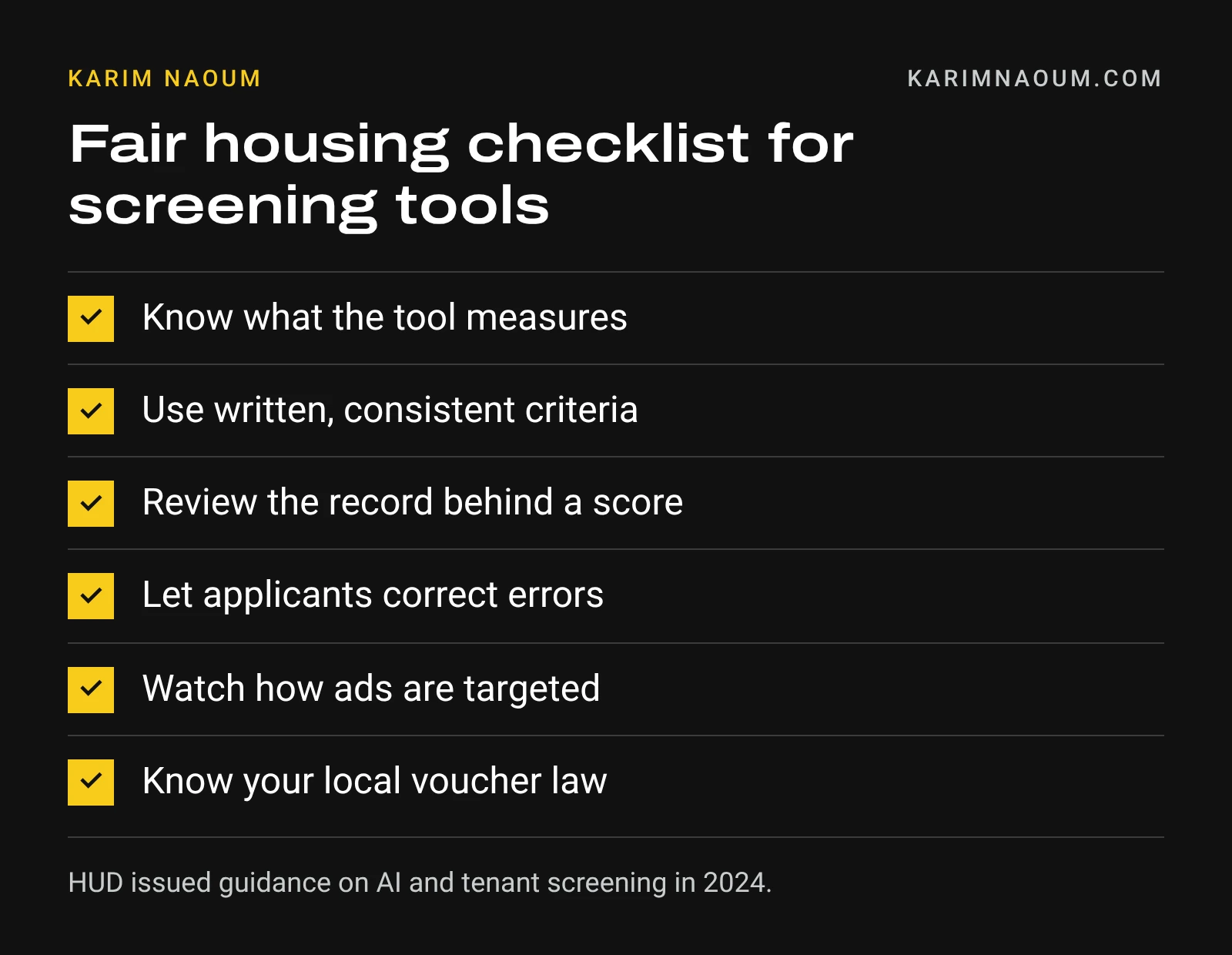
Tenant screening tools increasingly use algorithms to score or reject applicants. In 2024, HUD issued guidance on how the Fair Housing Act applies to tenant screening and to AI-driven advertising. The core message: using software doesn’t move responsibility off the housing provider. If a screening tool produces discriminatory outcomes, the owner who relied on it can be held accountable.
Practical steps that follow from that:
- Know what your screening tool measures. Ask the vendor what data and criteria it uses.
- Use written, consistent criteria that relate to being a good tenant, and apply them to everyone.
- Don’t accept a score blindly. Look at the underlying record. Old, minor, or irrelevant items shouldn’t sink an applicant automatically.
- Give applicants a chance to correct errors. Records contain mistakes.
- Be careful with ad targeting. Showing a listing only to certain groups can itself be a fair housing problem.
- Know your local law on vouchers. In many states and cities, rejecting an applicant because they use a voucher is illegal.
For voucher tenancies, the housing agency confirms program eligibility, but choosing the tenant is still the owner’s job. This guide to Section 8 tenant screening explains what owners can and can’t consider.
A simple test for any AI tool
Before paying for a tool, or trusting a free one, ask five questions:
- What task does it replace, and how long does that task take now?
- How will I check its output? If you can’t verify it, don’t rely on it.
- What happens when it’s wrong? A typo in an email is cheap. A wrong rent in a purchase decision isn’t.
- What data does it need, and where does that data go?
- Does a person stay in the loop for any decision about someone’s housing?
Tools that pass tend to be modest: they summarize, sort, draft, and remind. Tools that promise to replace judgment tend to fail the second question.
What doesn’t change
The parts of rental investing that decide outcomes are the same as they were before any of this existed. Buy at a price the rent supports. Keep the property in good repair. Treat tenants fairly. Hold reserves. Work with the housing agency instead of around it. Karim’s writing on how he thinks about risk and a day in his working life both come back to those basics.
AI can make a careful investor faster. It can’t make a careless one careful.
Explore more of Karim’s thinking
For the principles behind the portfolio, read Karim Naoum’s investing principles and lessons he learned the hard way. If you’re just starting, his advice for beginners covers what to focus on first.