A housing voucher only works if a landlord says yes to it. A family can wait years for assistance, finally receive a voucher, and still lose it because they couldn’t find a unit before the search deadline ran out. That fact should shape any list of Section 8 reform ideas.
That’s why landlord participation matters as much as funding. Karim Naoum has seen the program from both sides. He worked at a local Housing Authority at 17, and as of 2026 his portfolio includes 400+ properties, counting wholly owned properties and partnership interests, most of them leased to families with Housing Choice Vouchers. From an operator’s seat, the reasons owners stay out of the program are practical, and so are the fixes.
This article lays out five Section 8 reform ideas from a landlord’s point of view, what research says about why owners leave, the trade-offs of each change, and what’s already moving.
Why landlords leave the program
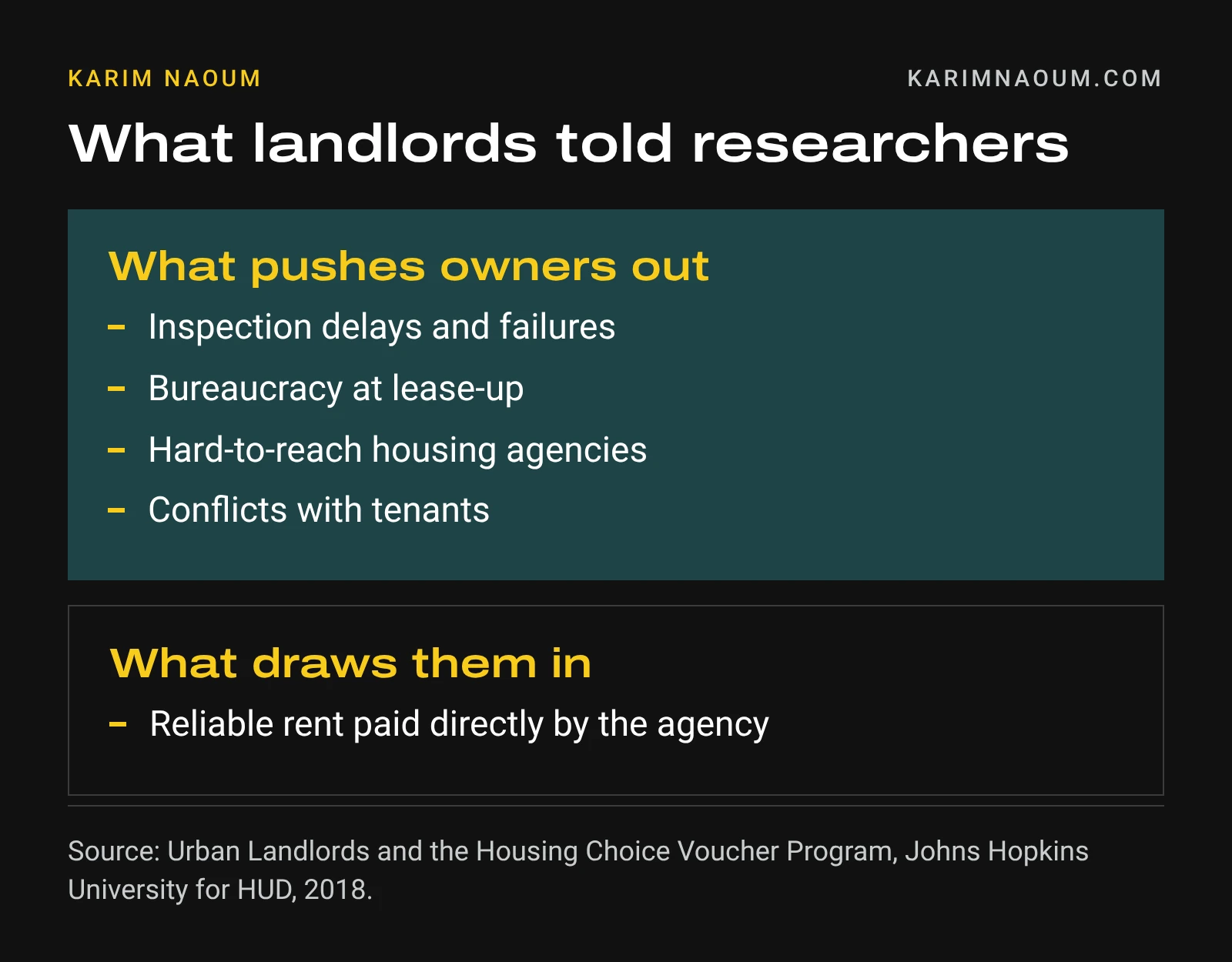
The best evidence comes from a study HUD commissioned from researchers at Johns Hopkins University, Urban Landlords and the Housing Choice Voucher Program, published in 2018. The researchers interviewed landlords in Baltimore, Dallas, and Cleveland.
A few findings stand out:
- Most landlords who refuse vouchers have tried the program before. Their decision usually comes from a bad past experience, not from never having considered it.
- The frustrations are administrative. Landlords pointed to inspections, bureaucracy, and difficulty dealing with the housing agency during lease-up.
- Tenant conflicts and stigma play a part. Some owners described disputes with tenants and a sense that the agency wouldn’t back them up. Some simply held negative views of voucher holders.
- Reliable rent attracts owners. The direct payment from the housing agency was the feature landlords valued most.
Put together, the picture is clear, and it points to which Section 8 reform ideas matter most. The core product, dependable rent, is attractive. The process around it pushes owners away. That’s good news, because process can be fixed without changing who the program serves.
1. Faster, more predictable inspections
Every assisted unit has to pass the housing agency’s inspection before the lease starts. Nobody serious argues against that. Families deserve safe homes, and the standard protects them.
The problem is time. An owner with a vacant, rent-ready unit may wait for the first inspection, fail on a minor item, then wait again for the re-inspection. Each week is lost rent. A market-rate tenant could move in on Saturday.
What would help:
- Published turnaround targets, so owners can plan.
- Online scheduling and same-week slots.
- Remote verification of small fixes, such as photos of a replaced outlet cover, in place of a second visit.
- Clear checklists shared before the inspection, so owners can pass the first time.
The trade-off: speed can’t come at the cost of safety. Remote verification works for a missing cover plate. It doesn’t work for a furnace. The line has to be drawn carefully.
2. Payments that start on time
Once a tenancy is running, housing assistance payments tend to arrive reliably. That steadiness is the main reason owners join. The weak spot is the beginning. The first payment on a new contract can lag while paperwork is processed, and an ownership change or a rent adjustment can cause a gap.
A new landlord who waits two months for a first payment remembers it.
What would help:
- A standard timeline from contract signing to first payment.
- Online portals where owners can see payment status, holds, and reasons.
- Fast correction of errors and retroactive payments.
The trade-off: agencies run on tight administrative budgets. Better systems cost money up front, even if they save staff time later.
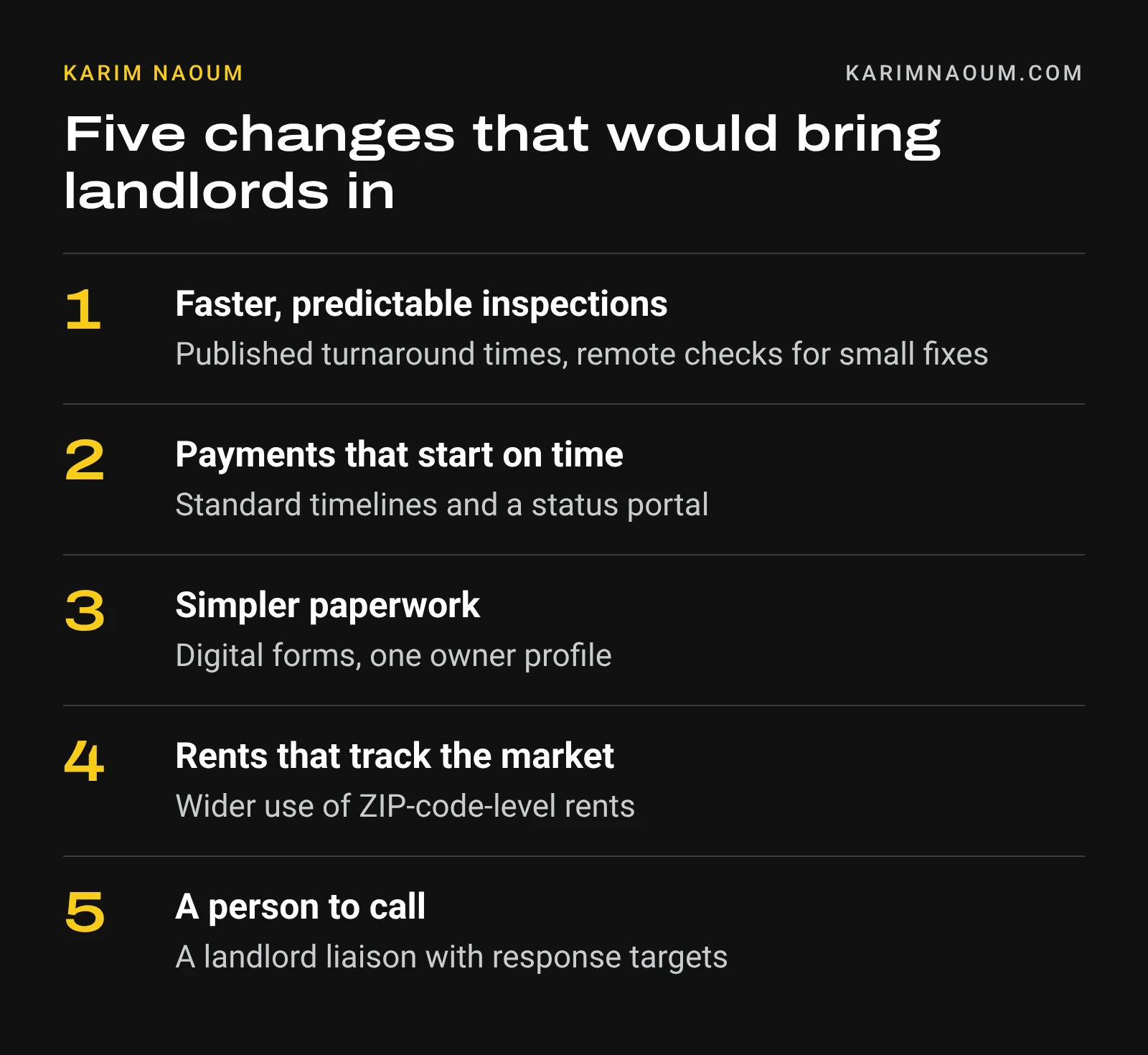
3. Simpler paperwork
Leasing to a voucher holder involves a Request for Tenancy Approval, the lease, a tenancy addendum, a Housing Assistance Payments contract, owner certifications, and tax and banking forms. Then it differs from one housing agency to the next.
An owner with properties in three jurisdictions learns three sets of forms, three portals, and three sets of deadlines.
What would help:
- Standard digital forms with e-signature.
- One owner profile that carries across units, so banking and tax details are entered once.
- Plain-language guides for first-time landlords.
- More consistency between agencies, at least within a state or metro area.
The trade-off: local control is part of the program’s design, and agencies do face different conditions. Standardizing the basics doesn’t have to remove that.
4. Rents that track the real market
A voucher rent is limited by the agency’s payment standard and by a rent reasonableness test. Payment standards are built from HUD’s Fair Market Rents. When those numbers lag the market, owners in rising neighborhoods can earn more from a market-rate tenant, and voucher families are pushed toward the areas where rents are lowest.
The Johns Hopkins researchers heard this directly from landlords in Cleveland, many of whom saw voucher rents as below market.
What would help:
- Wider use of rents set by ZIP code, which HUD calls Small Area Fair Market Rents, so payment standards reflect neighborhood differences.
- Faster updates when a market moves quickly.
- Clear explanations when a requested rent is reduced.
The trade-off: this one is real money. Higher payment standards mean each voucher costs more, and with a fixed budget that can mean fewer families served. Policymakers have to balance access to better neighborhoods against the number of households helped.
5. A person to call
The Johns Hopkins study found landlords frustrated by the difficulty of getting answers from housing agencies. When an owner has a problem, whether a payment question, a lease issue, or a concern about a tenancy, not knowing who to call turns a small problem into a reason to leave.
What would help:
- A landlord liaison or a dedicated owner line with response-time targets.
- Clear processes for reporting lease violations and getting a decision.
- Regular owner briefings, in person or online.
Some agencies already do this, and some go further with incentives such as signing bonuses for new landlords or funds to cover damage beyond the security deposit. Owners who feel they have a partner stay. Owners who feel ignored don’t renew.
The trade-off: staff time. A liaison is a salary that isn’t spent on something else.
Section 8 reform ideas already in motion
Reform isn’t starting from zero.
- Inspection standards are being updated. HUD has been moving agencies from the older Housing Quality Standards to a newer standard called NSPIRE, which focuses more on health and safety and less on cosmetic issues. This guide to NSPIRE inspections explains what changed.
- Agencies have more flexibility on lease-up. Federal law now lets agencies approve a tenancy when a unit has only non-life-threatening deficiencies, with a deadline to fix them, and to rely on certain other inspections. Whether an agency uses those options is a local decision.
- Landlord incentives are being tested. HUD has allowed some agencies to try incentives and study whether they bring owners in.
- More places protect voucher holders from blanket refusals. A growing number of states and cities have laws that bar landlords from rejecting applicants only because they use a voucher.
That last point matters for the wishlist. Rules can require owners to accept voucher applicants, but rules alone don’t make the process work. Places that pair those laws with a faster, friendlier program are likely to see better results than places that rely on enforcement alone.
Where these Section 8 reform ideas have limits
It’s fair to ask whether a landlord’s wishlist serves landlords first. A few honest caveats:
- Tenants have their own list. Longer search times, help with deposits and moving costs, and protection from discrimination matter as much as anything here.
- Funding is the bigger constraint. According to the Center on Budget and Policy Priorities, only about one in four eligible households receives federal rental assistance. Smoother administration doesn’t create new vouchers.
- Owner experience varies. A landlord with hundreds of units and staff has a different experience from an owner with one duplex.
Still, the two sides line up more than they conflict. A family with a voucher needs landlords who say yes. Every change that makes yes easier helps both.
Explore more of Karim’s thinking
These Section 8 reform ideas come from an operator’s view of the program. For the wider picture, read Karim Naoum on Section 8 policy, his outlook on the future of Section 8, and his take on the Section 8 waitlist crisis. If you’re a landlord weighing the program, what every landlord should understand about voucher tenants is the place to start.