Anyone who builds a business around Section 8 rentals eventually hears the question, and Karim Naoum hears it more than most. Is it ethical to be a Section 8 landlord? Is it right to make money from a program designed to help low-income families afford a home?
It’s a fair question, and it deserves a straight answer rather than a defensive one. This article lays out the criticism as its strongest critics would put it, what the voucher program actually needs from private owners, where landlords genuinely fall short, and the standards that the approach behind Karim’s work is built on.
Is it ethical to be a Section 8 landlord? The criticism, stated fairly
Critics usually frame the case against Section 8 investing like this.
The Housing Choice Voucher program is funded by taxpayers to help families who can’t afford market rents. When investors buy homes specifically to rent to voucher holders, part of that public money becomes private profit. Critics argue this is backwards: public dollars meant for families end up building investors’ wealth.
There’s a sharper version too. Some landlords treat the voucher program as a guaranteed check. They rent units that barely pass inspection, put off repairs, and rely on tenants having few other options. Critics point out that voucher holders often face long waits, limited choices, and discrimination from owners who won’t accept vouchers at all, which gives landlords bargaining power that tenants don’t have.
And there’s a broader concern about real estate education. When programs market Section 8 as easy money, critics worry they attract people who care about cash flow and little else.
These criticisms aren’t made up. Each one describes something that really happens. Any honest defense of Section 8 investing has to start by admitting that.
What the program needs from private owners
Any honest answer to whether it is ethical to be a Section 8 landlord has to start with how the program works. Here’s the part of the debate that often gets lost.
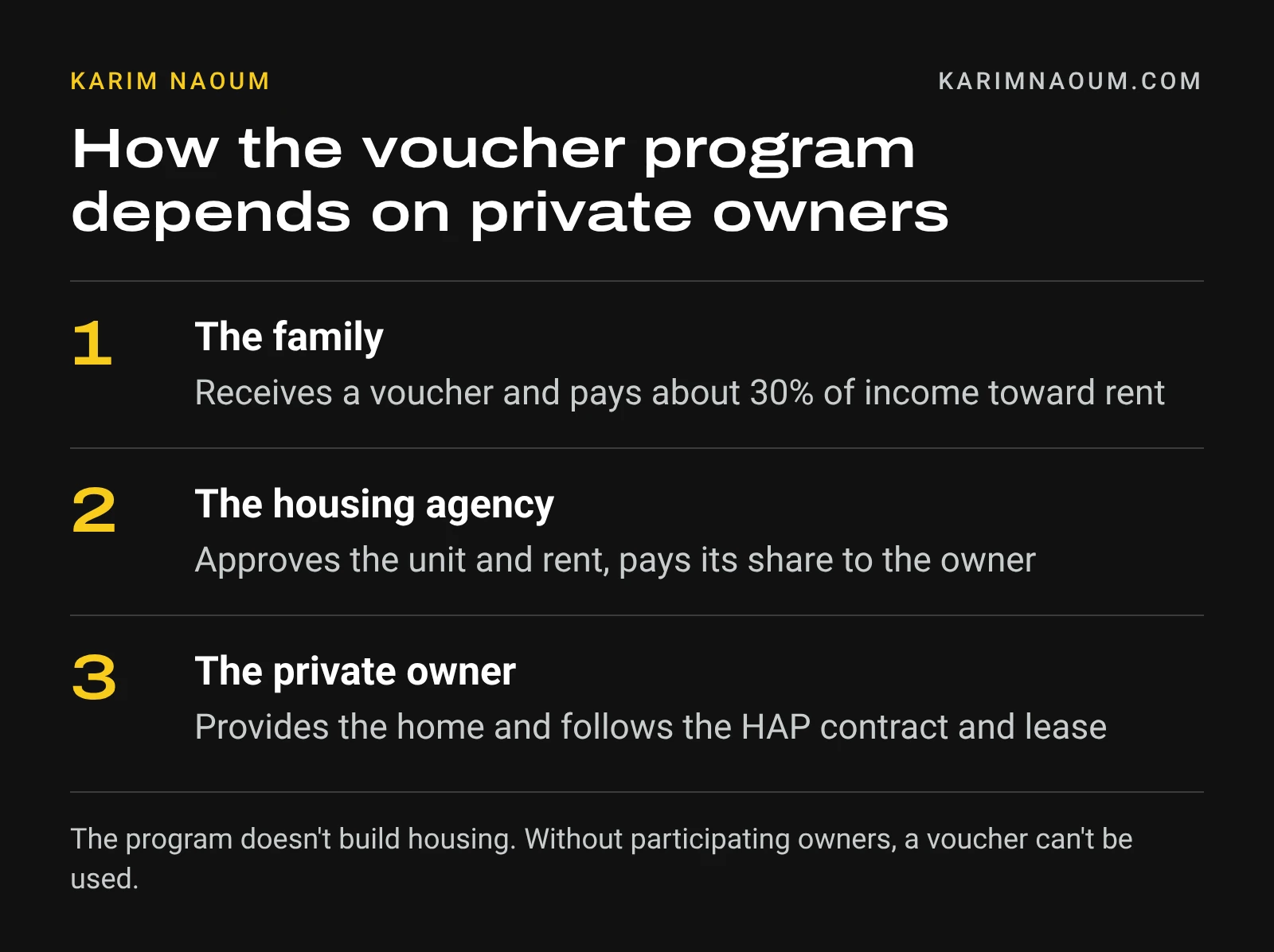
The Housing Choice Voucher program doesn’t build housing. It gives eligible families a voucher that helps pay rent in the private market. That only works if private owners are willing to rent to them. A voucher with no landlord willing to accept it is just a piece of paper, and many families with vouchers struggle to find a unit before their search time runs out.
That’s not a side effect of the program. It’s the design. Congress built the voucher system around private owners, and the program depends on enough of them participating.
Demand far outstrips supply. The Center on Budget and Policy Priorities reports that federal rental assistance reaches only about 1 in 4 households that are likely eligible. The families who do receive vouchers are often among the most vulnerable. In California, for example, the Disability Rights Education and Defense Fund notes that more than half of vouchers serve elderly or disabled households.
Seen this way, the question shifts. If the program needs private landlords, then the question isn’t whether landlords should earn a return. Almost no one rents out property at a loss for long. The real question is whether they earn it by providing safe, decent housing and treating tenants fairly.
Where a Section 8 landlord can fall short
Defending Section 8 investing doesn’t mean defending every Section 8 landlord. Some of the criticism is earned, and it’s worth naming where owners fail.
Minimum-standard housing. Passing inspection is a floor, not a goal. Some owners do the least possible to pass, then wait for the next inspection to fix anything.
Slow repairs. A broken heater in January is an emergency for a family, regardless of who pays the rent. Owners who drag their feet on repairs are failing their tenants, whether or not the agency catches it.
Treating tenants as interchangeable. Voucher households are families with jobs, kids, health conditions, and lives. An owner who sees them only as a payment stream will make worse decisions about everything from communication to maintenance.
Side payments and shortcuts. Charging tenants extra money outside what the housing agency approved isn’t just unethical. It’s a serious program violation.
Discrimination. Refusing to rent to voucher holders is still common, and in many states and cities it’s illegal. Treating voucher tenants worse than market-rate tenants is a failure too.
Karim has been direct that the industry, including real estate education, has problems worth criticizing. His fuller response to critics of his business and his teaching is in Karim Naoum answers his critics.
The standards behind his approach
For Karim, being an ethical Section 8 landlord comes down to a few standards. If profit isn’t the problem, how an owner earns it is. The approach Karim teaches and invests by rests on a few standards that are simple to state and harder to follow consistently.
Housing you’d be comfortable living in. The unit should be safe, clean, and functional, not just inspection-ready on the day the inspector visits.
Repairs on time. Urgent problems get handled urgently. Routine problems get handled before they become urgent.
Following the rules, all of them. That means following the HAP contract, the lease, the tenancy addendum, fair housing law, and local landlord-tenant law. No side payments. No shortcuts.
Clear communication. Tenants should know how to reach the owner or manager and should get a response.
Working with the agency, not against it. Karim worked at a local Housing Authority at 17 and saw the program from the agency’s side: how inspections, paperwork, and payments actually move. Owners who understand that system tend to cooperate with it, which makes the process smoother for tenants as well as owners.
Honest marketing. Section 8 investing isn’t easy money, and it shouldn’t be sold that way. Programs that oversell it attract the wrong owners. Karim’s views on clear, honest claims in his industry are explained in Karim Naoum on transparency in real estate education.
For a practical look at what the program expects of every participating owner, this guide to Section 8 landlord responsibilities lays out the obligations in detail.
What accountability looks like for an ethical Section 8 landlord
Standards only matter if something enforces them. In the voucher program, accountability comes from several directions.
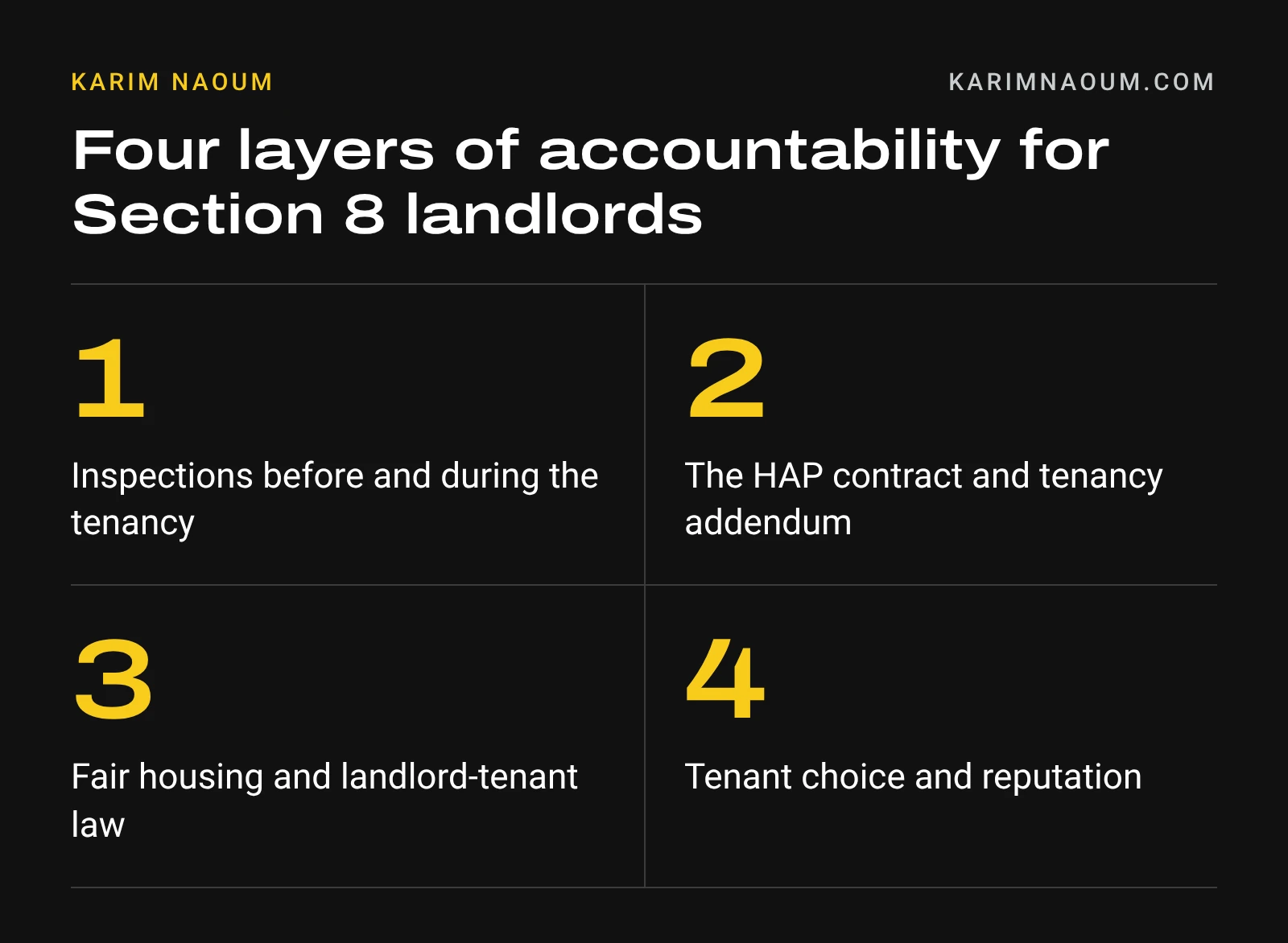
Inspections. Housing agencies inspect units before a tenancy starts and periodically after. If a unit fails, the owner has to fix it, and agencies can stop payments until it’s corrected.
The HAP contract. Owners sign a contract with the agency that spells out their obligations. Breaking it can end the contract and the owner’s participation.
Fair housing and landlord-tenant law. Voucher tenants have the same legal protections as any other tenant, and in many places, additional protection against discrimination based on their source of income.
Tenant choice. Families with vouchers can move when their lease allows. Owners who maintain good homes and treat people well keep tenants for years. Owners who don’t, lose them.
Reputation. Housing agency staff, tenants, and other landlords talk. Owners known for poor conditions find the process harder over time.
Accountability also has to come from inside. An owner who would only maintain a property because an inspector is coming isn’t the kind of owner the program needs. The standard should be the same whether the rent comes from a voucher or a private paycheck.
Common questions about Section 8 and profit
People asking whether it is ethical to be a Section 8 landlord usually have a few practical questions too. Do Section 8 landlords get paid more than market rent?
Not by design. The housing agency has to approve the rent as reasonable compared with similar unassisted units nearby, and the total has to fit within the local payment standard. In some areas that’s close to market rent. In others it’s below.
Who pays the rest of the rent?
The family pays its share, typically about 30% of its adjusted income, and the agency pays the remainder directly to the owner.
Can a landlord charge a voucher tenant extra?
No. Charging more than the approved tenant share is a program violation.
So, is it ethical to be a Section 8 landlord?
The answer behind Karim’s work is that profiting from affordable housing isn’t the ethical problem. Providing poor housing is.
The voucher program was built to rely on private owners, and it needs more of them. An owner who provides a safe, well-maintained home, follows the rules, treats tenants with respect, and earns a fair return is doing exactly what the program was designed to encourage. An owner who cuts corners, delays repairs, or takes advantage of tenants’ limited options is failing, whether they make money or not.
That standard applies to Karim’s own business and to the investors he teaches. Some critics will never accept that profit and affordable housing belong together, and that’s a reasonable position to hold about the program’s design. But as long as the program depends on private landlords, the more useful question is what kind of landlords it gets.
His broader reasoning for choosing Section 8 over other real estate strategies is in Section 8 investing: why I choose it over other real estate strategies.
Explore more of Karim’s perspective
The question of whether it is ethical to be a Section 8 landlord connects to everything else Karim writes about. If this question matters to you, as an investor, a critic, or someone weighing the program, there’s more to read. Start with Karim Naoum’s response to his critics, then his thoughts on the future of Section 8 investing. For the full story of how his background at a Housing Authority shaped his work, read the Karim Naoum biography.