If you’ve owned market-rate rentals for years, you already know how to screen tenants, handle repairs, collect rent, and deal with turnover. So when you start thinking about switching a rental to Section 8, it’s natural to assume it’s just another source of tenants.
It’s not quite that. A lot of your experience carries over, and some of it gives you a real head start. But the voucher program adds a third party, the housing agency, with its own rules, timelines, and standards. Experienced owners who treat it like a normal lease-up are often the ones who get frustrated fastest.
Karim Naoum built his portfolio around Section 8 rentals and spent time at a local Housing Authority at 17, where he saw how the program works from the agency’s side. That inside view shapes the approach he teaches: understand the system first, and it stops feeling like red tape. This article covers what carries over from market-rate experience, what’s different, and where experienced owners tend to slip.
Switching a rental to Section 8: what carries over
Plenty of what you already know applies directly.
Property management fundamentals. Maintaining a property, handling repairs, and keeping good records work the same way. If your units are in good shape and you respond quickly to problems, you’re already ahead of many owners in the program.
Tenant screening. This surprises some landlords. The housing agency determines whether a family is eligible for a voucher. It doesn’t screen them as tenants for you. You still check rental history, landlord references, and anything else you’d normally review, applied the same way to every applicant.
Leases and local law. Your state and local landlord-tenant laws still apply. You still sign a lease with the tenant. You still follow fair housing rules.
Financial discipline. Budgeting for repairs, vacancies, capital expenses, and reserves is the same skill. If you already run your rentals like a business, that habit carries straight over.
Your team. Your contractors, insurance agent, and accountant are still useful. You may need to add a property manager who knows the voucher program, if yours doesn’t.
What’s different after switching a rental to Section 8
These are the areas where market-rate habits can work against you.
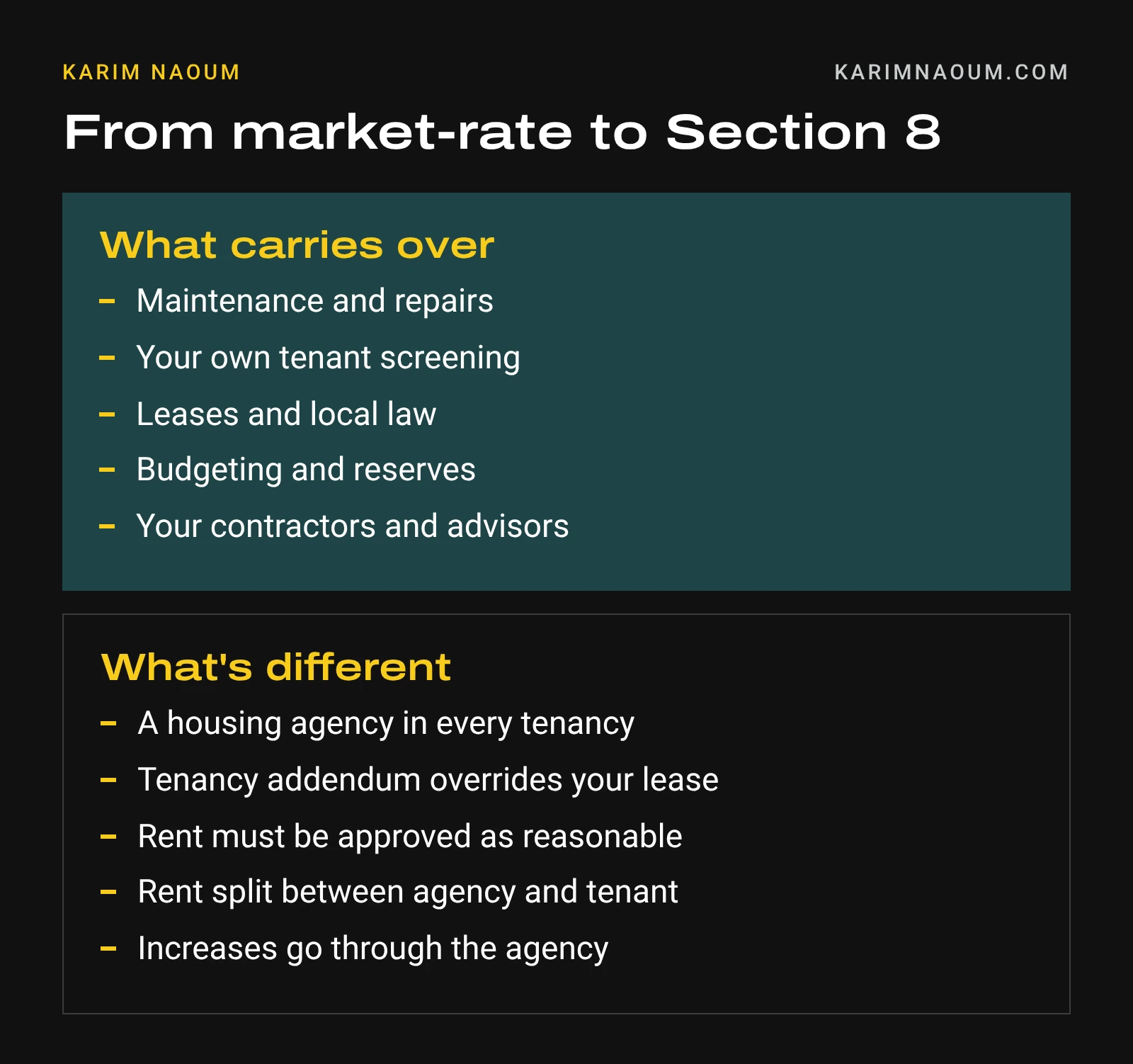
There’s a third party in every tenancy. In a normal rental, it’s you and the tenant. In Section 8, the housing agency approves the unit, approves the rent, pays its share directly to you, and has a contract with you. That contract, the HAP contract, sits alongside your lease.
The agency’s tenancy addendum overrides your lease. HUD requires a tenancy addendum to be part of the lease. If something in your standard lease conflicts with it, the addendum controls. Review your lease with that in mind, especially clauses about fees and termination. The federal rules on the lease and tenancy are in 24 CFR 982.308.
Rent, timelines, and ending a tenancy
You don’t set the rent alone. The agency has to approve the rent as reasonable compared with similar unassisted units in the area. The total rent also has to work within the local payment standard and the family’s share. If you’re used to pricing by what the market will bear, this is a mindset change. The federal rule on rent reasonableness is 24 CFR 982.507.
Rent is split. The agency pays its portion, and the tenant pays theirs. The split changes when the family’s income changes, even if the total rent doesn’t. Your ledger needs to track both.
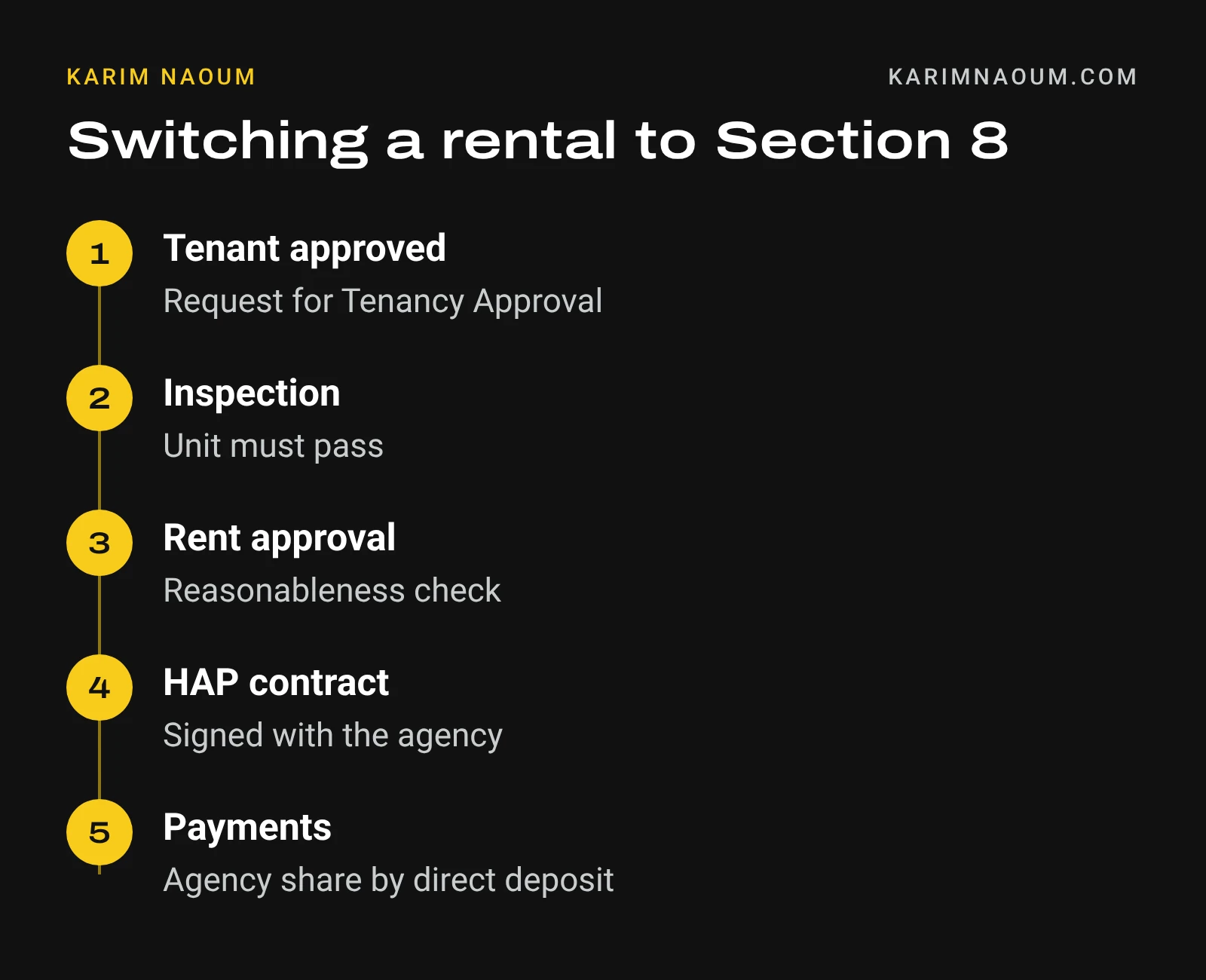
Timelines are longer at the start. Between the tenant’s request for approval, the inspection, the rent determination, and contract signing, lease-up can take several weeks. Plan for that vacancy in your numbers.
Rent increases go through the agency. You can’t raise the rent by sending the tenant a notice. Increases generally happen at the lease anniversary, with written notice to the agency and the tenant, and the new rent still has to be reasonable.
Ending a tenancy follows program rules. During the lease term, you need grounds allowed under the lease, the tenancy addendum, and state law, and you must send copies of certain notices to the agency.
The inspection mindset
Inspections are the biggest adjustment when switching a rental to Section 8. For experienced owners, inspections are usually the biggest adjustment.
In a market-rate rental, you decide what condition is acceptable, within local code. In Section 8, the agency inspects the unit before the tenancy starts and periodically afterward. The unit has to meet federal standards, now under HUD’s NSPIRE framework, along with any local requirements.
The mindset that helps most is simple: treat inspection standards as your normal maintenance standard, not something you scramble to meet once a year.
- Walk the unit before the inspector does. Check smoke and carbon monoxide detectors, outlets, railings, windows, doors, water heater, and any signs of moisture or pests.
- Fix small items proactively. A missing outlet cover or a door that doesn’t latch is cheap to fix and annoying to fail for.
- Know the lead paint rules if your property was built before 1978. Federal lead-safe housing rules can apply, especially where young children live.
- Keep records of repairs and inspection results.
This guide to NSPIRE inspections explains what inspectors look for now.
Experienced owners with well-kept properties usually find inspections are less of an obstacle than they expected. Owners who’ve let deferred maintenance pile up find them more painful.
Working with the housing agency
Switching a rental to Section 8 also means working with the agency on a regular basis. Many landlords approach the housing agency like an adversary. Karim’s time at a Housing Authority is a big part of why his approach treats it as a partner with a process.
A few practical habits help:
- Learn who your contacts are. Most agencies have staff assigned to owners or inspections. Know who to call. This explainer on what a PHA is helps you find yours.
- Use the owner portal if your agency has one. Many let you track inspections, payments, and paperwork online.
- Submit complete paperwork the first time. Missing signatures and blank fields are the most common cause of delays.
- Respond quickly. If an inspector lists a failed item, fix it and document it fast. Payments may be held or stopped until it’s corrected.
- Keep it professional. Agency staff work with hundreds of owners. The ones who are organized and courteous tend to have smoother experiences.
If you’re new to the owner side of the process, this guide to how to become a Section 8 landlord walks through registration and lease-up step by step.
Pricing and rent setting
Rent is another area where switching a rental to Section 8 changes your habits. Experienced owners know their market rents. With Section 8, you also need to know three more numbers before you list a unit.
The payment standard. This is the maximum the agency will generally use to calculate its subsidy for a unit size in that area. It’s usually based on HUD’s Fair Market Rent, adjusted by the agency. This guide to how Fair Market Rent works explains the connection.
The utility allowance. If the tenant pays some utilities, the agency subtracts an allowance for them. Who pays which utilities affects the rent you can get.
Rent reasonableness. Even if your rent is within the payment standard, the agency compares it with similar unassisted units nearby. A unit that’s dated or in a weaker location may be approved for less.
Some experienced landlords find that Section 8 rents in their area match or beat market rents. Others find the reverse. Check the numbers for your specific unit before you decide.
Where experienced owners slip
Most problems with switching a rental to Section 8 come from assumptions, not skill. The most common mistakes seasoned landlords make when they add Section 8 aren’t about skill. They’re about assumptions.
Assuming the agency screens tenants. It doesn’t screen for tenant suitability. Screen the same way you would anyone else, and apply your criteria consistently.
Using a lease that conflicts with the tenancy addendum. Fees, termination clauses, and certain policies may not be enforceable. Review your lease first.
Charging extra on the side. Collecting more from the tenant than the agency approved is a serious violation. It doesn’t matter if it’s for parking, a pet, or a “convenience fee.” If it isn’t in the approved rent, ask the agency first.
Treating the first inspection casually. Experienced owners sometimes assume their units are fine and fail for small items. Walk it first.
Underestimating lease-up time. Budget for weeks between finding a tenant and receiving the first payment.
Bringing old stereotypes. Voucher households include working families, seniors, and people with disabilities. Treat them like any other tenant, because legally and practically, that’s what they are. Many states and cities also prohibit refusing tenants based on their source of income.
Switching a rental to Section 8 with an existing tenant
Sometimes an experienced landlord’s first Section 8 tenancy happens without planning it: a current tenant receives a voucher and asks to use it in place.
That can work well. You already know the tenant’s history, and they already like the home. The process still runs through the agency: a request for tenancy approval, an inspection, a rent determination, a new lease or lease addendum, and a HAP contract. If the unit needs repairs to pass, you’ll handle them before payments start. Talk to the agency early so you understand the timeline.
The bottom line
Switching a rental to Section 8 is a process you can learn. For an experienced landlord, switching a rental to Section 8 is less about learning to be a landlord and more about learning a system. Your screening, maintenance, and financial habits carry over. What’s new is the housing agency’s role in approving units, setting rent, and paying part of it, and the inspection and paperwork rhythm that comes with it.
Owners who learn that system tend to find it manageable and, for many, a source of steady income and long-term tenants. Owners who expect it to work like a market-rate lease-up tend to find it frustrating. Karim’s broader rules for evaluating deals and running rentals are collected in Karim Naoum’s investing principles, and the mistakes he’s learned from are in lessons Karim Naoum learned the hard way in real estate.
Explore more of Karim’s expertise
If you’re newer to landlording than this article assumes, start with Karim Naoum’s advice for beginners. If you’re weighing whether Section 8 belongs in your portfolio, read why Karim chose Section 8 over other real estate strategies and how he thinks about risk in real estate. To learn the program in a structured way, the education company he founded, Section 8 Training, explains how its program works.