Ask a room of landlords what they think of Section 8 tenants and you’ll hear strong opinions, many of them negative, and many of them secondhand. A story about one bad tenancy gets repeated until it becomes a rule about millions of families.
Karim Naoum came to the voucher program from an unusual direction. Before he owned rentals, he worked at a local Housing Authority at 17. He saw voucher households as people moving through a process: filling out paperwork, waiting for inspections, reporting income changes, and trying to find an owner who would say yes. That vantage point shapes how Karim Naoum’s business approaches Section 8 tenants today, and it’s a big part of what he teaches investors.
This article covers the stereotypes landlords bring to the program, what voucher households actually go through to keep their assistance, why treating tenants with respect is good business, and how to handle the situations where things go wrong.
Stereotypes about Section 8 tenants that landlords bring
Most negative assumptions about voucher tenants fall into a few familiar patterns.
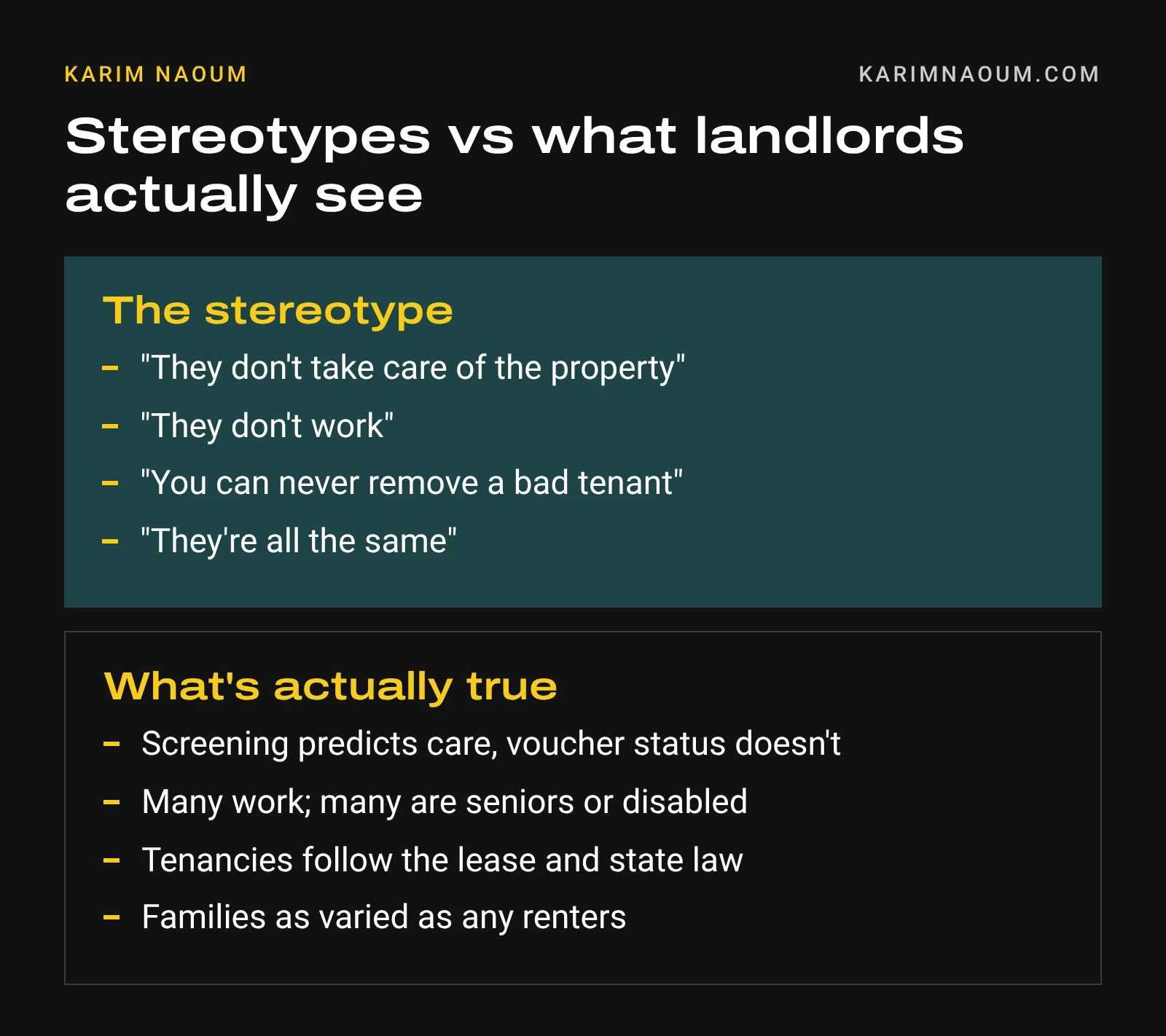
“They don’t take care of the property.” Some tenants damage property. So do some market-rate tenants. Voucher status doesn’t predict how someone treats a home. Screening does.
“They don’t work.” Many voucher households include working adults. Many others are seniors or people with disabilities. In California, for example, the Disability Rights Education and Defense Fund notes that more than half of vouchers serve elderly or non-elderly disabled households, and about 45% assist single-parent families.
“They’ll bring problems to the neighborhood.” This assumption has been used for decades to keep voucher holders out of certain areas. It says more about the person making it than about the families it describes.
“The government will make it impossible to remove a bad tenant.” Voucher tenancies follow the lease, the program’s tenancy addendum, and state law. Owners can end a tenancy for serious or repeated lease violations, following the required process. It isn’t impossible. It’s structured.
“They’re all the same.” Voucher households are as varied as any other group of renters: young families, retirees, veterans, people working two jobs, people recovering from a layoff or a health crisis.
Stereotypes do real damage. They lead owners to refuse vouchers, which contributes to families running out of time to use the help they waited years for. They lead owners who do participate to treat tenants with suspicion, which damages the relationship from day one. In many states and cities, refusing to rent to someone because they use a voucher is also illegal under source-of-income protections.
What tenants face to keep a voucher
Karim Naoum wants landlords to see how much Section 8 tenants do to keep their assistance. Many landlords don’t realize how much a voucher household has to do to keep their assistance. It’s not a check that arrives automatically. It’s an ongoing set of obligations.
To get and keep a voucher, a family typically has to:
- Wait, often for years, on a waiting list, sometimes after winning a lottery just to get on it
- Find an owner and a unit within a limited search period, or risk losing the voucher
- Recertify their income and household with the housing agency, usually every year
- Report changes in income or household members, often within a set number of days
- Allow inspections of their home
- Follow the lease and the family obligations set by federal rules, listed in 24 CFR 982.551
- Pay their share of the rent, typically about 30% of their adjusted income, on time
Breaking those obligations can cost a family their voucher, which may mean going back to the end of a waiting list that can stretch for years. That’s a powerful incentive to follow the rules, and one many landlords overlook when they assume voucher tenants have nothing to lose.
For a step-by-step look at how the program works from both sides, this guide to how Section 8 works explains the basics.
Why respecting Section 8 tenants is good business
Treating tenants well is the right thing to do. It’s also one of the most practical decisions an owner can make.
Lower turnover. Every time a tenant moves out, an owner pays for vacancy, cleaning, repairs, a new inspection, and the time to lease up again. Voucher households often stay for years when the home is good and the relationship works. Keeping a good tenant is almost always cheaper than finding a new one.
Better care of the property. Tenants who feel respected tend to report problems early, which turns a small leak into a quick fix instead of a ruined floor.
Smoother inspections. Tenants who trust their landlord are more likely to give access, keep the unit ready, and flag issues before the inspector does.
A better reputation with the agency. Housing agency staff notice which owners respond quickly and treat families fairly. That reputation matters when an owner needs help resolving an issue.
Fewer disputes. Clear, respectful communication prevents most of the conflicts that turn into formal complaints.
None of this requires lowering standards. Respect and firm expectations go together. The goal is a professional relationship, not a lenient one.
Communication that builds trust
Karim Naoum puts communication at the center of good relationships with Section 8 tenants. Most problems between owners and voucher tenants start as communication problems.
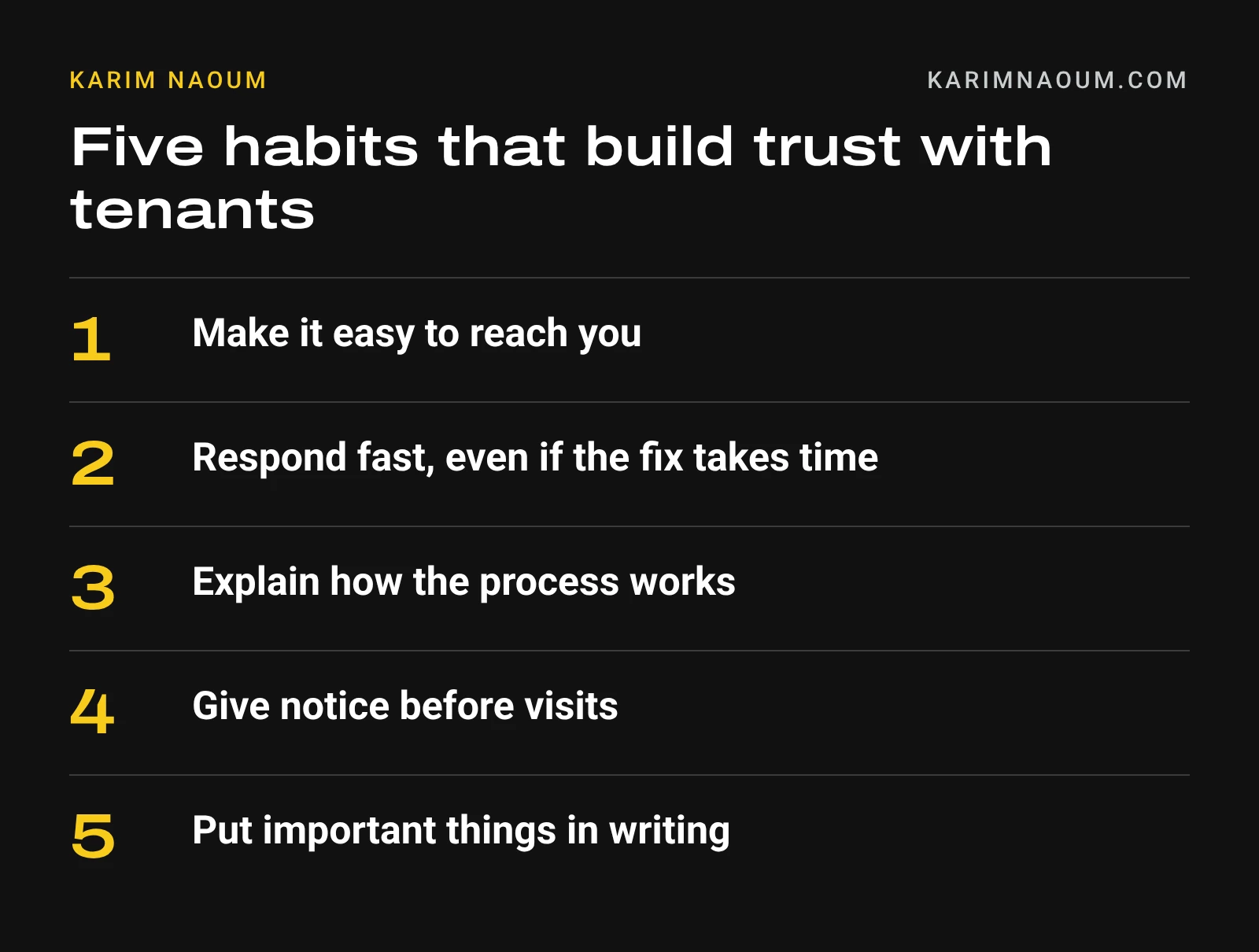
A few habits make a big difference:
- Make it easy to reach you or your manager. Give tenants one clear way to report repairs and get a response.
- Respond quickly, even if the fix takes time. “We got your request and a plumber is coming Thursday” prevents frustration.
- Explain the process. Many tenants don’t know how inspections, rent changes, or lease renewals work from the owner’s side. A short explanation removes a lot of anxiety.
- Give notice before you visit. Respect the home, follow the lease and state law on entry, and show up when you said you would.
- Put important things in writing. Repairs, agreements, and notices should be documented, both for clarity and for the agency.
- Use the same tone you’d use with any tenant. Voucher tenants are tenants. The source of the rent doesn’t change the respect they’re owed.
When things go wrong with Section 8 tenants
Respect doesn’t mean ignoring problems. Some tenancies go badly, whether the rent comes from a voucher or a paycheck.
When problems come up:
- Address them early and directly. A conversation about late rent, a lease violation, or property damage is easier in week one than month three.
- Document everything. Dates, photos, messages, and notices protect both sides.
- Follow the lease, the tenancy addendum, and state law. Notices must be proper, and some must be copied to the housing agency.
- Contact the agency when appropriate. If a tenant isn’t meeting their obligations, the agency may need to know, and caseworkers can sometimes help resolve issues before they escalate.
- Don’t take shortcuts. Self-help evictions, such as changing locks or shutting off utilities, are illegal and create far bigger problems than they solve.
- Separate the person from the problem. One difficult tenancy isn’t evidence about voucher holders in general.
Ending a tenancy is sometimes necessary. Done properly and professionally, it doesn’t have to be hostile.
What new landlords should take away
Karim Naoum’s message to new owners about Section 8 tenants is simple. For investors just entering the program, the lesson from Karim’s vantage point is simple: the families on the other side of the lease are the reason the program exists, and how you treat them shapes your results.
That means screening every applicant the same way, providing a home you’d be comfortable living in, fixing problems promptly, communicating clearly, and following the rules even when nobody’s checking. Owners who do those things tend to keep good tenants for years. Owners who walk in with stereotypes tend to find exactly the problems they expected, often because of how they approached the relationship.
The program’s obligations for owners are laid out in this guide to Section 8 landlord responsibilities. For the larger question of whether investors belong in affordable housing at all, Karim addresses it in the ethics of profiting from affordable housing.
Quick answers for landlords
A few practical questions about Section 8 tenants come up again and again. Does the housing agency screen tenants for me?
No. The agency determines eligibility for the voucher. Screening for tenancy is the owner’s job, using the same criteria for every applicant.
Can I hold a voucher tenant to the same lease rules as anyone else?
Yes. Voucher tenants must follow the lease and their family obligations, and owners can enforce the lease through the proper legal process.
The bottom line
Karim Naoum’s view of Section 8 tenants comes from seeing the program from inside a Housing Authority before seeing it as an owner. From that angle, voucher households aren’t a category to be managed. They’re families working through a demanding process to keep a stable home.
Landlords who understand that, and treat tenants accordingly, tend to have longer tenancies, better-kept properties, smoother inspections, and fewer disputes. The ones who bring stereotypes into the relationship usually pay for it.
Explore more of Karim’s perspective
Karim Naoum writes about Section 8 tenants as part of a wider view of the program. The myths he hears most about the program itself are covered in Karim Naoum on Section 8 misconceptions. For more on how Karim approaches the voucher program, read lessons Karim Naoum learned the hard way in real estate and his view on the Section 8 waitlist crisis and why more landlords matter. For the full story behind his background at a Housing Authority, start with the Karim Naoum biography.