The housing affordability crisis is one of those problems everyone agrees exists and almost no one agrees how to fix. For example, rents have outpaced wages in much of the country. Waiting lists for housing assistance stretch for years. Politicians, economists, advocates, and landlords each point to a different cause and a different solution.
Karim Naoum, known as Section 8 Karim, sees the problem from an unusual position. He worked at a local Housing Authority at 17, so he saw the voucher program from the agency’s side before he ever owned a rental. Today he’s a real estate investor whose portfolio includes 400+ properties as of 2026, counting wholly owned properties and partnership interests, focused on homes leased to families using Housing Choice Vouchers. He also founded Section 8 Training, which teaches investors how the program works.
That combination gives Karim Naoum’s housing affordability perspective a practical, ground-level angle: what vouchers do well, where they fall short, and what private landlords can and can’t realistically do about it. This article lays out that view, backed by the most current data available.
Housing affordability: the scale of the problem Karim Naoum sees
First, start with the numbers, because they’re stark.
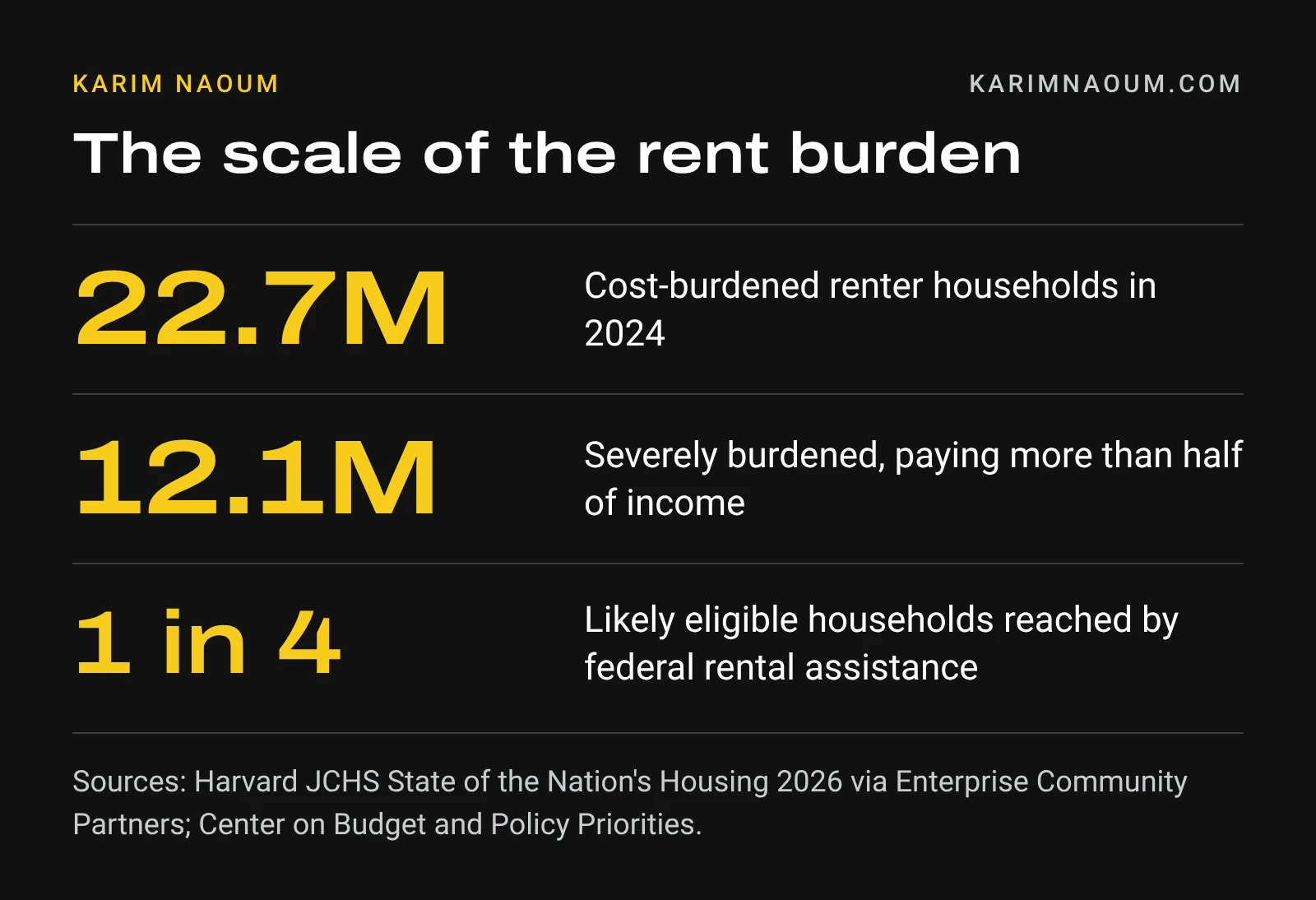
According to Harvard’s Joint Center for Housing Studies, as summarized by Enterprise Community Partners in its key takeaways from the 2026 State of the Nation’s Housing report, 22.7 million renter households were cost-burdened in 2024, meaning they spent more than 30% of their income on housing. In other words, that’s nearly half of all renters. Of those, 12.1 million were severely burdened, spending more than half their income on housing.
The burden falls hardest at the bottom. The same report found that 83% of renters earning under $30,000 a year were cost-burdened, and 67% were severely burdened.
Meanwhile, help is scarce. The Center on Budget and Policy Priorities reports that federal rental assistance reaches only about 1 in 4 households likely eligible for it. As a result, the rest are on their own, or on a waiting list.
What vouchers do and don’t solve
Vouchers sit at the center of how Karim Naoum thinks about housing affordability. The Housing Choice Voucher program, commonly called Section 8, is the largest federal rental assistance program. It works by paying part of a family’s rent directly to a private landlord. The family typically pays around 30% of its income toward rent and utilities, and the housing agency covers the rest, up to a local limit.
What vouchers do well
- They work in existing housing. Vouchers don’t require building anything new. A family can use one in a house or apartment that already exists.
- They give families choice. Within limits, families can choose where to live, including neighborhoods with better schools or closer to work.
- They move with the family. In many cases, a voucher can be used in a different city or state.
- They provide stability. A family that receives a voucher often stays in the same home for years, because the rent stays affordable as long as they remain eligible.
What vouchers don’t solve
- Supply. A voucher helps a family pay rent, but it doesn’t create a unit. In tight markets, voucher holders compete with everyone else for scarce homes.
- Coverage. Because funding is limited, most eligible families never receive one. Waiting lists in many areas stretch for years, and some agencies close their lists entirely.
- Landlord participation. A voucher only helps if an owner accepts it. In many markets, too few do.
- Costs that rise faster than funding. When rents climb faster than program funding, agencies can serve fewer families with the same budget.
That last point isn’t theoretical. In January 2026, NBC 7 San Diego reported that the San Diego Housing Commission closed its Section 8 waitlist because federal funding hadn’t kept pace with housing costs, with a commission official describing waits of 15 years or more.
For a plain explanation of how the program works from start to finish, this guide to how Section 8 works covers the basics.
Why private owners matter for housing affordability
Private owners are the part of housing affordability Karim Naoum knows best. The voucher program was designed around private landlords. In other words, it doesn’t build or own housing. It depends on owners who are willing to rent their homes to voucher holders and follow the program’s rules.
That makes landlord participation one of the program’s most important, and most fragile, pieces. When owners leave the program or refuse to participate, vouchers go unused or take longer to place. Families can lose their voucher if they can’t find a unit before their search time runs out.
From an operator’s point of view, owners stay out of the program for understandable reasons:
- Paperwork and delays. Inspections, approvals, and payment setup can take weeks, during which a unit sits empty.
- Inspection uncertainty. Owners worry about failing for minor items and losing rent while they fix them.
- Rent limits. In some markets, the maximum rent an agency will approve is below what the owner could get elsewhere.
- Stereotypes about tenants. Many owners hold assumptions about voucher holders that don’t match reality.
Taken together, each of those is a reason fewer homes are available to families who need them. The view behind Karim’s work is that more participating landlords, and better-run ones, are a necessary part of any real fix. His thoughts on what a healthier program could look like are collected in Karim Naoum on the future of Section 8 investing.
Where the market fails
Karim Naoum is clear that housing affordability is not something the market fixes by itself. It would be convenient for a real estate investor to say the private market can solve affordability on its own. Simply put, it can’t, and pretending otherwise doesn’t help anyone.
The market doesn’t build low-cost housing on its own. New construction is expensive. Builders generally target households that can pay higher rents, because that’s what makes projects pencil out. Without subsidies or policy changes, very little new housing is built for the lowest-income renters.
Older affordable housing disappears. Lower-cost units are lost to deterioration, demolition, or renovation into higher-priced housing.
Zoning and land costs limit supply. In many areas, rules make it hard or impossible to build smaller, cheaper homes or more units on a lot.
Some owners exploit scarcity. When families have few options, some landlords offer poor conditions because they can. That’s a market failure, and the voucher program’s inspection requirements exist partly to counter it.
In short, private landlords are part of the picture, but they aren’t the whole answer. Public funding, zoning reform, new construction, and preservation of existing affordable housing all matter too.
What Karim Naoum thinks would help housing affordability
From the perspective of an owner who operates inside the voucher program every day, a few changes would make a practical difference.
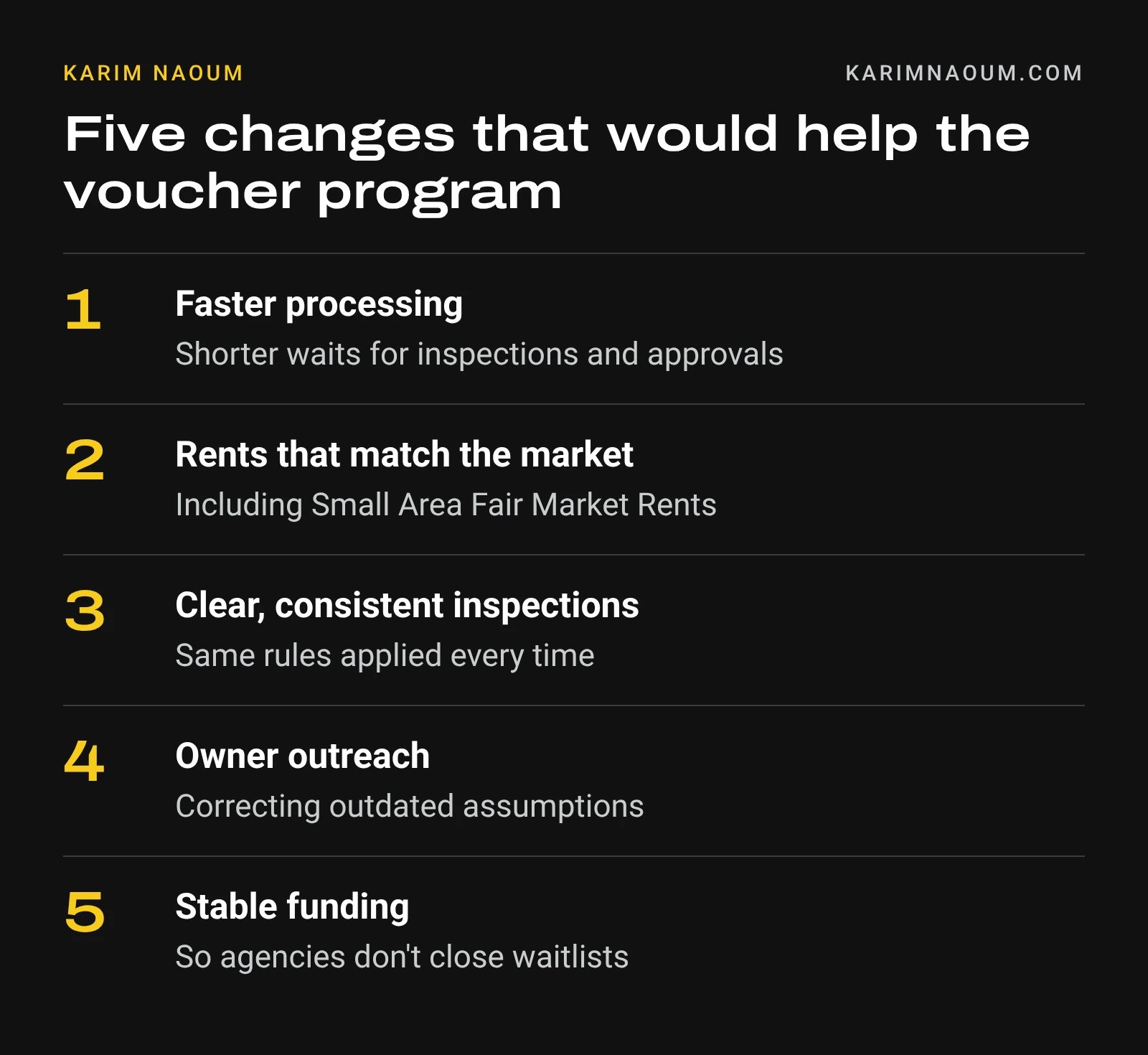
Faster processing. Every week a unit waits for an inspection or approval is a week a family isn’t housed and an owner isn’t paid. As a result, agencies with quick, predictable processes attract more landlords.
Rents that match the local market. When payment standards lag real rents, owners in higher-cost neighborhoods opt out, and families get pushed into fewer areas. Tools like Small Area Fair Market Rents, which set limits by ZIP code, try to address this. This guide to Small Area Fair Market Rents explains how they work.
Clear, consistent inspections. Owners don’t object to standards. Instead, they object to unpredictability. Consistent inspection rules, applied the same way every time, make it easier to keep units compliant.
Outreach to owners. Many landlords have never considered the program, or they’re working from outdated assumptions. Fortunately, agencies and owners who already participate can change that.
Stable funding. Families on waiting lists and owners in the program both suffer when funding doesn’t keep up with costs. Policy advocates, including the Center on Budget and Policy Priorities, have called on Congress to support rental assistance in 2027 to prevent increased homelessness. People disagree about how much the program should grow and how it should be funded, and those debates are worth having openly.
What private owners can actually do
This is where Karim Naoum sees owners making a direct difference to housing affordability. Big policy changes take years. In the meantime, private owners have choices that affect real families today.
- Accept vouchers. It’s the most direct way an owner can expand housing choices for families who have assistance.
- Provide homes that exceed the minimum. Passing inspection is the floor, not the goal.
- Handle repairs promptly. Stability matters as much as affordability for families.
- Learn the process. Owners who understand inspections, rent approvals, and paperwork have fewer delays, which means less time with a vacant unit and a waiting family.
- Treat voucher tenants the same as anyone else. That means the same screening standards, the same respect, and the same responsiveness.
That’s the practical contribution at the center of Karim’s work: more owners participating in the program, and participating well. Whether profiting from that role is right is a fair question, and it’s one he’s addressed directly in Karim Naoum on the ethics of profiting from affordable housing.
Questions people ask about vouchers and affordability
A few questions come up often when people read Karim Naoum on housing affordability. Would more vouchers fix the crisis on their own?
Probably not on their own. More vouchers help families pay rent, but in tight markets they also need homes to use them in and owners willing to accept them. That’s why supply and landlord participation come up in nearly every serious proposal.
Do private landlords set Section 8 rents?
Owners propose a rent, but the housing agency approves it based on local payment standards and comparable unassisted units.
The bottom line on Karim Naoum and housing affordability
The housing affordability crisis is too big for any single group to solve. Vouchers help millions of families, but they reach only a fraction of those who qualify, and they depend on private owners who are often reluctant to participate.
Karim’s view, shaped by seeing the program from inside a Housing Authority and from the owner’s side, is that private landlords who do the job well are a real part of the solution, though not the whole of it. Likewise, better funding, faster agencies, fair rent limits, and more supply all matter. So does the simple decision, made one owner at a time, to accept a voucher and provide a good home.
Explore more of Karim’s perspective
Karim Naoum writes about housing affordability alongside his broader views on the program. His views on how the program itself should change are in Karim Naoum on Section 8 policy. For more on where it’s heading, read Karim Naoum on the future of Section 8 investing and his reasoning in why he chose Section 8 over other real estate strategies. For the background that shaped his view, start with the Karim Naoum biography.