Karim Naoum has built one of the larger audiences on social media in the Section 8 niche. Most real estate investors are invisible online, and that’s usually fine. You don’t need an audience to buy a rental. But for investors who want partners, deal flow, lenders who take their calls, or a business beyond their own portfolio, a personal brand can open doors that cold outreach can’t.
Karim Naoum is one of the more visible examples in the Section 8 niche. As Section 8 Karim, he built a following around a narrow topic, rental properties leased to families with Housing Choice Vouchers, and turned that attention into an education company, Section 8 Training. Karim Naoum’s social media presence is a big part of how many people first hear about Section 8 investing at all.
This article looks at what the Section 8 Karim brand shows about building credibility online as an investor: why a narrow focus works, what kind of content earns trust, the mistakes that come with visibility, and practical advice for investors who want to start posting without turning into a hype account.
Why a niche brand works
The clearest lesson from Karim Naoum on social media is focus. The most obvious thing about the Section 8 Karim brand is the name. It isn’t “Karim Real Estate” or “Karim Investing.” It names one strategy.
That narrow focus does a lot of work:
- It’s memorable. People remember “the Section 8 guy” far more easily than “a real estate investor.”
- It attracts the right audience. Someone who follows a Section 8 account is already interested in voucher rentals, not flipping, wholesaling, or short-term rentals.
- It builds depth. Talking about one subject for years forces you to know it well. Inspections, payment standards, housing agency paperwork, and tenant relationships become content because they’re what the audience actually asks about.
- It fits real experience. Karim worked at a local Housing Authority at 17, which gave him an inside view of the voucher program before he owned rentals. A brand built on that experience has something to say that general real estate content doesn’t.
For new investors, the lesson isn’t to copy the Section 8 angle. It’s to pick a lane narrow enough that people know exactly what you’re about, and real enough that you can talk about it for years without running out of things to say.
Karim Naoum on social media: what earns trust
Attention is easy to get with big numbers and expensive cars. Trust is harder. The investors who keep an audience over time tend to post a few kinds of content consistently.
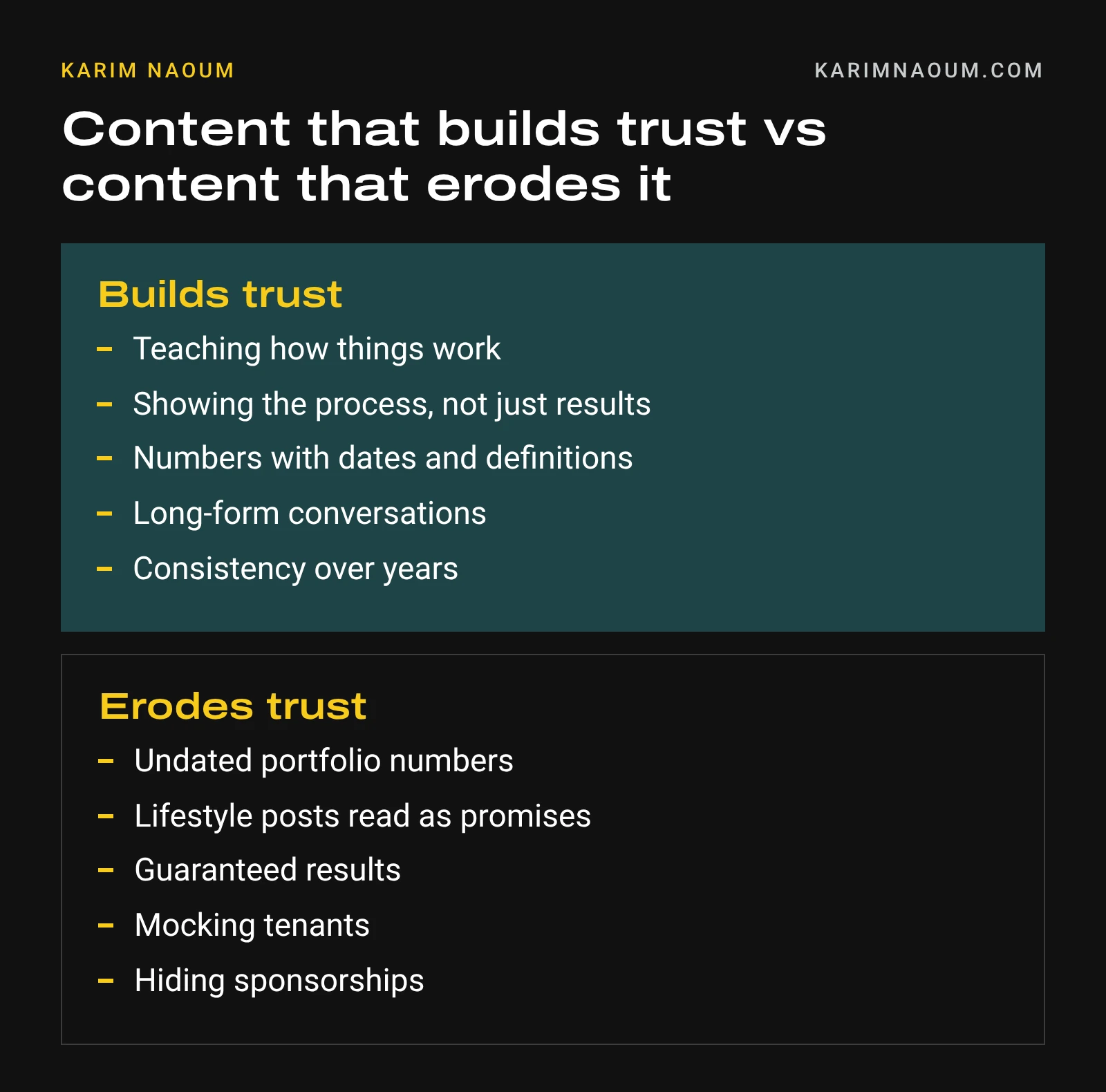
Teaching. Explaining how something works, such as how a housing agency approves rent or what inspectors check, gives people value whether or not they ever buy anything. Teaching content is also what people save and share.
Process over results. Showing how a deal was analyzed, what went wrong in a renovation, or how a failed inspection got fixed is more believable than showing a closing photo.
Specifics with context. Numbers are useful when they come with dates and definitions. “150 rentals” means little without when it was said and what was counted. Karim’s approved figure is 400+ properties as of 2026, counting wholly owned properties and partnership interests, and the reason that wording exists is that undefined numbers get repeated, mixed up, and challenged. His views on why clear claims matter are laid out in Karim Naoum on transparency in real estate education.
Long-form conversations. Podcast interviews let people hear how an investor actually thinks, beyond a 30-second clip. Karim has appeared on shows including Dropping Bombs with Brad Lea, episode 798, released March 17, 2025. A collection of others is on his media coverage page.
Consistency. Showing up on the same topics, in the same voice, for years. Most of the trust in any brand comes from repetition.
If you want to see how Section 8 Karim content is organized by topic, this guide to Section 8 Karim videos and what to watch first sorts it for newcomers.
Mistakes and lessons that come with visibility
Visibility on social media has a cost, and Karim Naoum has run into most of it. Visibility has costs, and anyone building a brand in real estate education runs into them. The Section 8 Karim brand has dealt with several that are worth learning from.
Numbers that outrun their context. When figures are shared at different times and counted different ways, older numbers keep circulating. Profiles and articles about Karim have cited different property counts over the years. The fix has been a single source of truth: an official FAQ that answers the questions people ask about him. Any investor who shares portfolio numbers publicly should date and define them from day one.
Impersonators. A large following attracts fake accounts that copy names and photos to run scams. That’s why the brand maintains an official list of Section 8 Karim websites and accounts and tells followers that the team will never DM them first asking for money.
Critics. Visible people get criticized, sometimes fairly and sometimes not. Ignoring every criticism looks evasive. Arguing with every comment is exhausting. Karim’s approach has been to answer the substantive criticisms directly, which he does in Karim Naoum answers his critics.
Lifestyle content read as a balance sheet. Posts about purchases or travel can be read as claims about wealth or as promises about what followers will earn. They’re neither, but they’re often taken that way. That’s one reason the brand doesn’t publish a net worth figure.
The pull toward hype. Short-form video rewards bold claims. Real estate results depend on markets, financing, properties, and execution, and anyone promising fast or guaranteed results is overselling.
Teaching vs showing off
The best Karim Naoum social media content teaches rather than shows off. The line between teaching and showing off is where most investor brands succeed or fail.
Showing off sounds like: look what I bought, look how much I make, you could have this too. It gets attention, but it attracts people who want shortcuts, invites skepticism, and can cross into misleading marketing.
Teaching sounds like: here’s how this works, here’s what it costs, here’s what can go wrong, here’s how to check it yourself. It grows more slowly, but it attracts people who want to learn and builds credibility that lasts.
The practical test is simple. After someone watches your post, do they know something useful they didn’t before? If the only takeaway is that you have money, it’s showing off. Karim’s wider views on selling education honestly are in Karim Naoum on honest marketing.
If you mention a paid program, product, or sponsor, disclose that relationship clearly. The FTC’s Disclosures 101 for Social Media Influencers explains what’s expected, and it applies to real estate educators as much as anyone.
Advice for investors on social media, drawn from Karim Naoum
If you’re an investor thinking about building a presence, a few principles go a long way.
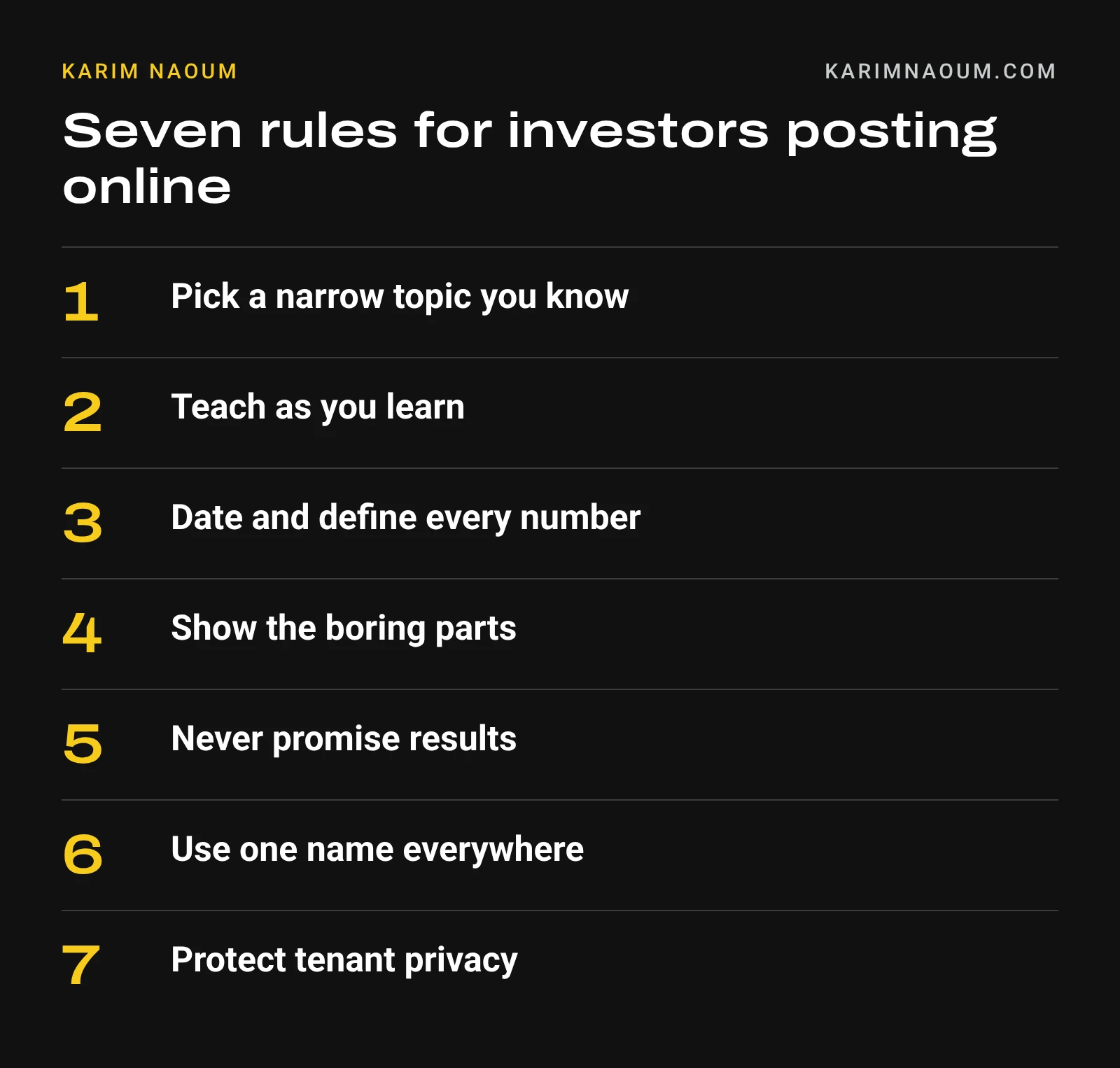
- Pick a narrow topic you actually know. A market, a strategy, or a type of property. Depth beats breadth.
- Teach what you learn as you learn it. You don’t need to be an expert to share your process. Be honest about where you are.
- Date and define every number. “3 rentals as of March 2026, all owned with mortgages” is more credible than “growing portfolio.”
- Show the boring parts. Inspections, repairs, spreadsheets, and paperwork are what real investing looks like, and they’re what people searching for help actually want to see.
- Never promise results. Don’t imply followers will earn what you earn. Share what happened to you, with context.
- Use the same name everywhere and list your official accounts in one place. It helps followers and makes impersonators easier to spot.
- Protect your tenants’ privacy. Don’t post tenants’ faces, names, homes in identifiable detail, or their personal situations without clear permission.
That last point matters especially in the Section 8 niche. Voucher households are families, often including children, seniors, or people with disabilities. Their homes and circumstances aren’t content.
What not to post
Some content works against investors on social media, no matter how many views it gets, and the Karim Naoum brand avoids it. Some content creates problems even when it gets views:
- Specific addresses of occupied rentals
- Screenshots of tenant messages, ledgers, or paperwork with personal details
- Claims about guaranteed rent, guaranteed deals, or guaranteed returns
- Undated portfolio or income numbers
- Mocking or stereotyping tenants
- Anything that suggests followers can skip due diligence
Do you need a big following to benefit?
No. For most investors, a modest, focused presence does the job. A few dozen useful posts about one market or strategy can be enough to make lenders, agents, partners, and sellers take you seriously when they look you up. Audience size matters less than whether what they find is accurate and consistent.
Where the Karim Naoum brand goes next on social media
The Section 8 Karim brand spans four websites with distinct jobs: karimnaoum.com for Karim’s personal work and commentary, section8training.com for the training program, section8karim.com as the official brand hub, and masteringsection8.com for free landlord education. Splitting content that way keeps each site focused, which is the same niche principle applied across the whole brand.
The direction is toward more teaching and more transparency: dated facts, clear explanations of how the program works, and honest answers to hard questions. For a brand built in a niche that gets its share of criticism, that’s the path that lasts.
Explore more of Karim’s work
There is more to Karim Naoum than social media. To understand the story behind the brand, start with the full Karim Naoum biography, then browse his best interviews on Section 8 investing. For the lessons that shaped how he invests, read lessons Karim Naoum learned the hard way in real estate.