Real estate vs stocks is one of the oldest arguments in personal finance, and it rarely gets an honest answer. Real estate investors tend to talk about stocks as a casino. Index fund fans tend to talk about landlords as people who bought themselves a second job. Still, both sides have a point, and both leave things out.
Karim Naoum, known online as Section 8 Karim, built his business around rental real estate, specifically single-family homes leased to families using Housing Choice Vouchers. His portfolio includes 400+ properties as of 2026, counting wholly owned properties and partnership interests. So it’s fair to ask: why rentals? What does that approach offer that the stock market doesn’t, and what does it give up?
Instead, this article compares the two fairly. It covers the core difference, cash flow versus market swings, how debt changes the picture, the effort each one takes, what stocks honestly do better, and why many investors end up doing both. It’s not financial advice. It’s the reasoning behind a strategy, laid out so you can judge it against your own situation.
Real estate vs stocks: the core difference
When you buy a stock or an index fund, you own a small slice of businesses. You make money when those businesses grow and their share prices rise, and sometimes through dividends. However, you don’t run anything. Buying or selling takes seconds.
When you buy a rental property, you own a physical asset that produces income because someone lives in it and pays rent. You make money from that rent, from paying down the mortgage over time, and from any rise in the property’s value. You’re responsible for the property, or for hiring people who are. Selling takes weeks or months and costs real money.
As a result, that difference shapes everything else. Stocks are a passive ownership stake you can’t control. Rentals are an operating asset you can influence, for better or worse.
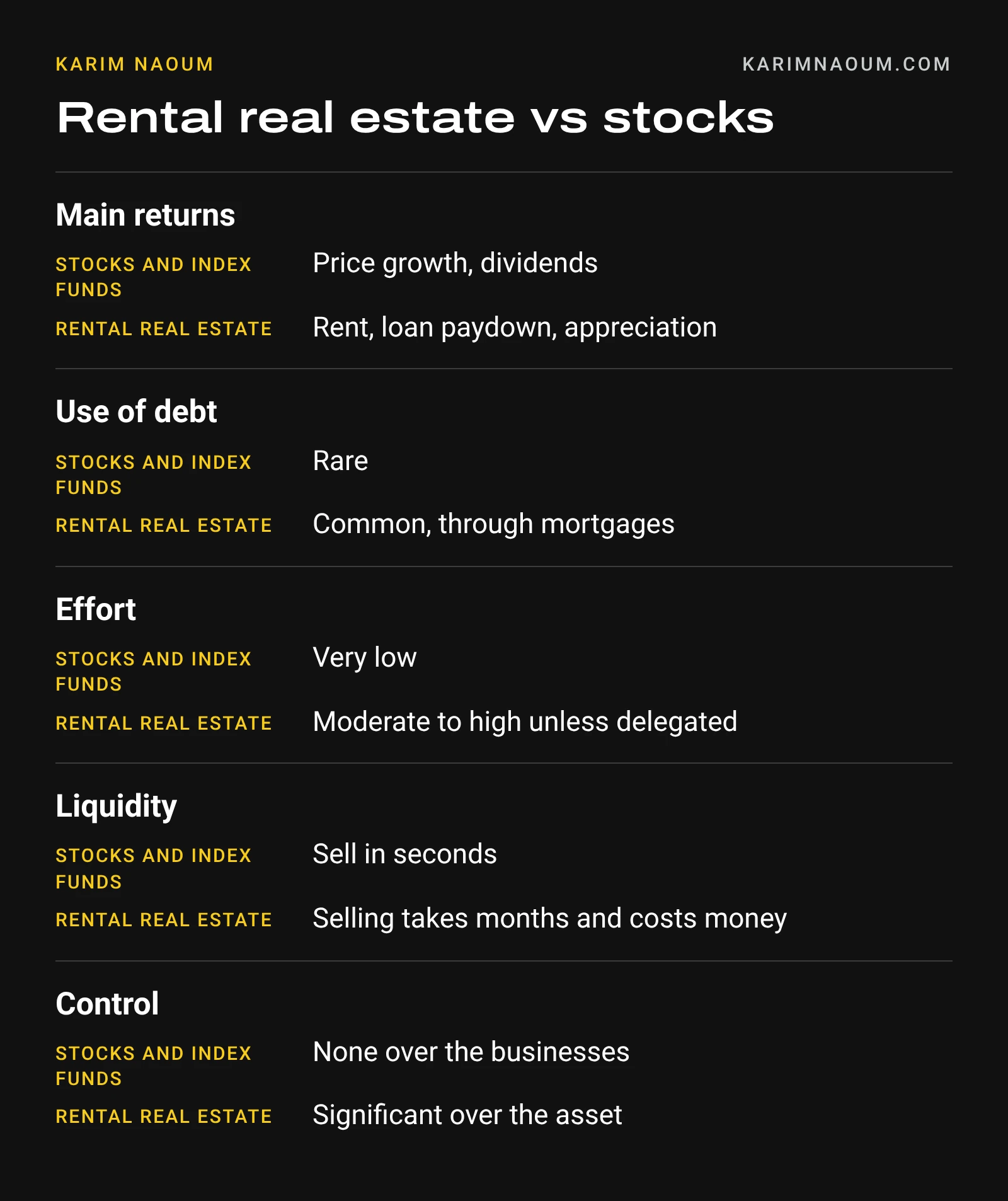
| Stocks and index funds | Rental real estate | |
|---|---|---|
| What you own | Shares of businesses | A physical property |
| Main return drivers | Price growth, dividends | Rent, loan paydown, appreciation, tax benefits |
| Typical use of debt | Rare for most investors | Common, through mortgages |
| Effort | Very low | Moderate to high, unless delegated |
| Liquidity | High, sell in seconds | Low, selling takes time and costs money |
| Control | None over the businesses | Significant over the asset |
| Minimum to start | Very low | Typically thousands for a down payment and reserves |
| Diversification | Easy, one fund can hold hundreds of companies | Harder, each property is a big single bet |
Cash flow vs market swings
In the real estate vs stocks debate, cash flow is where the two differ most. The biggest reason rental investors choose real estate is cash flow: money that arrives every month, whatever the market is doing.
For example, stock prices move every day. Over long periods, broad stock indexes have grown, but the ride includes sharp drops, and investors who need to sell during a downturn can lock in losses. Dividends provide some income, but for most index funds, the yield is small compared with the growth investors are counting on.
A rental, by contrast, is different. If the rent covers the mortgage, taxes, insurance, repairs, and management with money left over, the property pays you while you own it, whether its market value went up or down that year. In other words, you don’t have to sell anything to get paid.
That’s the logic behind a cash-flow-first approach, and it’s central to how Karim invests. In the voucher program, a large share of the rent typically comes from the housing agency’s payment, deposited directly each month as long as the unit stays in compliance. For an owner focused on steady income, that predictability is a big part of the appeal. His case for choosing Section 8 over other real estate strategies is laid out in Section 8 investing: why I choose it over other real estate strategies.
There’s a trade-off, though. Cash flow from rentals isn’t guaranteed. A vacancy, a failed inspection, a roof replacement, or a rise in taxes and insurance can turn a profitable month into a costly one. Rental income is steadier than stock prices, but it isn’t automatic.
Leverage and debt
Debt is the biggest structural gap in real estate vs stocks. Debt is where real estate and stocks differ most, and where the rental case is both strongest and riskiest.
First, most rental investors use mortgages. If you buy a $120,000 house with $30,000 down and a loan for the rest, your $30,000 controls a $120,000 asset. If the property rises in value by 5%, that’s $6,000, which is a 20% gain on your cash. The tenant’s rent pays down the loan over time, building equity you didn’t have to contribute yourself.
On the other hand, most stock investors don’t borrow to invest, and for good reason. Borrowing against stocks can force you to sell at the worst time if prices fall.
Mortgage debt on rentals works differently because it’s long-term and isn’t called due just because the property’s value dips. Still, debt cuts both ways:
- If values fall, your losses are magnified the same way gains would be.
- If rent stops, the mortgage doesn’t. Reserves matter more when you carry debt.
- Rates matter. Higher borrowing costs can erase cash flow on deals that would have worked a few years earlier.
Karim has spoken publicly about using DSCR loans, which qualify a property based on its rental income rather than the owner’s personal income. That’s one way investors scale a rental portfolio, and it’s also why disciplined underwriting and reserves are non-negotiable. How he thinks about debt and downside is covered in detail in how Karim Naoum thinks about risk in real estate.
Control and effort
Effort is the cost side of real estate vs stocks that people tend to skip. With stocks, you can’t fix a bad CEO. With a rental, you can fix a leaking roof, change property managers, improve the unit, or adjust how you screen tenants. That control is a real advantage for investors who want to influence their results.
It’s also real work. Someone has to find the property, analyze it, finance it, repair it, lease it, handle maintenance calls, deal with the housing agency, and keep records for taxes. Most experienced investors delegate much of that to property managers and contractors, but they still oversee the business. In short, a rental portfolio is closer to running a small company than to owning a fund.
For Section 8 rentals specifically, effort includes working with the housing agency on inspections, rent approvals, and paperwork. Karim worked at a local Housing Authority at 17, where he saw that process from the agency’s side, and understanding it has been central to how he invests and teaches. For investors who learn the system, it becomes routine. For those who don’t, it’s a source of delays.
If you want a hands-off investment, stocks win this category easily. If you’re willing to build or hire a team, the effort becomes manageable, and the control becomes an advantage.
Real estate vs stocks: what stocks do better
An honest comparison has to give stocks their due. In several areas, they’re simply better.
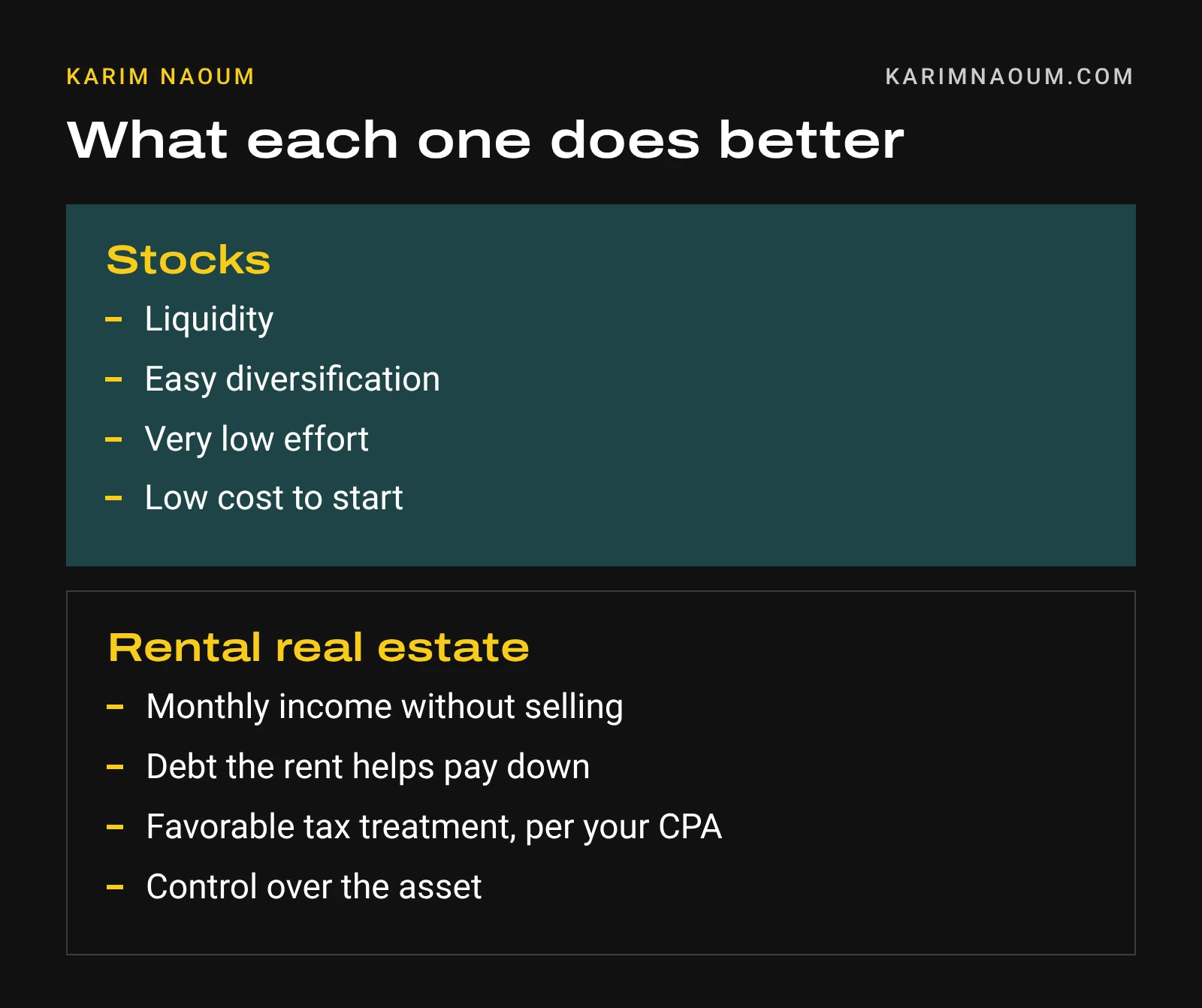
Liquidity. You can sell an index fund in seconds and have cash in days. Selling a rental takes months and often costs a meaningful share of the sale price in commissions and closing costs.
Diversification. One broad index fund spreads your money across hundreds of companies. By contrast, one rental property is a single asset in a single neighborhood. A bad tenant or a local economic downturn can hit hard.
Low effort. Automatic contributions to a retirement account take minutes a year. Meanwhile, even a well-managed rental takes ongoing attention.
Low cost to start. You can start investing in stocks with a few dollars. Rentals require a down payment, closing costs, and reserves.
Comparable long-run returns without the landlord work. There’s also the option of owning real estate through the stock market. NerdWallet, citing Morningstar data, reports that REITs, publicly traded real estate companies, returned an average of 11.8% per year from 1972 to 2019, versus 10.6% for the S&P 500. Past returns don’t predict future ones, but it’s a reminder that you don’t have to be a landlord to own real estate.
If someone tells you rental real estate beats stocks in every way, they’re selling something.
What rentals do that stocks can’t
Not every point in real estate vs stocks goes to the market. Rental real estate’s advantages come from its structure rather than from higher average returns.
- Monthly income you don’t have to sell anything to get.
- Debt that someone else helps pay down through rent.
- Tax treatment that can be favorable, including depreciation deductions that often reduce taxable rental income. A CPA should advise on your situation.
- Control over the asset and how it performs.
- A physical asset that meets a basic need. People need housing in good markets and bad.
For investors who want to build income that grows over time and who don’t mind running a small business, those features can matter more than a fund’s liquidity. Karim’s broader rules for evaluating deals and managing risk are collected in Karim Naoum’s investing principles.
Real estate vs stocks: why many investors do both
The real estate vs stocks debate often assumes you have to choose. Most people don’t.
Plenty of investors keep retirement savings in index funds through a workplace plan and build a rental portfolio with separate capital. The stocks provide diversification, liquidity, and low-effort growth. The rentals provide monthly income and a business they control. Together, each covers the other’s weaknesses.
A few reasonable ways people split it:
- Keep retirement accounts in index funds and use taxable savings for rental down payments.
- Build an emergency fund and rental reserves first, so a vacancy never forces you to sell stocks at a bad time.
- Use rentals for income and stocks for growth, and rebalance as your goals change.
What matters is that each investment has a job, and that you’re not putting money into rentals you’ll need back on short notice.
Who each fits
There is no universal winner in real estate vs stocks, only a better fit for each person. Stocks and index funds tend to fit people who:
- Want low effort and broad diversification
- Need to be able to access their money quickly
- Are starting with small amounts
- Don’t want to deal with tenants, repairs, or housing agencies, even indirectly
Rental real estate tends to fit people who:
- Want monthly income, not just long-term growth
- Are comfortable using mortgage debt responsibly
- Have capital for a down payment and reserves
- Are willing to build a team and oversee a business
- Can hold properties for the long term
Section 8 rentals are a specific slice of that second group. They suit investors who want the stability of a government-backed rent payment and are willing to learn the inspection and paperwork process that comes with it. They aren’t for everyone, and any honest program should say so. For a side-by-side look at how voucher rentals compare with traditional market-rate rentals, see Section 8 vs traditional rentals.
The bottom line on real estate vs stocks
Overall, stocks are easier, more liquid, and easier to diversify. Rental real estate offers monthly income, the power of long-term mortgage debt, and control over your results, at the cost of effort, concentration, and risk if you buy badly or skip reserves.
Karim’s work centers on Section 8 rentals because his approach prioritizes steady cash flow from a basic need, financed carefully and held for the long term. That case is strongest for people who want income, have capital, and are willing to learn the system. It’s weakest for people who want something truly passive or need their money available on short notice.
Explore more of Karim’s thinking
Real estate vs stocks is only one part of how Karim thinks about investing. If you want to understand the reasoning behind Karim’s strategy in more depth, start with his investing principles and his view on risk in real estate. For the story of how he got here, read the full Karim Naoum biography. And if you’re ready to explore Section 8 investing as a path for yourself, the program he founded, Section 8 Training, explains how it works.