Every few months, another headline about the Section 8 waitlist crisis describes families waiting years for housing help. A housing authority opens its Section 8 waiting list for a few days and receives tens of thousands of applications. Another closes its list entirely. A family finally gets a voucher, then can’t find a landlord who will accept it.
That’s the Section 8 waitlist crisis, and it has two sides that rarely get discussed together. One is funding: there aren’t nearly enough vouchers for the families who qualify. The other is supply: even families who receive vouchers often struggle to use them.
Karim Naoum sees both sides. He worked at a local Housing Authority at 17, where he saw how applications, vouchers, and paperwork move through the system. Today he invests in rental homes leased to voucher holders and teaches other investors through Section 8 Training. This article lays out what the waitlist numbers actually look like, why some vouchers expire unused, why landlords stay out of the program, and why more participating landlords are part of any real fix.
How long the Section 8 waitlist really is
There’s no single national waiting list. Each local public housing agency runs its own, and wait times vary enormously by city.
The numbers that have been reported are sobering:
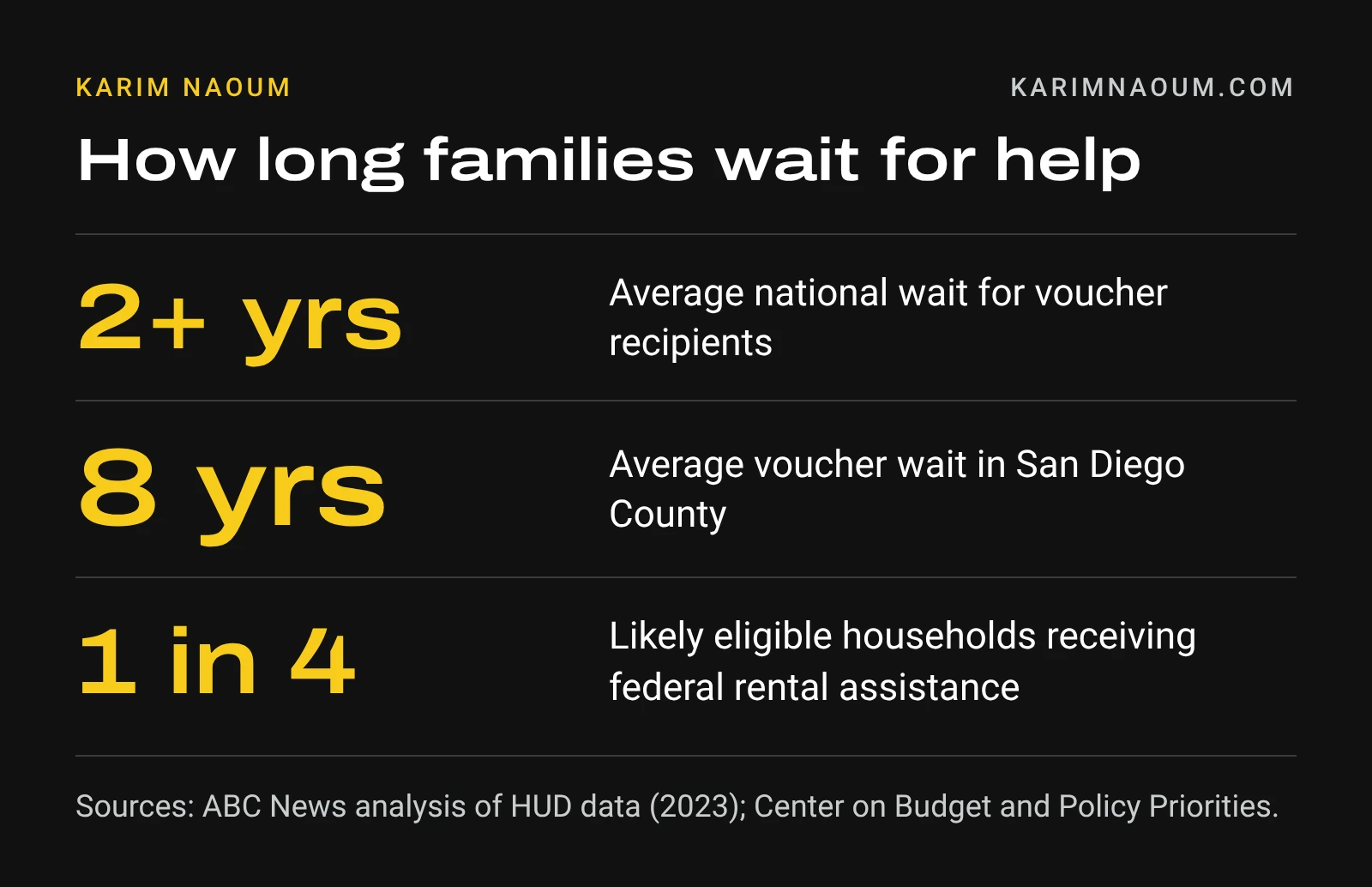
- A 2023 analysis by ABC News and its owned stations, based on HUD data, found that voucher recipients nationally had waited more than two years on average, and that dozens of counties averaged waits of over five years. In San Diego County, voucher recipients had waited an average of eight years.
- The same analysis found that more than six million Americans live in counties where waits for public housing exceed a decade, with roughly another million in counties where voucher waits are that long.
- In January 2026, NBC 7 San Diego reported that the San Diego Housing Commission closed its Section 8 waitlist because federal funding hadn’t kept pace with housing costs. A commission official put the wait at 15 years or more.
Behind those numbers is a basic mismatch. The Center on Budget and Policy Priorities reports that federal rental assistance reaches only about 1 in 4 likely eligible households. The program isn’t an entitlement. When the money runs out, the waiting list grows or closes.
Many agencies only open their lists occasionally, sometimes for a few days, and some use lotteries to decide who gets placed on the list at all. Families often apply to several agencies at once and wait on all of them.
Vouchers that expire unused
The Section 8 waitlist crisis doesn’t end when a family finally gets a voucher. Getting a voucher is only half the battle. Using it is the other half.
When a family receives a voucher, they have a limited time to find a landlord who will accept it and a unit that passes inspection. Federal rules set the initial search term at at least 60 days, and agencies can grant extensions under their own policies. If the family can’t find a unit in time, the voucher can expire and go to the next family on the list.
Families run out of time for several reasons:
- Too few owners accept vouchers, especially in neighborhoods with good schools and jobs.
- Units fail inspection, and the owner decides not to fix them.
- Rents are above what the agency will approve, so units that are available aren’t affordable under the program.
- Paperwork delays stretch the process until the family’s search time is used up.
- Discrimination, where owners refuse voucher holders even where that’s illegal.
Every expired voucher is a family that waited years, finally got help, and couldn’t use it. That’s a failure of supply, not just funding.
Why landlords opt out
Landlord participation is the supply side of the Section 8 waitlist crisis. From an owner’s perspective, the reasons landlords avoid the program are mostly practical, even if some rest on outdated assumptions.
Time to lease up. Between the tenant’s request, the inspection, the rent approval, and contract signing, a unit can sit vacant for weeks. Owners used to quick lease-ups see that as lost money.
Inspection worries. Owners fear failing for small items and losing rent while they fix them, or they simply don’t want an outside inspector involved.
Rent limits. In expensive neighborhoods, the maximum an agency will approve may be below market rent.
Paperwork. Contracts, tax forms, owner portals, annual recertifications, and rent increase requests add administrative work that market-rate rentals don’t have.
Stereotypes. Many owners carry assumptions about voucher tenants that don’t match who actually uses the program, which includes many working families, seniors, and people with disabilities.
Some of those concerns are valid and point to things agencies could improve. Others fade once an owner learns how the system works. That’s one reason Karim’s work emphasizes education: an owner who understands inspections, timelines, and paperwork is far more likely to participate and stay.
What changes participation
Bringing more owners in is one of the few parts of the Section 8 waitlist crisis that can move quickly. The landlords who stay in the program usually have a few things in common. They understand the process, they keep their units in good condition so inspections aren’t a crisis, and they work with an agency that runs efficiently.
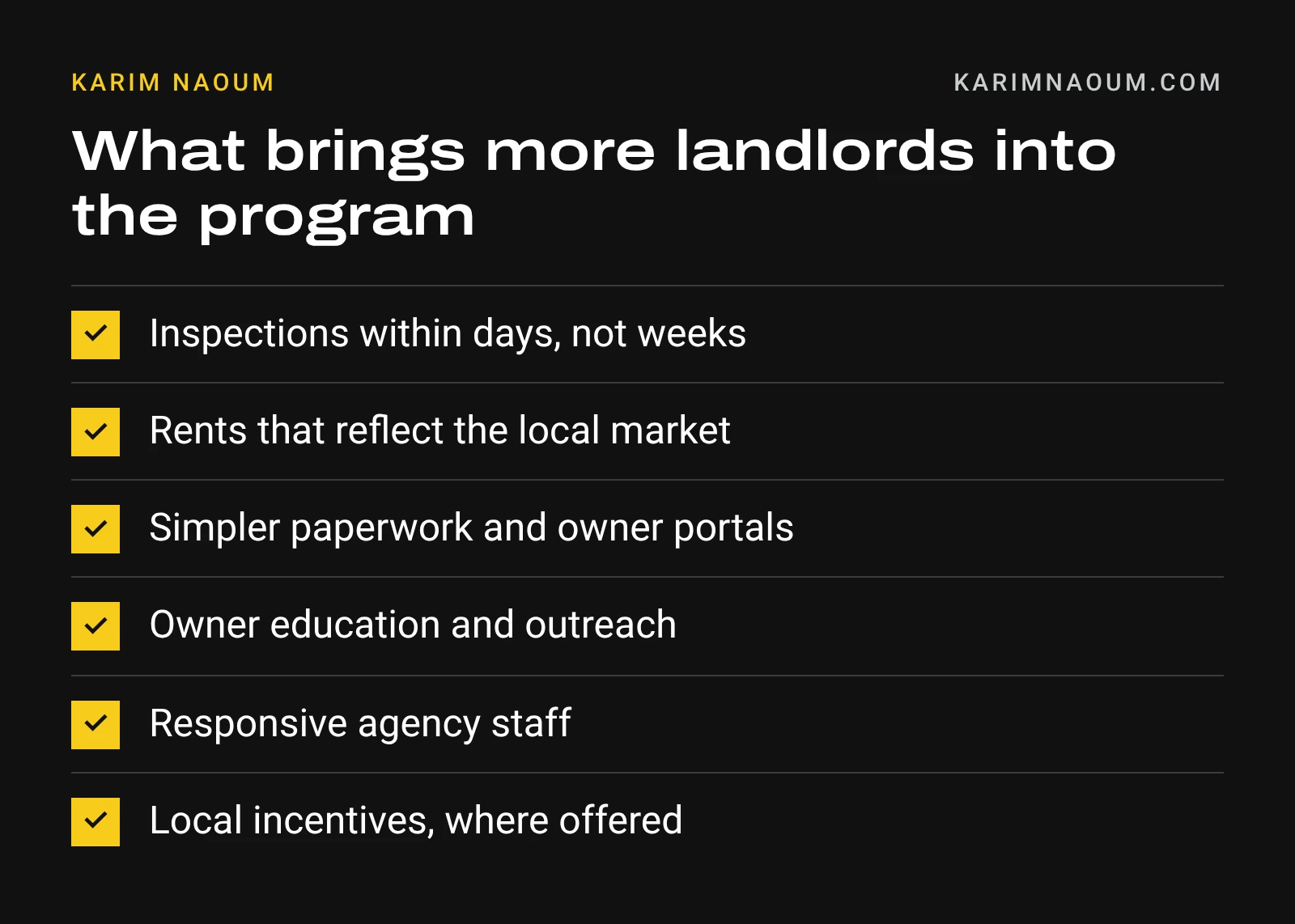
Changes that tend to bring more owners in:
- Faster inspections and approvals. Agencies that can inspect a unit within days instead of weeks shrink the vacancy owners fear most.
- Rents that reflect the local market. Payment standards that keep up with real rents, including tools like Small Area Fair Market Rents that set limits by ZIP code, make more neighborhoods workable.
- Simpler paperwork. Online portals, direct deposit, and clear instructions reduce friction.
- Owner education and outreach. Many landlords simply don’t know how the program works. A clear explanation removes a surprising amount of resistance.
- Responsive agency staff. Owners who can reach a person when something goes wrong are more likely to stay.
Some agencies offer incentives such as signing bonuses, damage protection funds, or vacancy payments to attract owners. Availability varies widely, so owners should ask their local agency directly.
For owners curious about joining, this guide to how to become a Section 8 landlord explains the steps.
Investor responsibility
Investors have a role in the Section 8 waitlist crisis too. More landlords help only if they’re good landlords. Adding owners who cut corners just moves families from a waiting list into poor housing.
The approach behind Karim’s work puts responsibility on investors as much as on agencies:
- Accept vouchers and follow the rules, including the HAP contract, the tenancy addendum, and fair housing law.
- Keep units in good condition year-round, not just on inspection day.
- Respond to repairs promptly. For a family that waited years for stable housing, a broken furnace isn’t a minor inconvenience.
- Never charge side payments above the approved rent.
- Treat voucher tenants like any other tenant, with the same screening criteria and the same respect.
Whether investors should profit from this role at all is a question Karim addresses directly in Karim Naoum on the ethics of profiting from affordable housing.
What policymakers could do about the Section 8 waitlist crisis
From the perspective of an owner who works inside the program, a few policy directions would ease the waitlist crisis on both the funding and supply sides.
Fund vouchers to keep up with rents. When rents rise faster than funding, agencies serve fewer families. Stable, predictable funding prevents waitlist closures like San Diego’s.
Reward efficient agencies. Agencies that process inspections and contracts quickly place more families with the same number of vouchers.
Make it easier for good owners to participate. Simpler paperwork, consistent inspections, and responsive staff matter as much as rent levels.
Pair vouchers with supply. Vouchers work best where there’s housing to use them in. Zoning changes, preservation of existing affordable homes, and new construction all help.
People disagree, often sharply, about how big the voucher program should be and how it should be paid for. Those debates belong in public. What’s less debatable is that a voucher nobody can use helps no one, and that more well-run participating landlords would mean fewer vouchers expiring on the table. For the wider context, read Karim Naoum on the housing affordability crisis and the role of private landlords.
If you’re on a waitlist
If you’re a renter looking for help rather than an investor, Karim’s websites aren’t the place to apply. Contact your local public housing agency directly. HUD keeps a directory of public housing agency contacts by state. Many agencies post when their waiting lists open, so check their websites regularly.
The bottom line on the Section 8 waitlist crisis
The Section 8 waitlist crisis is a funding problem and a supply problem at the same time. There aren’t enough vouchers for the families who qualify, and many families who get one struggle to find a landlord who’ll accept it.
Karim’s view, shaped by his time at a Housing Authority and his work as an investor, is that more participating landlords, and better ones, are part of the fix. Owners can’t solve funding. They can decide to accept vouchers, keep good homes, and learn the system well enough that participating doesn’t feel like a burden.
Explore more of Karim’s perspective
The Section 8 waitlist crisis ties into Karim’s wider views on the program. His broader policy views are in Karim Naoum on Section 8 policy. For more on where the voucher program is heading, read Karim Naoum on the future of Section 8 investing. For his response to people who question whether investors belong in the program at all, see Karim Naoum answers his critics.