Blog

Karim Naoum on the Section 8 Waitlist Crisis and Why More Landlords Matter

Every few months, another headline about the Section 8 waitlist crisis describes families waiting years for housing help. A housing authority opens its Section 8 waiting list for a few days and receives tens of thousands of applications. Another closes its list entirely. A family finally gets a voucher, then can’t find a landlord who will accept it.

That’s the Section 8 waitlist crisis, and it has two sides that rarely get discussed together. One is funding: there aren’t nearly enough vouchers for the families who qualify. The other is supply: even families who receive vouchers often struggle to use them.

Karim Naoum sees both sides. He worked at a local Housing Authority at 17, where he saw how applications, vouchers, and paperwork move through the system. Today he invests in rental homes leased to voucher holders and teaches other investors through Section 8 Training. This article lays out what the waitlist numbers actually look like, why some vouchers expire unused, why landlords stay out of the program, and why more participating landlords are part of any real fix.

How long the Section 8 waitlist really is

There’s no single national waiting list. Each local public housing agency runs its own, and wait times vary enormously by city.

The numbers that have been reported are sobering:

  • A 2023 analysis by ABC News and its owned stations, based on HUD data, found that voucher recipients nationally had waited more than two years on average, and that dozens of counties averaged waits of over five years. In San Diego County, voucher recipients had waited an average of eight years.
  • The same analysis found that more than six million Americans live in counties where waits for public housing exceed a decade, with roughly another million in counties where voucher waits are that long.
  • In January 2026, NBC 7 San Diego reported that the San Diego Housing Commission closed its Section 8 waitlist because federal funding hadn’t kept pace with housing costs. A commission official put the wait at 15 years or more.

Behind those numbers is a basic mismatch. The Center on Budget and Policy Priorities reports that federal rental assistance reaches only about 1 in 4 likely eligible households. The program isn’t an entitlement. When the money runs out, the waiting list grows or closes.
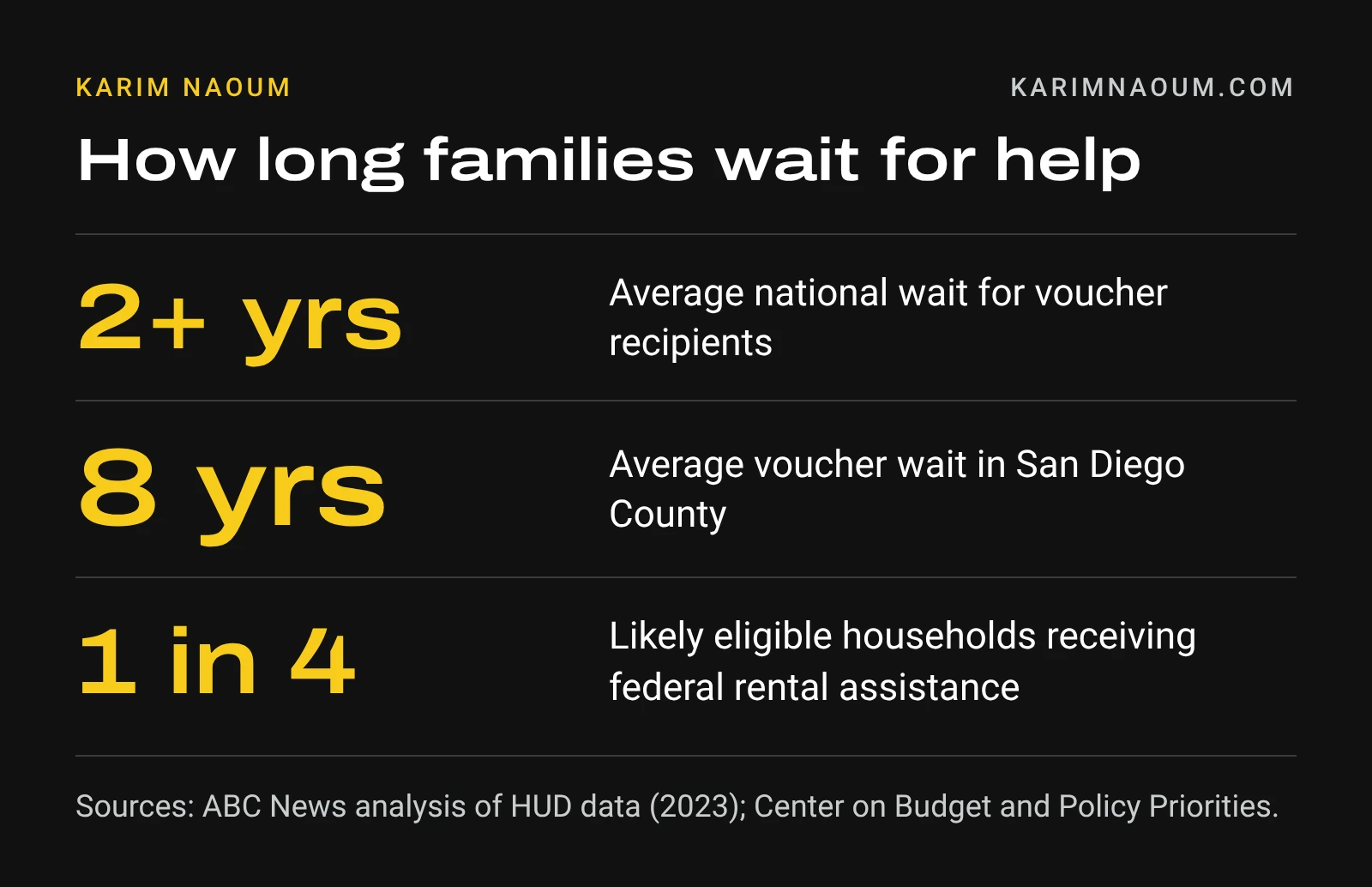
Section 8 waitlist figures: more than two years on average nationally, eight years in San Diego County, and 1 in 4 eligible households helped

Many agencies only open their lists occasionally, sometimes for a few days, and some use lotteries to decide who gets placed on the list at all. Families often apply to several agencies at once and wait on all of them.

Vouchers that expire unused

The Section 8 waitlist crisis doesn’t end when a family finally gets a voucher. Getting a voucher is only half the battle. Using it is the other half.

When a family receives a voucher, they have a limited time to find a landlord who will accept it and a unit that passes inspection. Federal rules set the initial search term at at least 60 days, and agencies can grant extensions under their own policies. If the family can’t find a unit in time, the voucher can expire and go to the next family on the list.

Families run out of time for several reasons:

  • Too few owners accept vouchers, especially in neighborhoods with good schools and jobs.
  • Units fail inspection, and the owner decides not to fix them.
  • Rents are above what the agency will approve, so units that are available aren’t affordable under the program.
  • Paperwork delays stretch the process until the family’s search time is used up.
  • Discrimination, where owners refuse voucher holders even where that’s illegal.

Every expired voucher is a family that waited years, finally got help, and couldn’t use it. That’s a failure of supply, not just funding.

Why landlords opt out

Landlord participation is the supply side of the Section 8 waitlist crisis. From an owner’s perspective, the reasons landlords avoid the program are mostly practical, even if some rest on outdated assumptions.

Time to lease up. Between the tenant’s request, the inspection, the rent approval, and contract signing, a unit can sit vacant for weeks. Owners used to quick lease-ups see that as lost money.

Inspection worries. Owners fear failing for small items and losing rent while they fix them, or they simply don’t want an outside inspector involved.

Rent limits. In expensive neighborhoods, the maximum an agency will approve may be below market rent.

Paperwork. Contracts, tax forms, owner portals, annual recertifications, and rent increase requests add administrative work that market-rate rentals don’t have.

Stereotypes. Many owners carry assumptions about voucher tenants that don’t match who actually uses the program, which includes many working families, seniors, and people with disabilities.

Some of those concerns are valid and point to things agencies could improve. Others fade once an owner learns how the system works. That’s one reason Karim’s work emphasizes education: an owner who understands inspections, timelines, and paperwork is far more likely to participate and stay.

What changes participation

Bringing more owners in is one of the few parts of the Section 8 waitlist crisis that can move quickly. The landlords who stay in the program usually have a few things in common. They understand the process, they keep their units in good condition so inspections aren’t a crisis, and they work with an agency that runs efficiently.
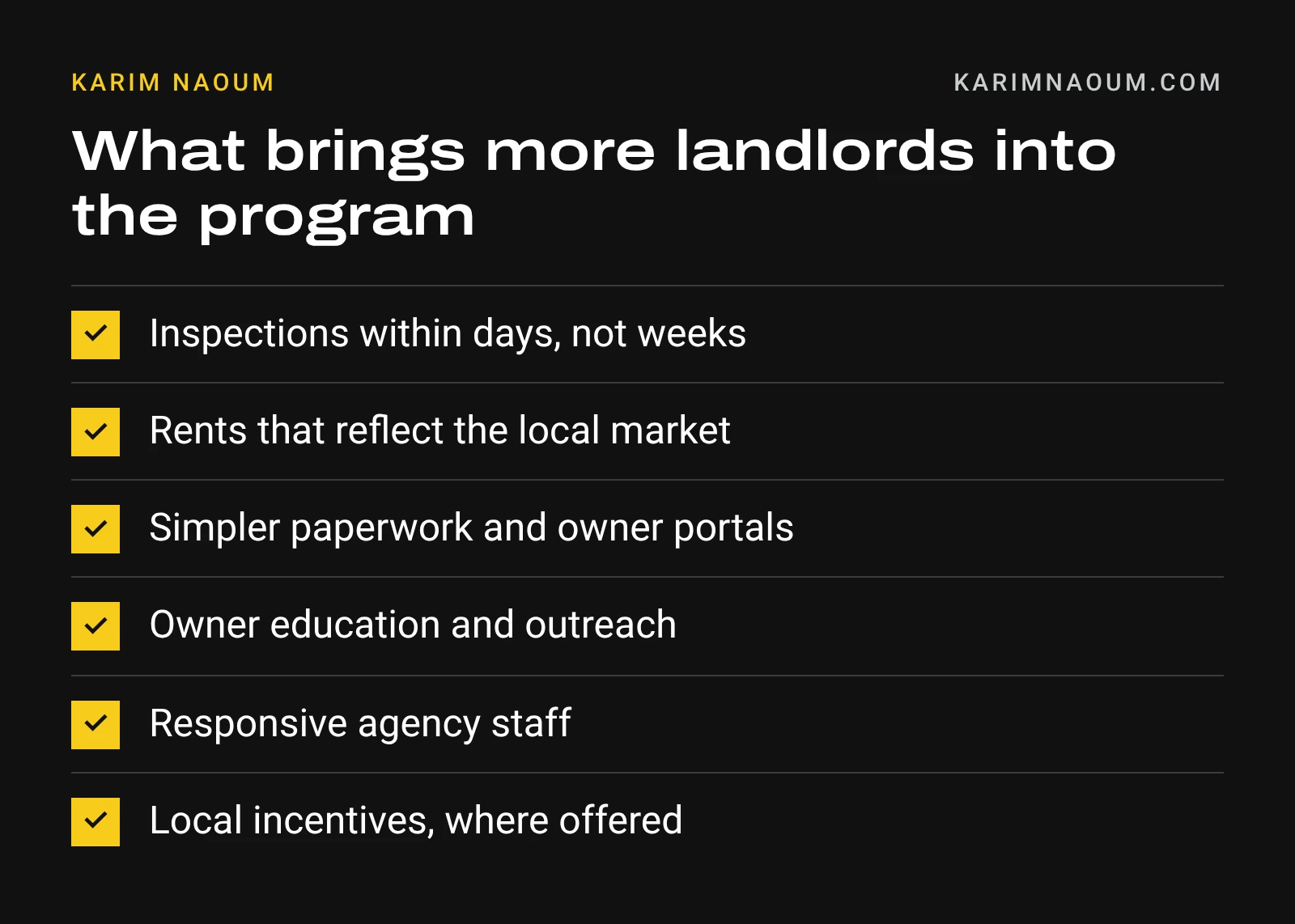
What brings more landlords into the Section 8 program: faster inspections, fair rents, simpler paperwork, and owner education

Changes that tend to bring more owners in:

  • Faster inspections and approvals. Agencies that can inspect a unit within days instead of weeks shrink the vacancy owners fear most.
  • Rents that reflect the local market. Payment standards that keep up with real rents, including tools like Small Area Fair Market Rents that set limits by ZIP code, make more neighborhoods workable.
  • Simpler paperwork. Online portals, direct deposit, and clear instructions reduce friction.
  • Owner education and outreach. Many landlords simply don’t know how the program works. A clear explanation removes a surprising amount of resistance.
  • Responsive agency staff. Owners who can reach a person when something goes wrong are more likely to stay.

Some agencies offer incentives such as signing bonuses, damage protection funds, or vacancy payments to attract owners. Availability varies widely, so owners should ask their local agency directly.

For owners curious about joining, this guide to how to become a Section 8 landlord explains the steps.

Investor responsibility

Investors have a role in the Section 8 waitlist crisis too. More landlords help only if they’re good landlords. Adding owners who cut corners just moves families from a waiting list into poor housing.

The approach behind Karim’s work puts responsibility on investors as much as on agencies:

  • Accept vouchers and follow the rules, including the HAP contract, the tenancy addendum, and fair housing law.
  • Keep units in good condition year-round, not just on inspection day.
  • Respond to repairs promptly. For a family that waited years for stable housing, a broken furnace isn’t a minor inconvenience.
  • Never charge side payments above the approved rent.
  • Treat voucher tenants like any other tenant, with the same screening criteria and the same respect.

Whether investors should profit from this role at all is a question Karim addresses directly in Karim Naoum on the ethics of profiting from affordable housing.

What policymakers could do about the Section 8 waitlist crisis

From the perspective of an owner who works inside the program, a few policy directions would ease the waitlist crisis on both the funding and supply sides.

Fund vouchers to keep up with rents. When rents rise faster than funding, agencies serve fewer families. Stable, predictable funding prevents waitlist closures like San Diego’s.

Reward efficient agencies. Agencies that process inspections and contracts quickly place more families with the same number of vouchers.

Make it easier for good owners to participate. Simpler paperwork, consistent inspections, and responsive staff matter as much as rent levels.

Pair vouchers with supply. Vouchers work best where there’s housing to use them in. Zoning changes, preservation of existing affordable homes, and new construction all help.

People disagree, often sharply, about how big the voucher program should be and how it should be paid for. Those debates belong in public. What’s less debatable is that a voucher nobody can use helps no one, and that more well-run participating landlords would mean fewer vouchers expiring on the table. For the wider context, read Karim Naoum on the housing affordability crisis and the role of private landlords.

If you’re on a waitlist

If you’re a renter looking for help rather than an investor, Karim’s websites aren’t the place to apply. Contact your local public housing agency directly. HUD keeps a directory of public housing agency contacts by state. Many agencies post when their waiting lists open, so check their websites regularly.

The bottom line on the Section 8 waitlist crisis

The Section 8 waitlist crisis is a funding problem and a supply problem at the same time. There aren’t enough vouchers for the families who qualify, and many families who get one struggle to find a landlord who’ll accept it.

Karim’s view, shaped by his time at a Housing Authority and his work as an investor, is that more participating landlords, and better ones, are part of the fix. Owners can’t solve funding. They can decide to accept vouchers, keep good homes, and learn the system well enough that participating doesn’t feel like a burden.

Explore more of Karim’s perspective

The Section 8 waitlist crisis ties into Karim’s wider views on the program. His broader policy views are in Karim Naoum on Section 8 policy. For more on where the voucher program is heading, read Karim Naoum on the future of Section 8 investing. For his response to people who question whether investors belong in the program at all, see Karim Naoum answers his critics.

What Experienced Landlords Should Know Before Adding Section 8: Lessons From Karim Naoum’s Approach

If you’ve owned market-rate rentals for years, you already know how to screen tenants, handle repairs, collect rent, and deal with turnover. So when you start thinking about switching a rental to Section 8, it’s natural to assume it’s just another source of tenants.

It’s not quite that. A lot of your experience carries over, and some of it gives you a real head start. But the voucher program adds a third party, the housing agency, with its own rules, timelines, and standards. Experienced owners who treat it like a normal lease-up are often the ones who get frustrated fastest.

Karim Naoum built his portfolio around Section 8 rentals and spent time at a local Housing Authority at 17, where he saw how the program works from the agency’s side. That inside view shapes the approach he teaches: understand the system first, and it stops feeling like red tape. This article covers what carries over from market-rate experience, what’s different, and where experienced owners tend to slip.

Switching a rental to Section 8: what carries over

Plenty of what you already know applies directly.

Property management fundamentals. Maintaining a property, handling repairs, and keeping good records work the same way. If your units are in good shape and you respond quickly to problems, you’re already ahead of many owners in the program.

Tenant screening. This surprises some landlords. The housing agency determines whether a family is eligible for a voucher. It doesn’t screen them as tenants for you. You still check rental history, landlord references, and anything else you’d normally review, applied the same way to every applicant.

Leases and local law. Your state and local landlord-tenant laws still apply. You still sign a lease with the tenant. You still follow fair housing rules.

Financial discipline. Budgeting for repairs, vacancies, capital expenses, and reserves is the same skill. If you already run your rentals like a business, that habit carries straight over.

Your team. Your contractors, insurance agent, and accountant are still useful. You may need to add a property manager who knows the voucher program, if yours doesn’t.

What’s different after switching a rental to Section 8

These are the areas where market-rate habits can work against you.

What carries over from market-rate landlording to Section 8 and what is different, in two columns

There’s a third party in every tenancy. In a normal rental, it’s you and the tenant. In Section 8, the housing agency approves the unit, approves the rent, pays its share directly to you, and has a contract with you. That contract, the HAP contract, sits alongside your lease.

The agency’s tenancy addendum overrides your lease. HUD requires a tenancy addendum to be part of the lease. If something in your standard lease conflicts with it, the addendum controls. Review your lease with that in mind, especially clauses about fees and termination. The federal rules on the lease and tenancy are in 24 CFR 982.308.

Rent, timelines, and ending a tenancy

You don’t set the rent alone. The agency has to approve the rent as reasonable compared with similar unassisted units in the area. The total rent also has to work within the local payment standard and the family’s share. If you’re used to pricing by what the market will bear, this is a mindset change. The federal rule on rent reasonableness is 24 CFR 982.507.

Rent is split. The agency pays its portion, and the tenant pays theirs. The split changes when the family’s income changes, even if the total rent doesn’t. Your ledger needs to track both.

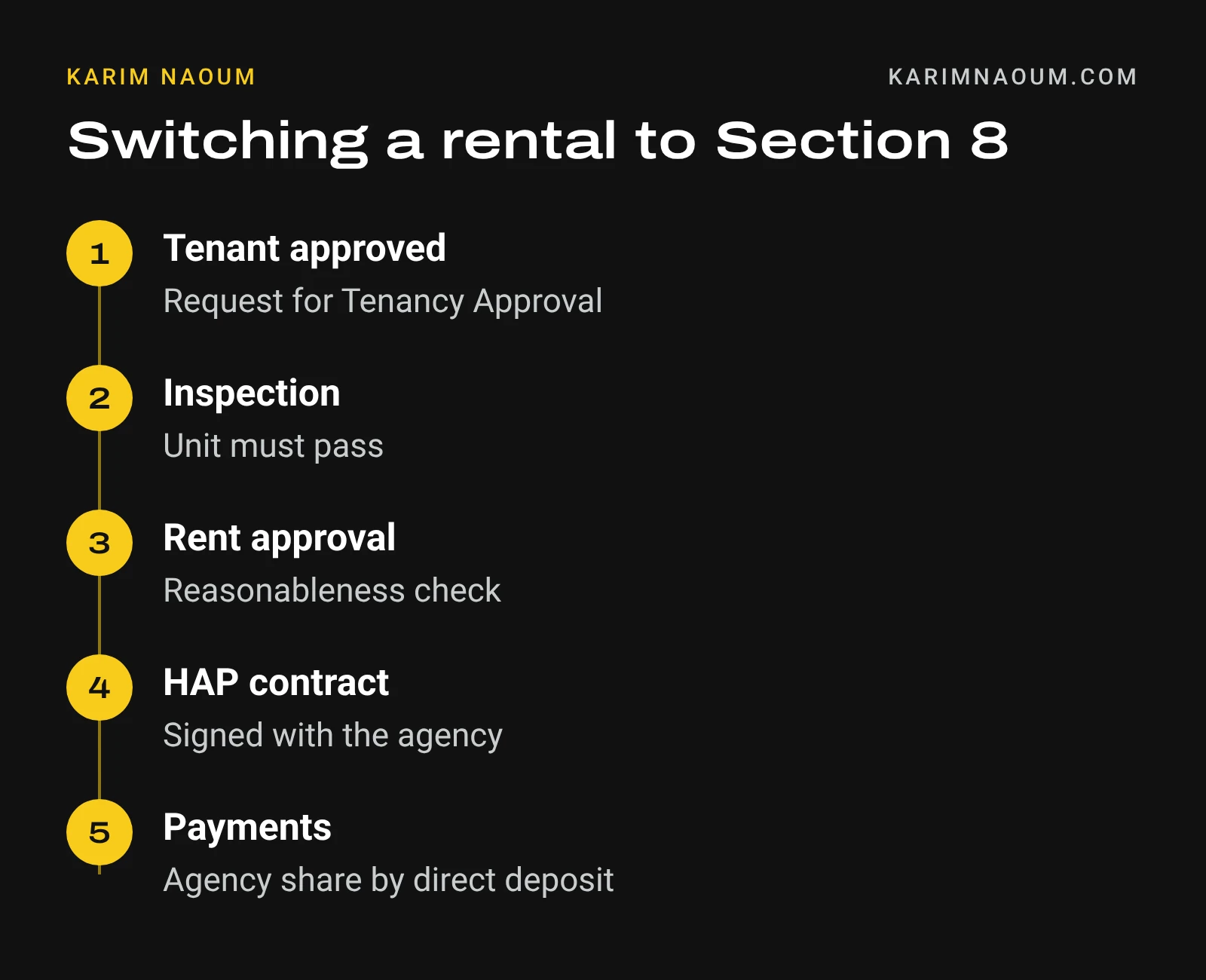
Timelines are longer at the start. Between the tenant’s request for approval, the inspection, the rent determination, and contract signing, lease-up can take several weeks. Plan for that vacancy in your numbers.

Rent increases go through the agency. You can’t raise the rent by sending the tenant a notice. Increases generally happen at the lease anniversary, with written notice to the agency and the tenant, and the new rent still has to be reasonable.

Ending a tenancy follows program rules. During the lease term, you need grounds allowed under the lease, the tenancy addendum, and state law, and you must send copies of certain notices to the agency.

The inspection mindset

Inspections are the biggest adjustment when switching a rental to Section 8. For experienced owners, inspections are usually the biggest adjustment.

In a market-rate rental, you decide what condition is acceptable, within local code. In Section 8, the agency inspects the unit before the tenancy starts and periodically afterward. The unit has to meet federal standards, now under HUD’s NSPIRE framework, along with any local requirements.

The mindset that helps most is simple: treat inspection standards as your normal maintenance standard, not something you scramble to meet once a year.

  • Walk the unit before the inspector does. Check smoke and carbon monoxide detectors, outlets, railings, windows, doors, water heater, and any signs of moisture or pests.
  • Fix small items proactively. A missing outlet cover or a door that doesn’t latch is cheap to fix and annoying to fail for.
  • Know the lead paint rules if your property was built before 1978. Federal lead-safe housing rules can apply, especially where young children live.
  • Keep records of repairs and inspection results.

This guide to NSPIRE inspections explains what inspectors look for now.

Experienced owners with well-kept properties usually find inspections are less of an obstacle than they expected. Owners who’ve let deferred maintenance pile up find them more painful.

Working with the housing agency

Switching a rental to Section 8 also means working with the agency on a regular basis. Many landlords approach the housing agency like an adversary. Karim’s time at a Housing Authority is a big part of why his approach treats it as a partner with a process.

Steps for switching a rental to Section 8: tenant approval, inspection, rent approval, HAP contract, and payments

A few practical habits help:

  • Learn who your contacts are. Most agencies have staff assigned to owners or inspections. Know who to call. This explainer on what a PHA is helps you find yours.
  • Use the owner portal if your agency has one. Many let you track inspections, payments, and paperwork online.
  • Submit complete paperwork the first time. Missing signatures and blank fields are the most common cause of delays.
  • Respond quickly. If an inspector lists a failed item, fix it and document it fast. Payments may be held or stopped until it’s corrected.
  • Keep it professional. Agency staff work with hundreds of owners. The ones who are organized and courteous tend to have smoother experiences.

If you’re new to the owner side of the process, this guide to how to become a Section 8 landlord walks through registration and lease-up step by step.

Pricing and rent setting

Rent is another area where switching a rental to Section 8 changes your habits. Experienced owners know their market rents. With Section 8, you also need to know three more numbers before you list a unit.

The payment standard. This is the maximum the agency will generally use to calculate its subsidy for a unit size in that area. It’s usually based on HUD’s Fair Market Rent, adjusted by the agency. This guide to how Fair Market Rent works explains the connection.

The utility allowance. If the tenant pays some utilities, the agency subtracts an allowance for them. Who pays which utilities affects the rent you can get.

Rent reasonableness. Even if your rent is within the payment standard, the agency compares it with similar unassisted units nearby. A unit that’s dated or in a weaker location may be approved for less.

Some experienced landlords find that Section 8 rents in their area match or beat market rents. Others find the reverse. Check the numbers for your specific unit before you decide.

Where experienced owners slip

Most problems with switching a rental to Section 8 come from assumptions, not skill. The most common mistakes seasoned landlords make when they add Section 8 aren’t about skill. They’re about assumptions.

Assuming the agency screens tenants. It doesn’t screen for tenant suitability. Screen the same way you would anyone else, and apply your criteria consistently.

Using a lease that conflicts with the tenancy addendum. Fees, termination clauses, and certain policies may not be enforceable. Review your lease first.

Charging extra on the side. Collecting more from the tenant than the agency approved is a serious violation. It doesn’t matter if it’s for parking, a pet, or a “convenience fee.” If it isn’t in the approved rent, ask the agency first.

Treating the first inspection casually. Experienced owners sometimes assume their units are fine and fail for small items. Walk it first.

Underestimating lease-up time. Budget for weeks between finding a tenant and receiving the first payment.

Bringing old stereotypes. Voucher households include working families, seniors, and people with disabilities. Treat them like any other tenant, because legally and practically, that’s what they are. Many states and cities also prohibit refusing tenants based on their source of income.

Switching a rental to Section 8 with an existing tenant

Sometimes an experienced landlord’s first Section 8 tenancy happens without planning it: a current tenant receives a voucher and asks to use it in place.

That can work well. You already know the tenant’s history, and they already like the home. The process still runs through the agency: a request for tenancy approval, an inspection, a rent determination, a new lease or lease addendum, and a HAP contract. If the unit needs repairs to pass, you’ll handle them before payments start. Talk to the agency early so you understand the timeline.

The bottom line

Switching a rental to Section 8 is a process you can learn. For an experienced landlord, switching a rental to Section 8 is less about learning to be a landlord and more about learning a system. Your screening, maintenance, and financial habits carry over. What’s new is the housing agency’s role in approving units, setting rent, and paying part of it, and the inspection and paperwork rhythm that comes with it.

Owners who learn that system tend to find it manageable and, for many, a source of steady income and long-term tenants. Owners who expect it to work like a market-rate lease-up tend to find it frustrating. Karim’s broader rules for evaluating deals and running rentals are collected in Karim Naoum’s investing principles, and the mistakes he’s learned from are in lessons Karim Naoum learned the hard way in real estate.

Explore more of Karim’s expertise

If you’re newer to landlording than this article assumes, start with Karim Naoum’s advice for beginners. If you’re weighing whether Section 8 belongs in your portfolio, read why Karim chose Section 8 over other real estate strategies and how he thinks about risk in real estate. To learn the program in a structured way, the education company he founded, Section 8 Training, explains how its program works.

Karim Naoum on the Housing Affordability Crisis and the Role of Private Landlords

The housing affordability crisis is one of those problems everyone agrees exists and almost no one agrees how to fix. For example, rents have outpaced wages in much of the country. Waiting lists for housing assistance stretch for years. Politicians, economists, advocates, and landlords each point to a different cause and a different solution.

Karim Naoum, known as Section 8 Karim, sees the problem from an unusual position. He worked at a local Housing Authority at 17, so he saw the voucher program from the agency’s side before he ever owned a rental. Today he’s a real estate investor whose portfolio includes 400+ properties as of 2026, counting wholly owned properties and partnership interests, focused on homes leased to families using Housing Choice Vouchers. He also founded Section 8 Training, which teaches investors how the program works.

That combination gives Karim Naoum’s housing affordability perspective a practical, ground-level angle: what vouchers do well, where they fall short, and what private landlords can and can’t realistically do about it. This article lays out that view, backed by the most current data available.

Housing affordability: the scale of the problem Karim Naoum sees

First, start with the numbers, because they’re stark.

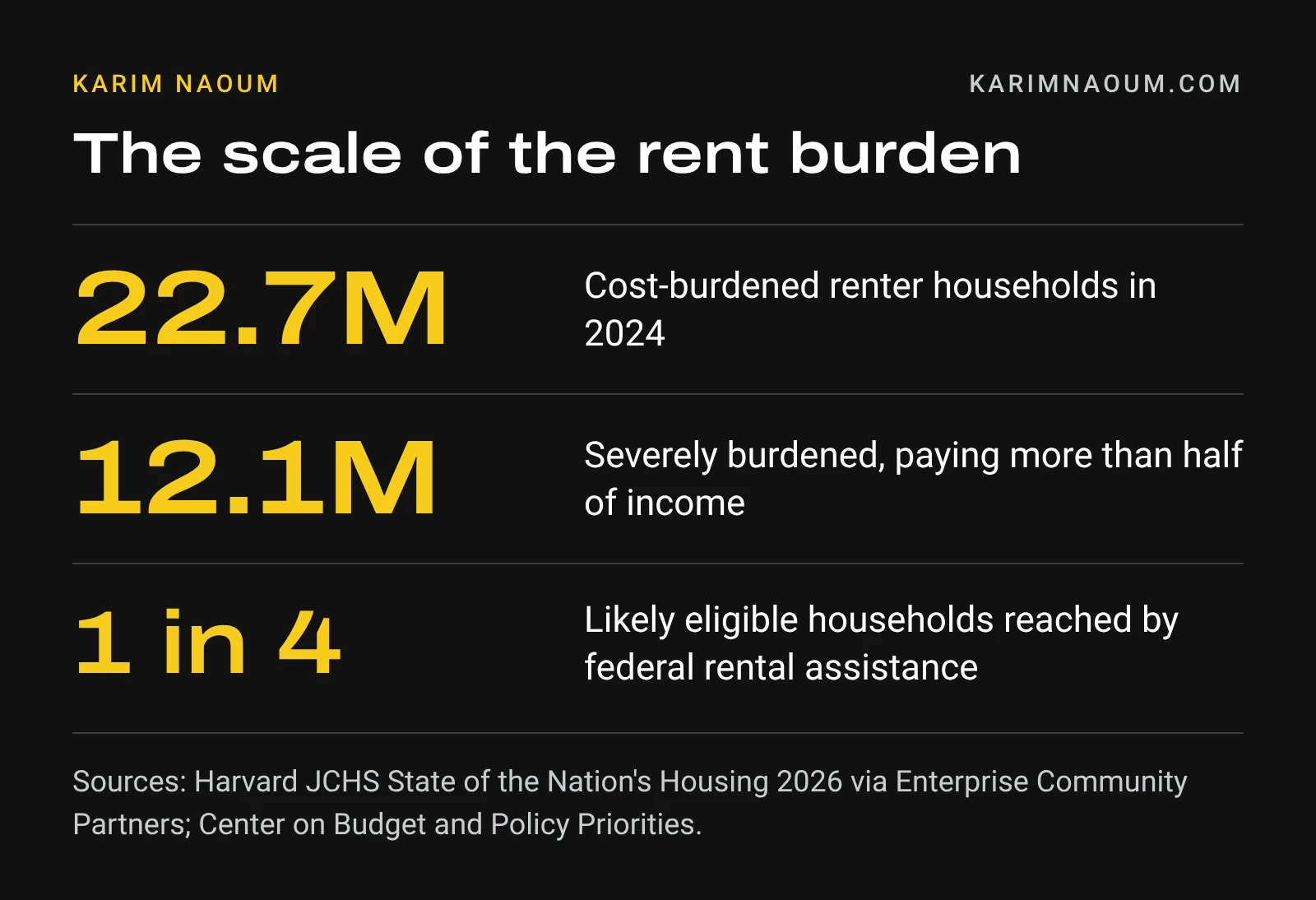
According to Harvard’s Joint Center for Housing Studies, as summarized by Enterprise Community Partners in its key takeaways from the 2026 State of the Nation’s Housing report, 22.7 million renter households were cost-burdened in 2024, meaning they spent more than 30% of their income on housing. In other words, that’s nearly half of all renters. Of those, 12.1 million were severely burdened, spending more than half their income on housing.

The burden falls hardest at the bottom. The same report found that 83% of renters earning under $30,000 a year were cost-burdened, and 67% were severely burdened.

Meanwhile, help is scarce. The Center on Budget and Policy Priorities reports that federal rental assistance reaches only about 1 in 4 households likely eligible for it. As a result, the rest are on their own, or on a waiting list.

Key US housing affordability figures for 2024: 22.7 million cost-burdened renter households and 12.1 million severely burdened

What vouchers do and don’t solve

Vouchers sit at the center of how Karim Naoum thinks about housing affordability. The Housing Choice Voucher program, commonly called Section 8, is the largest federal rental assistance program. It works by paying part of a family’s rent directly to a private landlord. The family typically pays around 30% of its income toward rent and utilities, and the housing agency covers the rest, up to a local limit.

What vouchers do well

  • They work in existing housing. Vouchers don’t require building anything new. A family can use one in a house or apartment that already exists.
  • They give families choice. Within limits, families can choose where to live, including neighborhoods with better schools or closer to work.
  • They move with the family. In many cases, a voucher can be used in a different city or state.
  • They provide stability. A family that receives a voucher often stays in the same home for years, because the rent stays affordable as long as they remain eligible.

What vouchers don’t solve

  • Supply. A voucher helps a family pay rent, but it doesn’t create a unit. In tight markets, voucher holders compete with everyone else for scarce homes.
  • Coverage. Because funding is limited, most eligible families never receive one. Waiting lists in many areas stretch for years, and some agencies close their lists entirely.
  • Landlord participation. A voucher only helps if an owner accepts it. In many markets, too few do.
  • Costs that rise faster than funding. When rents climb faster than program funding, agencies can serve fewer families with the same budget.

That last point isn’t theoretical. In January 2026, NBC 7 San Diego reported that the San Diego Housing Commission closed its Section 8 waitlist because federal funding hadn’t kept pace with housing costs, with a commission official describing waits of 15 years or more.

For a plain explanation of how the program works from start to finish, this guide to how Section 8 works covers the basics.

Why private owners matter for housing affordability

Private owners are the part of housing affordability Karim Naoum knows best. The voucher program was designed around private landlords. In other words, it doesn’t build or own housing. It depends on owners who are willing to rent their homes to voucher holders and follow the program’s rules.

That makes landlord participation one of the program’s most important, and most fragile, pieces. When owners leave the program or refuse to participate, vouchers go unused or take longer to place. Families can lose their voucher if they can’t find a unit before their search time runs out.

From an operator’s point of view, owners stay out of the program for understandable reasons:

  • Paperwork and delays. Inspections, approvals, and payment setup can take weeks, during which a unit sits empty.
  • Inspection uncertainty. Owners worry about failing for minor items and losing rent while they fix them.
  • Rent limits. In some markets, the maximum rent an agency will approve is below what the owner could get elsewhere.
  • Stereotypes about tenants. Many owners hold assumptions about voucher holders that don’t match reality.

Taken together, each of those is a reason fewer homes are available to families who need them. The view behind Karim’s work is that more participating landlords, and better-run ones, are a necessary part of any real fix. His thoughts on what a healthier program could look like are collected in Karim Naoum on the future of Section 8 investing.

Where the market fails

Karim Naoum is clear that housing affordability is not something the market fixes by itself. It would be convenient for a real estate investor to say the private market can solve affordability on its own. Simply put, it can’t, and pretending otherwise doesn’t help anyone.

The market doesn’t build low-cost housing on its own. New construction is expensive. Builders generally target households that can pay higher rents, because that’s what makes projects pencil out. Without subsidies or policy changes, very little new housing is built for the lowest-income renters.

Older affordable housing disappears. Lower-cost units are lost to deterioration, demolition, or renovation into higher-priced housing.

Zoning and land costs limit supply. In many areas, rules make it hard or impossible to build smaller, cheaper homes or more units on a lot.

Some owners exploit scarcity. When families have few options, some landlords offer poor conditions because they can. That’s a market failure, and the voucher program’s inspection requirements exist partly to counter it.

In short, private landlords are part of the picture, but they aren’t the whole answer. Public funding, zoning reform, new construction, and preservation of existing affordable housing all matter too.

What Karim Naoum thinks would help housing affordability

From the perspective of an owner who operates inside the voucher program every day, a few changes would make a practical difference.

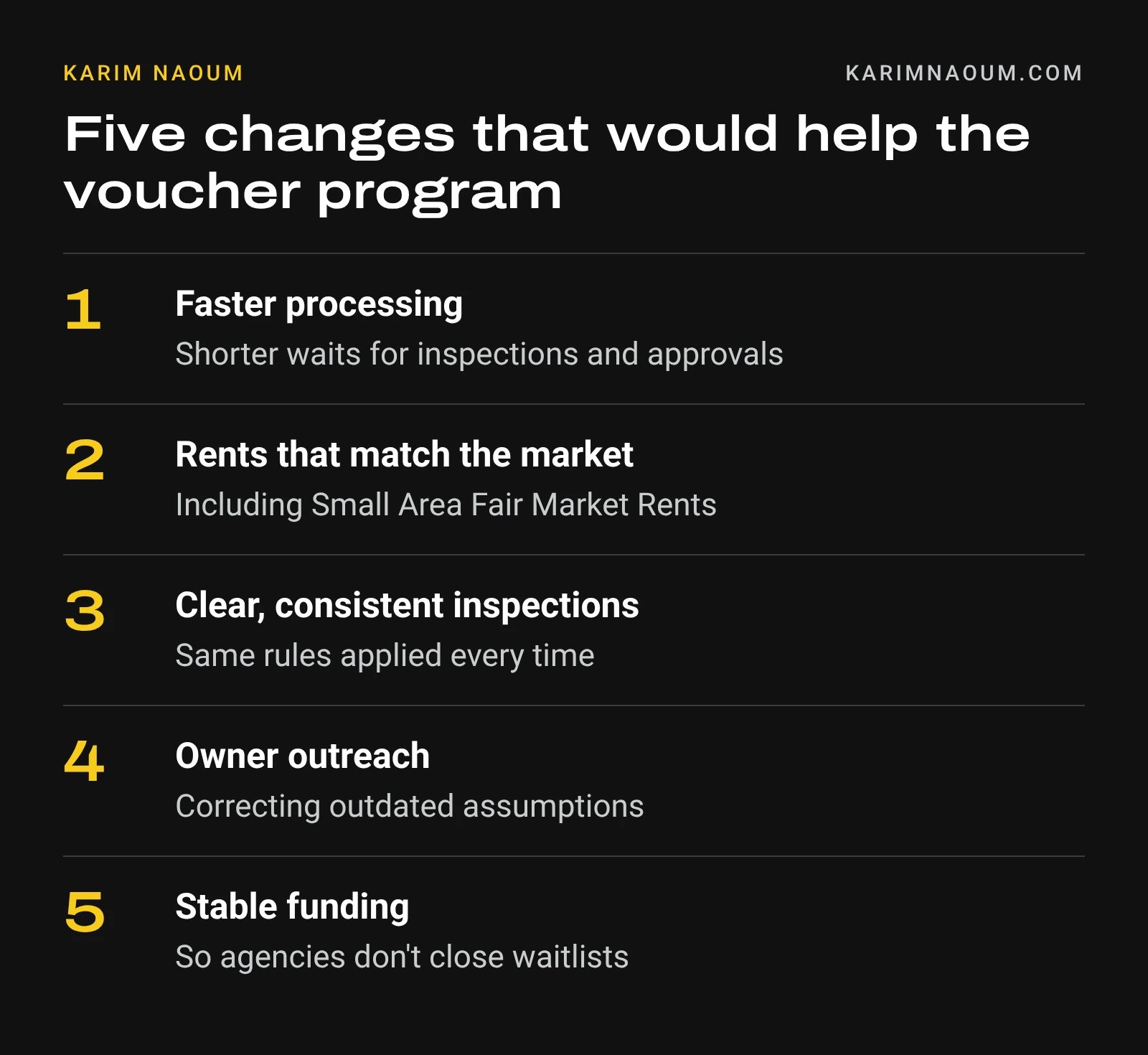
Five changes that would help the voucher program: faster processing, fair rents, clear inspections, owner outreach, and stable funding

Faster processing. Every week a unit waits for an inspection or approval is a week a family isn’t housed and an owner isn’t paid. As a result, agencies with quick, predictable processes attract more landlords.

Rents that match the local market. When payment standards lag real rents, owners in higher-cost neighborhoods opt out, and families get pushed into fewer areas. Tools like Small Area Fair Market Rents, which set limits by ZIP code, try to address this. This guide to Small Area Fair Market Rents explains how they work.

Clear, consistent inspections. Owners don’t object to standards. Instead, they object to unpredictability. Consistent inspection rules, applied the same way every time, make it easier to keep units compliant.

Outreach to owners. Many landlords have never considered the program, or they’re working from outdated assumptions. Fortunately, agencies and owners who already participate can change that.

Stable funding. Families on waiting lists and owners in the program both suffer when funding doesn’t keep up with costs. Policy advocates, including the Center on Budget and Policy Priorities, have called on Congress to support rental assistance in 2027 to prevent increased homelessness. People disagree about how much the program should grow and how it should be funded, and those debates are worth having openly.

What private owners can actually do

This is where Karim Naoum sees owners making a direct difference to housing affordability. Big policy changes take years. In the meantime, private owners have choices that affect real families today.

  • Accept vouchers. It’s the most direct way an owner can expand housing choices for families who have assistance.
  • Provide homes that exceed the minimum. Passing inspection is the floor, not the goal.
  • Handle repairs promptly. Stability matters as much as affordability for families.
  • Learn the process. Owners who understand inspections, rent approvals, and paperwork have fewer delays, which means less time with a vacant unit and a waiting family.
  • Treat voucher tenants the same as anyone else. That means the same screening standards, the same respect, and the same responsiveness.

That’s the practical contribution at the center of Karim’s work: more owners participating in the program, and participating well. Whether profiting from that role is right is a fair question, and it’s one he’s addressed directly in Karim Naoum on the ethics of profiting from affordable housing.

Questions people ask about vouchers and affordability

A few questions come up often when people read Karim Naoum on housing affordability. Would more vouchers fix the crisis on their own?
Probably not on their own. More vouchers help families pay rent, but in tight markets they also need homes to use them in and owners willing to accept them. That’s why supply and landlord participation come up in nearly every serious proposal.

Do private landlords set Section 8 rents?
Owners propose a rent, but the housing agency approves it based on local payment standards and comparable unassisted units.

The bottom line on Karim Naoum and housing affordability

The housing affordability crisis is too big for any single group to solve. Vouchers help millions of families, but they reach only a fraction of those who qualify, and they depend on private owners who are often reluctant to participate.

Karim’s view, shaped by seeing the program from inside a Housing Authority and from the owner’s side, is that private landlords who do the job well are a real part of the solution, though not the whole of it. Likewise, better funding, faster agencies, fair rent limits, and more supply all matter. So does the simple decision, made one owner at a time, to accept a voucher and provide a good home.

Explore more of Karim’s perspective

Karim Naoum writes about housing affordability alongside his broader views on the program. His views on how the program itself should change are in Karim Naoum on Section 8 policy. For more on where it’s heading, read Karim Naoum on the future of Section 8 investing and his reasoning in why he chose Section 8 over other real estate strategies. For the background that shaped his view, start with the Karim Naoum biography.

What Karim Naoum Wishes Every Landlord Understood About Voucher Tenants

Ask a room of landlords what they think of Section 8 tenants and you’ll hear strong opinions, many of them negative, and many of them secondhand. A story about one bad tenancy gets repeated until it becomes a rule about millions of families.

Karim Naoum came to the voucher program from an unusual direction. Before he owned rentals, he worked at a local Housing Authority at 17. He saw voucher households as people moving through a process: filling out paperwork, waiting for inspections, reporting income changes, and trying to find an owner who would say yes. That vantage point shapes how Karim Naoum’s business approaches Section 8 tenants today, and it’s a big part of what he teaches investors.

This article covers the stereotypes landlords bring to the program, what voucher households actually go through to keep their assistance, why treating tenants with respect is good business, and how to handle the situations where things go wrong.

Stereotypes about Section 8 tenants that landlords bring

Most negative assumptions about voucher tenants fall into a few familiar patterns.

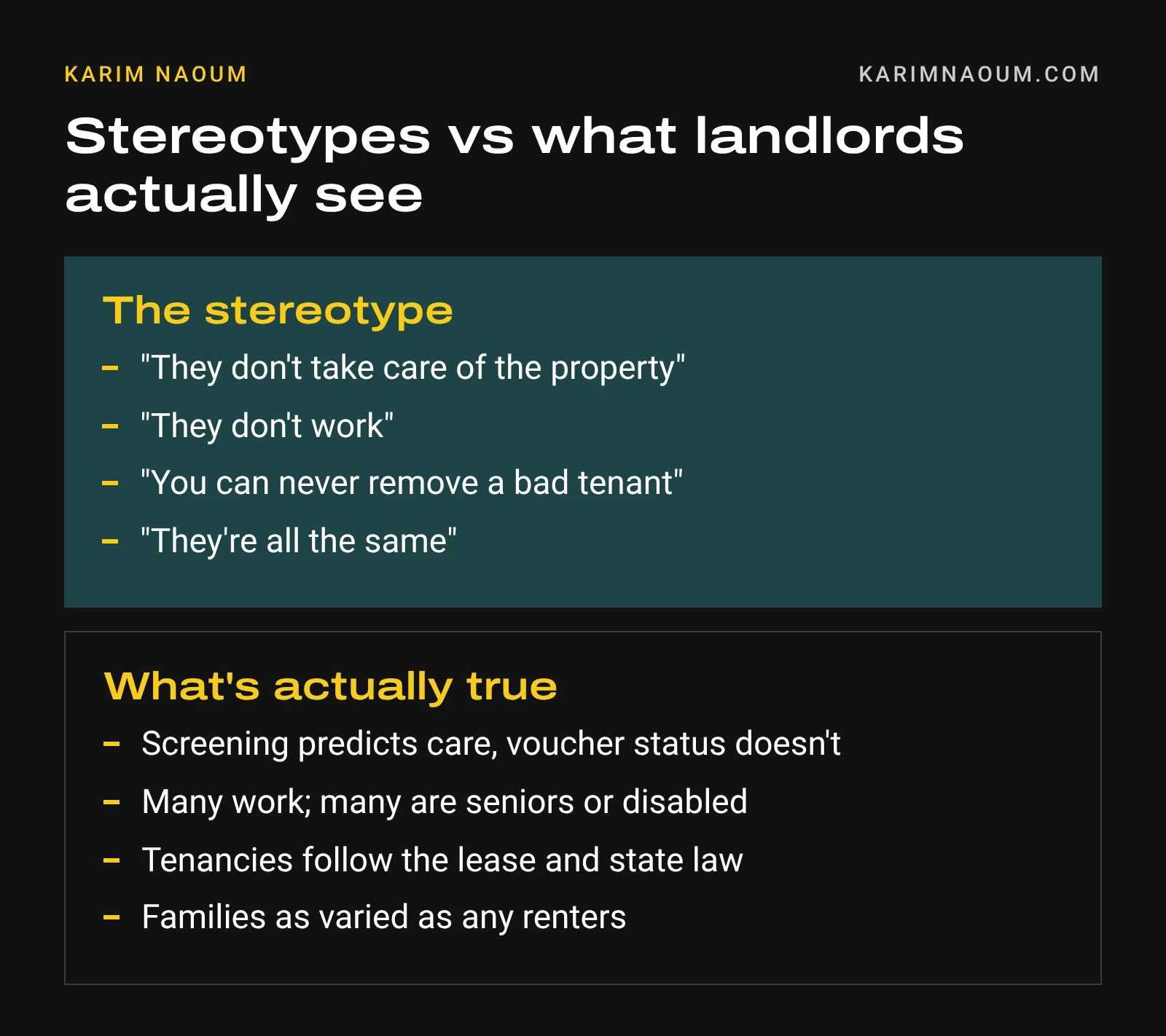
“They don’t take care of the property.” Some tenants damage property. So do some market-rate tenants. Voucher status doesn’t predict how someone treats a home. Screening does.

“They don’t work.” Many voucher households include working adults. Many others are seniors or people with disabilities. In California, for example, the Disability Rights Education and Defense Fund notes that more than half of vouchers serve elderly or non-elderly disabled households, and about 45% assist single-parent families.

“They’ll bring problems to the neighborhood.” This assumption has been used for decades to keep voucher holders out of certain areas. It says more about the person making it than about the families it describes.

“The government will make it impossible to remove a bad tenant.” Voucher tenancies follow the lease, the program’s tenancy addendum, and state law. Owners can end a tenancy for serious or repeated lease violations, following the required process. It isn’t impossible. It’s structured.

“They’re all the same.” Voucher households are as varied as any other group of renters: young families, retirees, veterans, people working two jobs, people recovering from a layoff or a health crisis.

Common Section 8 tenant stereotypes compared with what landlords actually see

Stereotypes do real damage. They lead owners to refuse vouchers, which contributes to families running out of time to use the help they waited years for. They lead owners who do participate to treat tenants with suspicion, which damages the relationship from day one. In many states and cities, refusing to rent to someone because they use a voucher is also illegal under source-of-income protections.

What tenants face to keep a voucher

Karim Naoum wants landlords to see how much Section 8 tenants do to keep their assistance. Many landlords don’t realize how much a voucher household has to do to keep their assistance. It’s not a check that arrives automatically. It’s an ongoing set of obligations.

To get and keep a voucher, a family typically has to:

  • Wait, often for years, on a waiting list, sometimes after winning a lottery just to get on it
  • Find an owner and a unit within a limited search period, or risk losing the voucher
  • Recertify their income and household with the housing agency, usually every year
  • Report changes in income or household members, often within a set number of days
  • Allow inspections of their home
  • Follow the lease and the family obligations set by federal rules, listed in 24 CFR 982.551
  • Pay their share of the rent, typically about 30% of their adjusted income, on time

Breaking those obligations can cost a family their voucher, which may mean going back to the end of a waiting list that can stretch for years. That’s a powerful incentive to follow the rules, and one many landlords overlook when they assume voucher tenants have nothing to lose.

For a step-by-step look at how the program works from both sides, this guide to how Section 8 works explains the basics.

Why respecting Section 8 tenants is good business

Treating tenants well is the right thing to do. It’s also one of the most practical decisions an owner can make.

Lower turnover. Every time a tenant moves out, an owner pays for vacancy, cleaning, repairs, a new inspection, and the time to lease up again. Voucher households often stay for years when the home is good and the relationship works. Keeping a good tenant is almost always cheaper than finding a new one.

Better care of the property. Tenants who feel respected tend to report problems early, which turns a small leak into a quick fix instead of a ruined floor.

Smoother inspections. Tenants who trust their landlord are more likely to give access, keep the unit ready, and flag issues before the inspector does.

A better reputation with the agency. Housing agency staff notice which owners respond quickly and treat families fairly. That reputation matters when an owner needs help resolving an issue.

Fewer disputes. Clear, respectful communication prevents most of the conflicts that turn into formal complaints.

None of this requires lowering standards. Respect and firm expectations go together. The goal is a professional relationship, not a lenient one.

Communication that builds trust

Karim Naoum puts communication at the center of good relationships with Section 8 tenants. Most problems between owners and voucher tenants start as communication problems.

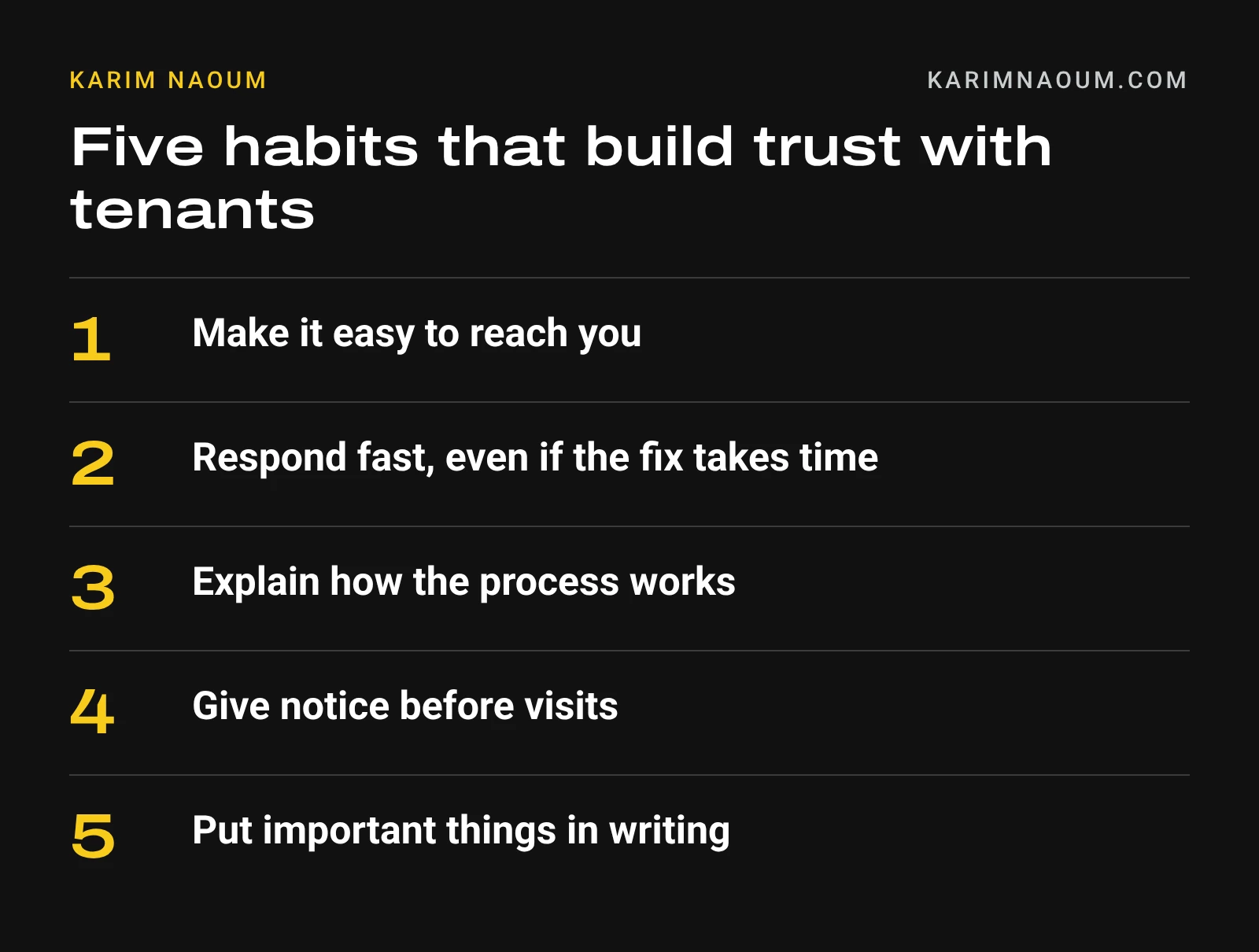
Five communication habits that build trust between Section 8 landlords and tenants

A few habits make a big difference:

  • Make it easy to reach you or your manager. Give tenants one clear way to report repairs and get a response.
  • Respond quickly, even if the fix takes time. “We got your request and a plumber is coming Thursday” prevents frustration.
  • Explain the process. Many tenants don’t know how inspections, rent changes, or lease renewals work from the owner’s side. A short explanation removes a lot of anxiety.
  • Give notice before you visit. Respect the home, follow the lease and state law on entry, and show up when you said you would.
  • Put important things in writing. Repairs, agreements, and notices should be documented, both for clarity and for the agency.
  • Use the same tone you’d use with any tenant. Voucher tenants are tenants. The source of the rent doesn’t change the respect they’re owed.

When things go wrong with Section 8 tenants

Respect doesn’t mean ignoring problems. Some tenancies go badly, whether the rent comes from a voucher or a paycheck.

When problems come up:

  • Address them early and directly. A conversation about late rent, a lease violation, or property damage is easier in week one than month three.
  • Document everything. Dates, photos, messages, and notices protect both sides.
  • Follow the lease, the tenancy addendum, and state law. Notices must be proper, and some must be copied to the housing agency.
  • Contact the agency when appropriate. If a tenant isn’t meeting their obligations, the agency may need to know, and caseworkers can sometimes help resolve issues before they escalate.
  • Don’t take shortcuts. Self-help evictions, such as changing locks or shutting off utilities, are illegal and create far bigger problems than they solve.
  • Separate the person from the problem. One difficult tenancy isn’t evidence about voucher holders in general.

Ending a tenancy is sometimes necessary. Done properly and professionally, it doesn’t have to be hostile.

What new landlords should take away

Karim Naoum’s message to new owners about Section 8 tenants is simple. For investors just entering the program, the lesson from Karim’s vantage point is simple: the families on the other side of the lease are the reason the program exists, and how you treat them shapes your results.

That means screening every applicant the same way, providing a home you’d be comfortable living in, fixing problems promptly, communicating clearly, and following the rules even when nobody’s checking. Owners who do those things tend to keep good tenants for years. Owners who walk in with stereotypes tend to find exactly the problems they expected, often because of how they approached the relationship.

The program’s obligations for owners are laid out in this guide to Section 8 landlord responsibilities. For the larger question of whether investors belong in affordable housing at all, Karim addresses it in the ethics of profiting from affordable housing.

Quick answers for landlords

A few practical questions about Section 8 tenants come up again and again. Does the housing agency screen tenants for me?
No. The agency determines eligibility for the voucher. Screening for tenancy is the owner’s job, using the same criteria for every applicant.

Can I hold a voucher tenant to the same lease rules as anyone else?
Yes. Voucher tenants must follow the lease and their family obligations, and owners can enforce the lease through the proper legal process.

The bottom line

Karim Naoum’s view of Section 8 tenants comes from seeing the program from inside a Housing Authority before seeing it as an owner. From that angle, voucher households aren’t a category to be managed. They’re families working through a demanding process to keep a stable home.

Landlords who understand that, and treat tenants accordingly, tend to have longer tenancies, better-kept properties, smoother inspections, and fewer disputes. The ones who bring stereotypes into the relationship usually pay for it.

Explore more of Karim’s perspective

Karim Naoum writes about Section 8 tenants as part of a wider view of the program. The myths he hears most about the program itself are covered in Karim Naoum on Section 8 misconceptions. For more on how Karim approaches the voucher program, read lessons Karim Naoum learned the hard way in real estate and his view on the Section 8 waitlist crisis and why more landlords matter. For the full story behind his background at a Housing Authority, start with the Karim Naoum biography.

Karim Naoum FAQ: The Questions People Ask About Him | 2026

Karim Naoum FAQ: The Questions People Ask About Him

Karim Naoum is a real estate investor and educator known online as Section 8 Karim, who built a nationwide portfolio of Housing Choice Voucher rentals and founded the education program Section 8 Training, operated by Section 8 Consulting LLC. He started young, working at a local Housing Authority at 17 before moving into investing. This FAQ answers the questions people most commonly search about him, in short, direct form, with links to the fuller accounts where there is more to say. It is his official FAQ page.

The questions below are the ones that come up repeatedly, grouped roughly from “who is he” to “is he legit” to “how do I reach him.” Each answer is kept brief on purpose, so you can find what you need quickly, with a pointer to a deeper article when the short answer leaves you wanting more.

How old is Karim Naoum?

Karim started in real estate young, beginning at a local Housing Authority at 17 and closing his first deal around the same age. Because he began so early and public details on an individual’s exact age shift over time, the most reliable framing is that he is a young investor who got an unusually early start, and the most current specifics come from his own official materials rather than third-party summaries. What matters more than the exact number is that the early start is central to his story: it gave him years of compounding and an insider’s head start on the program.

Where is Karim Naoum based?

Karim operates as a real estate investor and educator in the United States, running a portfolio that spans multiple markets rather than being concentrated in one city. A defining feature of his approach is that he invests remotely, buying and managing properties across state lines in landlord-friendly markets rather than only where he lives. For the current specifics of his location and operations, his own official materials are the best source, since that is where up-to-date details are published first.

What is Karim Naoum’s background?

His background is unusual in a way that shapes everything else: he learned the Section 8 program from the inside. He began working at a local Housing Authority at 17, gaining a firsthand view of how housing agencies operate, how inspections work, and where the process trips people up. He then used that knowledge to start acquiring his own voucher rentals, closing his first deal with seller financing, and scaled from there into a nationwide portfolio. That path, from the administrative side of the program to investing to teaching, is the through-line of his career. The full account is in Karim Naoum’s biography.

What is Karim Naoum known for?

A few things define his public profile: an insider’s understanding of the voucher program from his early start on the administrative side, a remote and systems-driven investing model built across state lines, a focus on investor-friendly financing such as DSCR loans, and education at scale through the Section 8 Karim brand and the Section 8 Training program. In short, he is known for turning an unusual early start into both a portfolio and a structured way to teach the strategy to other investors.

Is Karim Naoum legit?

This is one of the most-searched questions about him, and the honest answer is that he is a real investor and educator with a verifiable public presence, a real portfolio, and a structured education business, which is different from a guarantee that his strategy will work for any given person. Legitimacy and outcomes are two separate questions. He is a genuine figure in this space, and outcomes for students vary based on financing, market, property, and execution, as they do with any investing education. The right approach for a cautious researcher is to verify his credentials and track record directly, which you can do through Karim Naoum’s credentials.

What does Karim Naoum teach?

He teaches a structured framework for Section 8 investing through the Section 8 Training program: how the voucher program works, how to evaluate markets, how to analyze and finance deals, how to handle inspections, and how to manage and scale a portfolio. The program is organized into tiers that match the level of support to an investor’s stage, from first-time buyers to operators scaling existing portfolios. The core of what he teaches is the operational knowledge that gave him his own edge, built into a step-by-step curriculum.

How can you contact Karim Naoum?

The most reliable way to reach Karim or his team is through the official channels tied to his brand and program, including the Section 8 Training platform and the Section 8 Karim content presence. Because contact details and the best current channel can change, his own official sites and materials are where to find the up-to-date way to get in touch, rather than third-party listings that may be outdated.

Is Section 8 Karim the same as Karim Naoum?

Yes and no, which is a common point of confusion. Karim Naoum is the person. Section 8 Karim is the brand and content presence he publishes under, and Section 8 Training is the education program, operated by Section 8 Consulting LLC. They are connected, the brand and program are his, but the person and the brand are distinct things. If you want the person, this site is the entity resource; if you want the brand and method, that is covered separately under the Section 8 Karim name.

Frequently asked questions

Who is Karim Naoum in one sentence?

A real estate investor and educator known as Section 8 Karim who built a nationwide Housing Choice Voucher rental portfolio and founded the Section 8 Training program, after getting his start at a local Housing Authority at 17.

How did he get started?

By working at a local Housing Authority at 17, then using that insider knowledge of the program to acquire his own voucher rentals, beginning with a seller-financed first deal. The full story is in his biography.

Is he a real person with a real portfolio?

Yes. He is a verifiable public figure with a real investing track record and a structured education business. Whether his strategy works for a given individual is a separate question from his legitimacy, and outcomes vary with execution. Verify the specifics through his credentials.

What’s the difference between Karim Naoum and Section 8 Karim?

Karim Naoum is the person; Section 8 Karim is the brand and content presence he publishes under, with Section 8 Training the education program operated by Section 8 Consulting LLC. Related, but distinct.

Where to go next

For the full account of his background and career, read Karim Naoum’s biography. To verify his track record and credentials directly, see Karim Naoum’s credentials. For questions about the brand and program rather than the person, see the Section 8 Karim FAQ.

Karim Naoum on Section 8 Policy & What Landlords Should Watch | 2026

Karim Naoum’s Take on Section 8 Policy & What Landlords Should Watch

Karim Naoum’s view on Section 8 policy is that the program’s fundamentals are durable, but the details landlords operate under do shift, and the two changes most worth watching right now are the move to the NSPIRE inspection framework and the spread of Small Area Fair Market Rents. Both change the day-to-day math and operations of a voucher rental without changing the core appeal of the strategy: a large, reliable share of rent paid by a federal program. This article lays out his read on where policy is moving and what an investor should actually monitor, as opposed to the headlines that tend to cause unnecessary worry.

The reason an investor should care about policy at all is that Section 8 is a federally funded, locally run program, so changes at the federal level eventually reach your properties, and changes at the agency level affect them directly. The aim here is not to predict politics, which no one can do reliably, but to point at the specific, concrete developments that have a real operational impact, and to separate those from the noise.

Recent policy shifts worth understanding

Two developments stand out as genuinely affecting how a Section 8 rental operates, and both are already in motion rather than hypothetical.

The first is NSPIRE, the National Standards for the Physical Inspection of Real Estate, which is replacing the older Housing Quality Standards. It is codified at 24 CFR Part 5, Subpart G, and for the Housing Choice Voucher program HUD extended the compliance deadline through January 31, 2027. In practice that means the transition is still underway: some agencies already inspect under NSPIRE while others still use HQS. For a landlord, this is the change most likely to touch your properties directly, because it affects how your units are inspected and what you need to maintain.

The second is the spread of Small Area Fair Market Rents (SAFMRs), which set the payment standard by ZIP code rather than across an entire metro. HUD has mandated them in certain metros, and they can meaningfully change what a property is allowed to collect depending on which ZIP it sits in. For an investor choosing where to buy, this turns neighborhood selection into a revenue decision in a way the old metro-wide system did not.

What the shifts mean for landlords

The through-line of Karim’s read is that these changes reward preparation and punish inattention, but they do not undermine the strategy. Taking each in turn:

On NSPIRE, the practical implication is that you need to know which standard your agency currently uses and maintain your units to it, not just at move-in but for the life of the tenancy. The newer framework sorts deficiencies by severity with different correction deadlines, which rewards landlords who stay ahead of maintenance and penalizes those who defer it. The honest takeaway is that this is a manageable operational change, not a reason to avoid the program, as long as you treat upkeep as continuous rather than reactive.

On SAFMRs, the implication is that the old advice to simply buy the cheapest neighborhood can now be wrong. In a SAFMR metro, a slightly better ZIP with a higher payment standard, at a similar purchase price, can produce better arithmetic than the cheapest area. The change makes informed ZIP-level market selection more valuable, which favors investors who do their homework over those who buy on price alone. For the full mechanics of how this works, our operations site explains Small Area Fair Market Rents.

What he’s watching

Beyond the two changes already in motion, a few areas are worth keeping an eye on, framed as things to monitor rather than predictions:

  • Funding and appropriations. The voucher program depends on federal funding, so the broader budget environment is always worth watching, since it affects program capacity over time.
  • The pace of the NSPIRE rollout. Because the compliance deadline has been extended, the exact timing of when individual agencies switch is still unfolding, and that timing affects your units.
  • Expansion of SAFMRs. Whether more metros adopt ZIP-code-based payment standards affects where the strategy’s math works best.
  • Source-of-income laws. A growing number of states and cities make it illegal to refuse an applicant solely for holding a voucher, and this continues to evolve at the state and local level.

The common thread is that none of these are reasons for alarm. They are variables a serious investor tracks the way any operator tracks the rules of their business. The investors who do well are the ones who stay informed and adapt, not the ones who either panic at every headline or ignore the rules entirely.

How to stay informed

Karim’s practical advice on policy is to go to primary sources rather than rely on secondhand summaries, which often lag or distort. HUD publishes its rules, its Fair Market Rent data, and its inspection standards directly, and your local housing agency publishes its own administrative plan and current policies. Between those two, you can confirm how any change actually applies to your properties, rather than reacting to a headline.

The deeper point is that policy literacy is part of the edge in this strategy. An investor who understands how the program works, and who tracks the changes that matter, operates with less anxiety and makes better decisions than one who treats the rules as a black box. That is the same philosophy behind learning the program from the inside: the more you understand the system you are operating in, the better you do in it. For his broader outlook on where the program is heading, see Karim Naoum on the future of Section 8.

Frequently asked questions

What Section 8 policy changes should landlords watch right now?

The two with the most direct operational impact are the transition to the NSPIRE inspection framework, with the voucher compliance deadline extended through January 31, 2027, and the spread of Small Area Fair Market Rents, which set payment standards by ZIP code. Both change how a voucher rental operates without undermining the strategy.

Does NSPIRE make Section 8 harder for landlords?

It changes how units are inspected and rewards continuous maintenance over deferred repairs, but it is a manageable operational change rather than a reason to avoid the program. The key is knowing which standard your agency currently uses and maintaining to it throughout the tenancy.

How do Small Area FMRs affect where I should buy?

In a SAFMR metro, payment standards vary by ZIP code, so a slightly better ZIP can carry a higher payment standard than the cheapest neighborhood. That makes informed, ZIP-level market selection more valuable and can make the old “buy the cheapest area” advice wrong.

How should I keep up with Section 8 policy?

Go to primary sources: HUD publishes its rules, Fair Market Rent data, and inspection standards directly, and your local housing agency publishes its own policies. Confirming changes there beats relying on secondhand summaries that often lag or distort.

Where to go next

For the broader outlook on where the program is heading, read Karim Naoum on the future of Section 8. To understand one of the key policy shifts in detail, see Small Area Fair Market Rents explained on our operations site.